For about a decade, Korean skincare travelled abroad as a sequence. Cleanser, second cleanser, toner, essence, serum, ampoule, sheet mask, eye cream, moisturizer, sunscreen. Ten steps, in order, every night.
The number stuck because it was easy to explain and easy to sell. A routine with a fixed shape can be printed on a chart, packaged as a starter set, and turned into a video. What it could never really do was describe how skincare works in a country of fifty million people with different skin, different budgets, and different amounts of patience.
So the useful question in 2026 is not whether ten steps is too many. It is what actually shapes a routine here now.
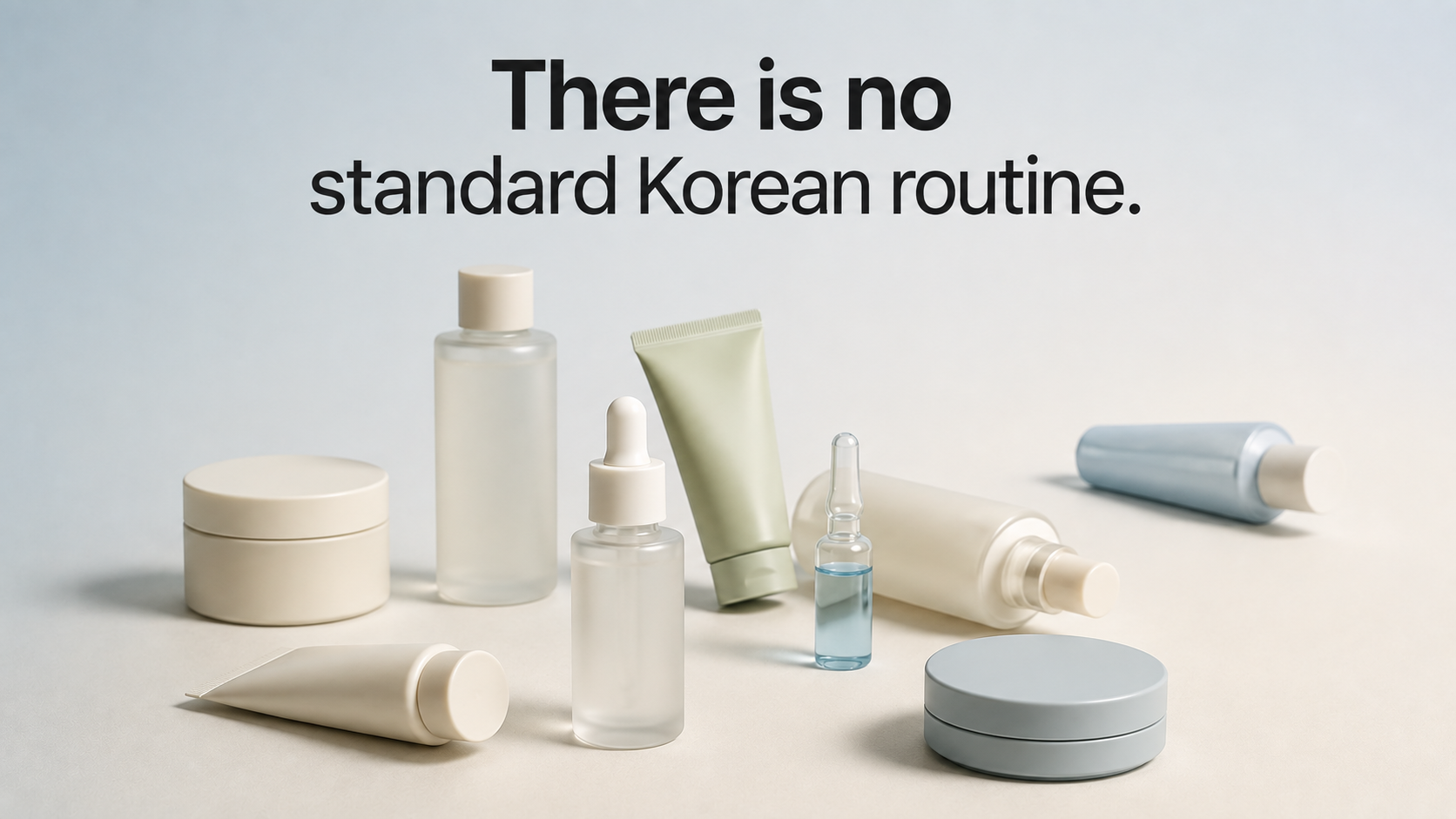
There is no standard Korean routine
This is the part that gets lost in translation.
The problem with the ten-step routine is not that nobody in Korea has ever used that many products. Some people do. The problem is the word “the” — the idea that there is one canonical sequence that Korean skincare consists of, and that following it correctly is what makes a routine Korean.
There is no such template. What exists is an unusually large and competitive beauty market where products are highly specialized, relatively easy to experiment with, and increasingly organized around specific concerns rather than a single fixed order of operations.
Which means the honest answer to “what is the Korean skincare routine?” is that it depends on the person — and that the more interesting question is what the market is pushing people toward.
What the 2026 data actually says
Hwahae, a Korean beauty platform built around ingredient information and user reviews, publishes an annual trend report (Korean).
Its 2026 edition draws on data from around 12 million app users, 9.4 million verified user reviews, and a database of roughly 380,000 beauty products. One of the three trends it identified for the year is directly relevant here: High-performance Minimalism, which Hwahae describes as increasing function while reducing the routine.
The consumer behaviour it describes is not simply “buy less skincare.” It is closer to this: reduce unnecessary steps, but expect each remaining product to do more than one job. Hwahae also points to growing interest around terms such as minimal skincare, skinimalism, and simple Korean skincare.
Two caveats matter. First, this is a trend report, not a survey measuring how many products Koreans apply every morning or night. There is no reliable national average showing that Korean routines have moved from ten steps to five, so putting a precise number on that shift would go beyond the data.
Second, Hwahae identifies exosomes as one of the ingredients connected to this trend. That is worth noting, but it also needs context because Korean cosmetic advertising places restrictions around unqualified use of the term. We covered that separately in exosome skincare in Korea.
More functions, not simply fewer bottles
Where this trend shows up most clearly is somewhere English-language K-beauty coverage does not always look: makeup.
Hwahae reported an increase in hybrid makeup products carrying skincare-related terms such as “serum,” “ampoule,” “glow,” and “hyal.” In its app data, BB and CC creams in this group increased 267%, lip tints 152%, and lip care and lip balm products 113%.
Those numbers are increases in the number of products in those groups, not sales figures, search volume, or market share, so the distinction matters. The change is not simply about removing products from a skincare shelf. It is also about folding more functions into the products that remain — including makeup designed to hydrate, soothe, support the barrier, or otherwise borrow functions that once sat more clearly inside skincare.
That is a meaningfully different picture from saying, “Koreans stopped doing ten steps.”
Routines here are built around concerns, not steps
Another useful clue comes from the 2025 Olive Young Awards (Korean).
The awards drew on about 180 million customer purchase records from July 2024 through June 2025 at Korea’s largest beauty retailer and named 166 products across 40 categories. The category structure itself is revealing: the market is increasingly divided into specific functions and use cases rather than presented as one routine everyone should follow.
Round Lab’s 1025 Dokdo Toner won in toner. Torriden’s Dive-In Low Molecular Hyaluronic Acid Serum led the serum category. Aestura’s Atobarrier365 Cream won in cream. Other categories separately cover pads, masks, cleansing oils, sunscreens, and more, with newer categories continuing to reflect changing consumer needs.
That is not a list of products meant to be used one after another. It is a market divided by function and concern: hydration, barrier support, calming, texture, pigmentation, cleansing, sun protection.
There is an important limitation here too. Awards data tells us what people bought, not how many of those products any one person used together, so it cannot tell us the “average Korean routine.” But it does show a beauty market organized around targeted functions, which fits poorly with the idea of one universal sequence everyone follows.
So how do you actually build one?
If the argument is that ten steps is not a standard, it would be strange to end by handing you a five-step standard instead. So here is a framework rather than a formula.
Start with what your skin actually needs. Cleansing should match what is on your skin. Barrier support might come from a moisturizer or cream. Sunscreen belongs in the daytime routine. These are less exciting than trend ingredients, but they are the parts that give the rest of the routine somewhere stable to sit.
Then add for a specific concern, one at a time. Dehydration, texture, breakouts, pigmentation, sensitivity — this is where Korea’s highly specialized products become useful. It is also where adding several new products at once makes it difficult to tell which one helped or which one caused a reaction.
That is especially relevant with stronger or more mechanically active products, including spicule skincare.
Let the routine change. Skin does not behave the same way all year. A Seoul winter and a Seoul August create very different conditions, and a routine that works in one season may feel completely wrong in another. The number of steps that produces is not a target; it is simply the result of what your skin needs at that moment.
The bottom line
Korean skincare in 2026 is better understood as selective and function-driven than as a fixed ritual.
The direction identified by Korea’s own beauty platforms is not simply “use less.” It is closer to get more function out of each step, with some of the clearest evidence appearing in skincare-makeup hybrids rather than in a neatly shortened skincare lineup.
If you came looking for the real Korean routine to copy, there is not one universal sequence waiting to be discovered. What there is instead is a way of choosing: identify what your skin needs, add products for a reason, and let the number of steps land wherever it lands.
Curious about a Korean ingredient or product you keep seeing online? Get in touch.