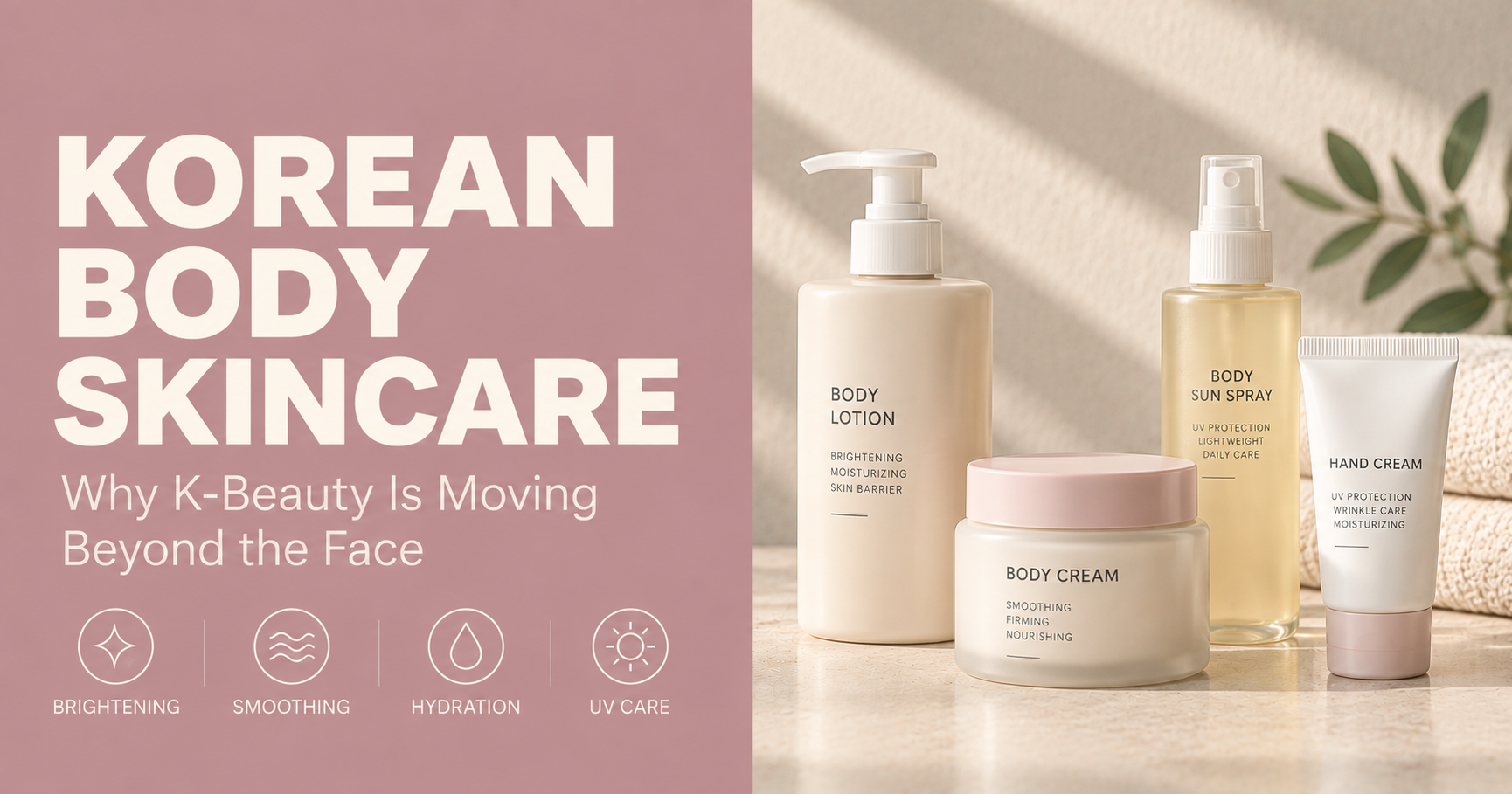
Korean body skincare is starting to look a lot more like facial skincare.
For years, the typical body-care shelf was relatively simple:
body wash
body lotion
hand cream
maybe a scrub.
But Korean beauty retailers are increasingly organizing body care around more specific concerns:
dryness
rough texture
dead skin
trouble-prone skin
elasticity
brightening
sun protection
and other targeted functions.
That change is part of a broader Korean beauty trend called:
Skinification.
The idea is straightforward.
Treat the skin on the body with the same concern-based thinking already used for facial skincare.
That does not mean Koreans are doing a 10-step skincare routine from their neck to their toes.
And it definitely does not mean everyone needs a body serum, ampoule and specialized cream.
The more interesting change is how body products are being selected.
Instead of asking only:
“Which body lotion smells good?”
the question increasingly becomes:
“What does my body skin actually need?”
That shift tells us something important about where K-beauty is going in 2026.
What Is Korean Body Skincare?
There is no official Korean body-skincare routine.
Korean body skincare is better understood as an expanding group of products selected according to specific skin concerns rather than only basic cleansing and moisturizing.
Traditional body care often emphasizes:
cleansing
moisturizing
fragrance
Those functions still matter.
But the Korean market increasingly adds another layer:
roughness
dead skin
trouble-prone areas
elasticity
brightening
UV exposure
and other specific concerns.
This changes how products are marketed and how shoppers evaluate them.
The product is no longer simply:
body lotion.
It might instead be positioned as a body product for:
dryness
elasticity
brightening
or another particular function.
That sounds a lot like facial skincare.
And that is exactly the point.
Korea Calls the Trend “Skinification”
Skinification is not a term I am applying to Korean beauty from the outside.
CJ Olive Young has explicitly used it.
In July 2024, Olive Young announced that it was expanding its hair and body categories around:
스키니피케이션
or:
Skinification.
The retailer described the trend as treating the scalp and body with the same detailed attention people already give facial skin.
Olive Young said it planned to expand hair and body care according to specific functions and concerns rather than focusing only on basic cleansing, moisturizing or fragrance.
That distinction matters.
A traditional body-care shelf might ask:
Do you want body wash or body lotion?
A Skinification-oriented shelf increasingly asks:
What is your skin concern?
You can read CJ Olive Young’s original Skinification announcement.
The Sales Data Shows the Shift Was Already Happening
Olive Young’s Skinification announcement included one particularly useful piece of retail data.
According to the company, 2023 sales of body products with trouble-care functions increased 65% compared with the previous year.
That does not mean Korea’s entire body-care market grew 65%.
It refers specifically to the relevant product group within Olive Young.
That distinction is important.
But the number still tells us something useful.
Consumers were increasingly interested in body products designed around more specific concerns rather than only cleansing, fragrance and basic moisturization.
And the broader personal-care trend continued after 2023.
Personal Care Kept Growing After the First Skinification Push
In October 2025, Olive Young published another update on its hair and body business.
The retailer said sales in its broader personal-care category — including hair and body care — had increased by approximately 20% annually for three consecutive years.
Olive Young specifically highlighted demand for products designed around more detailed concerns.
On the body side, it pointed to functional products for concerns such as:
elasticity
and
brightening.
That is important because it shows that Skinification was not simply a one-season campaign.
The retailer continued to see demand for products that moved beyond:
body wash = cleansing
body lotion = moisturizing.
Body care was becoming more segmented by function.
Why Facial Skincare Logic Is Moving to the Body
The shift makes sense when you look at how K-beauty consumers already shop.
Modern facial skincare encourages consumers to think about:
skin type
ingredients
texture
function
specific concerns
and how products fit together.
The familiar questions are:
Is my skin dry?
Is it oily?
Is my barrier compromised?
Am I trying to improve the appearance of pigmentation?
Do I want hydration?
Do I need exfoliation?
Once consumers become comfortable shopping this way, there is little reason for that logic to stop at the jawline.
The skin on the body can also feel:
dry
rough
irritated
congested
or uneven.
Skinification takes that familiar skincare framework and extends it beyond the face.
Trouble Care Is One of the Clearest Examples
The 65% Olive Young growth figure is especially interesting because it concerned trouble-care body products.
In Korean beauty, you will often encounter the word:
트러블 — trouble
It is a broad cosmetic term.
It may be used around blemish-prone skin or areas where consumers are concerned about bumps, congestion or irritation.
But there is an important limitation.
“Trouble” is not a diagnosis.
Not every bump on the back, chest or arms is acne.
Different conditions can look similar to a non-expert.
That means a cosmetic product marketed for trouble-prone body skin should not automatically be treated as a medical treatment for every kind of bump or rash.
Skinification can help consumers choose more targeted cosmetics.
It should not turn beauty packaging into a diagnostic tool.
Body Exfoliation Is Becoming More Concern-Specific
Body exfoliation itself is not new.
Physical body scrubs have existed for decades.
What changes under the Skinification model is the way exfoliation fits into a broader concern-based routine.
A consumer might be looking for help with:
rough-feeling skin
visible dead skin
buildup
or uneven texture.
That makes exfoliation one possible function rather than simply an occasional spa-like step.
But the same rule that applies to facial skincare applies here:
More exfoliation is not automatically better skincare.
Aggressive physical scrubbing combined with multiple exfoliating products can irritate the skin.
The useful question is not:
How many exfoliating steps can I add?
It is:
What problem am I actually trying to solve?
Brightening Body Care Needs Careful Interpretation
Brightening is another function Olive Young specifically mentioned when discussing the growth of functional body care.
This is where translation matters.
Korean cosmetics may use the term:
미백
It is frequently translated into English as:
whitening.
That English word can make the claim sound much broader than it is.
In Korean cosmetics, brightening-related functional claims are connected to the appearance of pigmentation and a brighter-looking complexion.
So when you see a Korean body product associated with:
미백
brightening
tone care
or pigmentation care
do not automatically interpret it as a promise to change someone’s natural skin color.
Read the actual claim.
This is the same principle that applies across Korean skincare:
The exact claim matters more than the biggest marketing word on the front of the package.
Elasticity Is Moving Beyond Facial Skincare Too
Elasticity is another concern Olive Young highlighted in its 2025 personal-care update.
That is notable because:
탄력 — elasticity
is already extremely familiar in Korean facial skincare.
It appears across:
creams
serums
ampoules
masks
and derma-oriented products.
Now similar concern-based language is being applied to the body.
This does not mean a body lotion and facial anti-aging serum are interchangeable.
It means the consumer is being encouraged to evaluate body skin through the same functional lens:
What is the concern?
What does the product claim to do?
That is the structural change Skinification represents.
A “Body Serum” Is Not Automatically Better Than Body Lotion
As body care becomes more skincare-like, product names also become more skincare-like.
You may encounter terms such as:
body serum
body essence
body treatment
body ampoule
But do not assume the name creates a potency hierarchy.
A product called a serum is not automatically more effective than a lotion.
A body essence is not automatically lighter or weaker.
A body ampoule is not automatically the most concentrated option.
Korean facial skincare has exactly the same naming problem.
I looked at this in detail in Essence vs. Serum vs. Ampoule: What the Words Mean in Korea.
Korean regulations and major Korean retail platforms do not support the neat international hierarchy that says:
essence → serum → ampoule
always means:
light → stronger → strongest.
The same caution should be applied when those words move into body care.
Read the product.
Not just the noun.
Sun Care Is Moving Beyond the Face Too
The Skinification story becomes even more interesting when you look at sun protection.
In June 2026, Olive Young reported a growing trend it called:
Sun Layering.
Consumers were using different sun-care formats according to situation and body area.
The retailer described products including:
sun serum
sun stick
sun powder
sun spray.
More importantly, Olive Young said the scope of UV care was expanding across the body.
It specifically pointed to products such as:
UV-protective hand cream
and
UV-protective hair mist.
During the same summer trend period, body-friendly formats such as sun sprays were part of the wider move toward whole-body beauty care.
This tells us something important.
Skinification is not only about putting facial-skincare ingredients into body lotion.
It is also about taking a concern — in this case UV exposure — and developing formats that work for different areas and situations.
Korea’s 2026 “Survival Beauty” Trend Pushes This Further
Olive Young placed these products inside a broader 2026 trend called:
Survival Beauty.
The idea was driven by hotter, more humid weather and concerns such as:
UV exposure
oil
sweat
skin trouble
and heat.
Instead of presenting summer beauty as simply:
buy sunscreen,
Olive Young organized products around different environmental problems.
That included more specialized formats for the face and body.
This is another example of concern-based beauty replacing rigid product categories.
The consumer starts with:
What problem am I dealing with?
Then chooses the format.
That is remarkably similar to how modern K-beauty skincare already works.
Do You Need Separate Skincare for Every Part of Your Body?
No.
This is where Skinification can become excessive.
Once beauty companies divide body skin into:
neck
chest
back
arms
hands
feet
elbows
knees
and other areas,
it becomes easy to assume each one requires a dedicated product.
Usually, it does not.
The useful question is:
Is there a specific concern my current routine does not address?
If your body skin feels comfortable with:
a gentle cleanser
a moisturizer
and appropriate sun protection,
you do not need to add a body serum simply because one exists.
If you have a specific concern, a targeted product may make sense.
Skinification is useful when it makes care more specific.
It becomes less useful when it simply makes routines longer.
A Korean Body-Skincare Routine Can Be Very Simple
There is no official Korean body-skincare routine.
And there is no reason to reproduce a facial routine from the neck down.
A simple routine might be:
Cleanse → Moisturize → Protect exposed skin from UV
That may be enough.
Someone with a particular concern might add:
an exfoliating product
a trouble-care product
a targeted functional body product
or another specialized step.
But the logic should be:
concern → product
not:
product exists → I need it.
That is also the more realistic way to understand Korean facial skincare.
As I explain in What a Korean Skincare Routine Actually Looks Like in 2026, there is no single standard Korean routine.
The old international idea that “Korean skincare” means stacking as many steps as possible is not particularly useful.
The same applies to the body.
Body Skinification and Scalp Skinification Are Part of the Same Story
Skinification does not stop at body lotion.
Olive Young’s original campaign covered both:
hair/scalp care
and
body care.
That makes the relationship between the two categories especially useful.
For scalp care:
shampoo is no longer the entire category.
Consumers can choose tonics, ampoules and other products according to scalp concerns.
For body care:
body wash and lotion are no longer the entire category.
Products can be organized around trouble care, elasticity, brightening, exfoliation and UV protection.
Different skin.
Different products.
Same broader retail logic.
That is the larger meaning of Skinification.
Skinification Does Not Mean More Products Are Always Better
This is probably the most important part of the trend.
Skinification can be interpreted in two ways.
The useful version is:
I have a specific concern, so I will choose a product designed for it.
The less useful version is:
My body now needs the same number of steps as my face.
Those are not the same thing.
A longer routine is not automatically a better routine.
A more expensive body serum is not automatically more useful than a simple moisturizer.
And a recognizable skincare ingredient does not automatically make a product necessary.
The most practical interpretation of Skinification is:
more precise care, not automatically more care.
Skinification Can Also Create Marketing Noise
There is another downside.
Once consumers respond to skincare-style products, brands have an incentive to use familiar skincare language everywhere.
A body lotion can become:
BODY SERUM
A hand cream can become:
ANTI-AGING HAND TREATMENT
A body wash can become:
BARRIER CLEANSING CARE
Sometimes that positioning reflects a meaningful formula or regulated function.
Sometimes the language is doing much of the work.
This is why the same rule applies across K-beauty:
Read beyond the hero ingredient and the product name.
Look at:
what the product actually claims
how it is meant to be used
whether the claim has specific regulatory meaning
and whether that function matters to you.
Functional Claims Matter More Than Skincare-Looking Packaging
A product can look clinical without being medicine.
A product can use words such as:
derma
serum
ampoule
repair
clinical
or treatment
without those words alone defining its legal category.
That distinction already appears elsewhere in Korean beauty.
Korean Pharmacy Skincare is a good example.
Some products sold around Korean pharmacies are cosmetics.
Others belong to different regulatory categories.
Their appearance alone cannot tell you which is which.
Body skincare deserves the same caution.
A clinical-looking body lotion is still something you should evaluate by:
its actual category
its ingredients
and its claim.
Not by packaging aesthetics.
Is Korean Body Skincare Better Than Western Body Care?
Not automatically.
Concern-based body care exists around the world.
So do:
exfoliating body lotions
blemish-focused body washes
body serums
targeted moisturizers
and body sunscreens.
Korea did not invent the idea of caring for skin below the neck.
What makes the Korean market interesting is how strongly facial-skincare shopping behavior is spreading into other beauty categories.
K-beauty consumers are already accustomed to comparing:
functions
ingredients
textures
claims
and concerns.
That creates a natural environment for more specialized body care.
But Korean packaging does not guarantee a better formula.
Evaluate the individual product.
What Should You Look for When Buying Korean Body Skincare?
Start with the concern.
If your body skin is simply dry
A good moisturizer may be all you need.
Do not assume a serum is automatically better than lotion.
If rough texture is the concern
Look at what type of exfoliation or smoothing function the product actually provides.
Avoid adding multiple aggressive exfoliating steps unnecessarily.
If you have trouble-prone areas
Check what the product means by “trouble care.”
A cosmetic claim is not a diagnosis.
If uneven-looking tone is the concern
Read the exact brightening claim rather than relying on an English translation of 미백.
If elasticity is the concern
Look at the product’s actual functional claim rather than assuming every anti-aging-looking body product provides the same benefit.
If UV exposure is the concern
Focus on adequate protection and practical application.
A format you can apply correctly is more useful than a sophisticated format you rarely use.
What Korean Body Skincare Tells Us About K-Beauty in 2026
Body skincare itself is not revolutionary.
What matters is what the category tells us about the direction of K-beauty.
The traditional boundaries are becoming less rigid.
Facial skincare is moving toward derma.
Makeup is borrowing skincare concepts.
Hair care is becoming scalp care.
Body care is becoming concern-specific.
Sun care is expanding into different formats for different areas.
And beauty is moving closer to wellness.
These trends look different on the shelf.
But underneath them is a common question:
What problem is the consumer trying to solve?
That is increasingly more important than:
What traditional product category does this belong to?
This is why looking only at individual viral products can give a distorted picture of K-beauty.
The larger change is structural.
Concern-based skincare logic is spreading across the beauty market.
The Bottom Line
So, what is Korean body skincare in 2026?
It is not a secret Korean body routine.
It is not a mandatory collection of body serums, essences and ampoules.
And it is not proof that Korean consumers use ten products from the neck down.
It is better understood as part of:
Skinification.
That means applying the concern-based logic of facial skincare to the rest of the skin.
And there is real retail evidence behind the shift.
Olive Young reported that its trouble-care body product group grew 65% year over year in 2023.
By October 2025, the retailer said its broader personal-care category, including hair and body care, had recorded approximately 20% annual sales growth for three consecutive years, with functional body products for concerns such as elasticity and brightening among the products attracting attention.
In 2026, that concern-based approach expanded further into full-body sun protection, with Olive Young highlighting formats such as sun sprays, UV hand creams and UV hair mists as part of changing summer beauty behavior.
The useful lesson is not:
You need more body products.
It is:
You can choose body products more intentionally.
Start with the concern.
Understand the claim.
Choose a practical format.
Then decide whether a specialized product gives you something your current routine does not.
That is the useful side of Skinification.
Not skincare everywhere for the sake of more steps.
Skincare logic where it actually helps.
FAQ
What is Korean body skincare?
Korean body skincare refers to body-care products selected according to specific skin concerns and functions rather than only cleansing, fragrance and basic moisturization.
What is Skinification?
Skinification is the trend of applying facial-skincare-style, concern-based thinking to other areas such as the scalp and body. CJ Olive Young has explicitly used the concept to develop its hair and body-care categories.
Is body skincare growing in Korea?
Olive Young reported that sales of its trouble-care body product group increased 65% year over year in 2023. It later reported approximately 20% annual sales growth for three consecutive years across its broader personal-care category, including hair and body care.
What body concerns are Korean retailers focusing on?
Olive Young has highlighted concerns including trouble care, elasticity, brightening, exfoliation and increasingly specialized UV protection.
Do I need a body serum?
Not necessarily. “Serum” does not automatically mean a product is more effective than body lotion. The formula, function and your individual concern matter more than the product name.
Does Korean body skincare include brightening products?
Yes. Olive Young has specifically highlighted functional body products for brightening among the growing concern-based body-care categories.
What does 미백 mean on Korean body skincare?
It is generally associated with Korea’s brightening-related cosmetic terminology. Translating it simply as “whitening” can make the claim sound broader than it is, so the exact product claim should be checked.
Is sun protection part of Korean body skincare?
Increasingly, yes. In 2026 Olive Young highlighted the expansion of UV care across the body, including sun sprays, UV-protective hand creams and UV-protective hair products.
Do I need a Korean body-skincare routine?
No. A basic routine of cleansing, moisturizing and appropriate UV protection may be enough. Targeted products can be added when there is a specific concern.
Is Korean body skincare better than Western body care?
Not automatically. Korea is notable for applying concern- and function-based skincare logic across body care, but effectiveness depends on the individual product and formula.
Sources & Further Reading
- CJ Olive Young — Skinification Expands Skincare to Hair and Body
- CJ Olive Young — Functional Hair & Body Care and Personal-Care Growth
- CJ Olive Young — Survival Beauty and Full-Body Sun Care, June 2026
- Picked in Korea — Essence vs. Serum vs. Ampoule: What the Words Mean in Korea
- Picked in Korea — What a Korean Skincare Routine Actually Looks Like in 2026
- Picked in Korea — Korean Pharmacy Skincare: What Koreans Actually Buy
Retail data and source pages were rechecked in September 2026. Product availability, retail categories and cosmetic claims may change after publication.