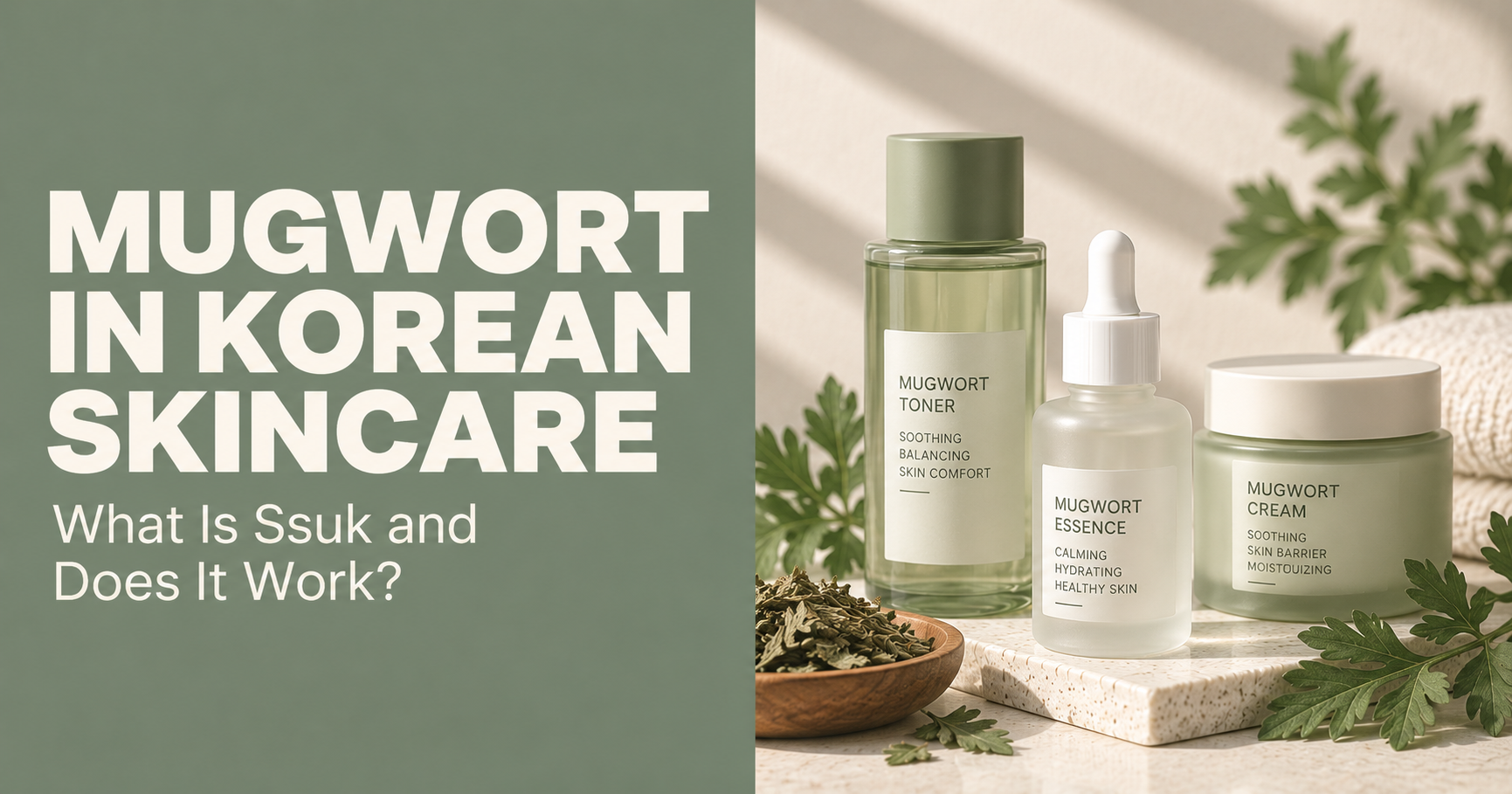
Mugwort in Korean skincare is usually associated with one word: soothing.
Mugwort essence.
Mugwort toner.
Mugwort mask.
Mugwort cream.
If you shop for K-beauty long enough, you will eventually encounter the ingredient, often in products built around the idea of calming or comforting sensitive-looking skin.
In Korean, mugwort is commonly called:
쑥 — ssuk.
That makes the story sound simple.
Mugwort is familiar in Korea, and Korean beauty brands have turned that familiar botanical into a modern skincare ingredient.
But there is an important complication.
“Mugwort” is not one single standardized cosmetic ingredient.
Different products may use different Artemisia species, different parts of the plant, different extraction methods and very different finished formulas.
And while laboratory research on several Artemisia species is interesting, that research does not automatically prove that every mugwort toner or essence provides the same effects on human skin.
So what exactly is mugwort in Korean skincare?
Why is it associated with soothing products?
Is there real research behind it?
And how is mugwort different from Cica, another botanical that appears everywhere in K-beauty?
Here is what the ingredient labels and research actually tell us.
What Is Mugwort?
Mugwort is a common name used for several plants belonging to the genus:
Artemisia.
That first distinction matters.
Mugwort is not the botanical equivalent of a single standardized molecule such as niacinamide.
Several Artemisia species can be described as mugwort, and those species do not necessarily contain identical combinations or amounts of plant compounds.
That means an English skincare page that says simply:
Mugwort Extract
may be simplifying what is actually a more specific botanical ingredient.
The species matters.
What Does “Ssuk” Mean in Korea?
The Korean word:
쑥
is generally translated as:
mugwort.
But ssuk has a much broader cultural presence in Korea than the average trendy skincare ingredient.
It is familiar from Korean food and traditional uses rather than being something created by the cosmetics industry.
That cultural familiarity helps explain why mugwort fits naturally into Korean beauty marketing.
To Korean consumers, 쑥 is not necessarily an exotic new laboratory ingredient.
It is a recognizable plant.
K-beauty brands can therefore connect two appealing ideas:
a familiar Korean botanical
and
modern soothing skincare.
But cultural familiarity and demonstrated cosmetic efficacy are different questions.
That is where the ingredient becomes more interesting.
“Mugwort” Can Mean Different Artemisia Species
This is probably the most important thing to understand about mugwort skincare.
Several Artemisia species appear in scientific literature and cosmetic formulations.
Examples include:
Artemisia princeps
Artemisia argyi
Artemisia vulgaris
and other Artemisia species.
They belong to the same genus.
They are not automatically interchangeable.
Their chemical composition can differ.
The plant part used can differ.
The extraction process can differ.
And the resulting cosmetic raw material can differ.
This is why the statement:
“Science proves mugwort does X.”
is usually too broad.
A study involving Artemisia princeps does not automatically prove the same effect for every Artemisia extract.
A study involving an isolated plant compound does not automatically prove the same effect for the finished mugwort toner sitting on a store shelf.
Why Artemisia Princeps Matters
One of the species particularly relevant to the Korean mugwort discussion is:
Artemisia princeps.
Researchers have investigated Artemisia princeps and compounds derived from it for several biological activities, including inflammatory signaling and skin-barrier-related mechanisms.
For example, a 2009 study investigated Artemisia princeps extract in stimulated T cells.
The researchers reported that the extract suppressed proliferation of activated CD4+ T cells and reduced production of certain pro-inflammatory cytokines under the experimental conditions.
That is interesting evidence of biological activity.
But look carefully at what was studied.
This was experimental immunology research.
It was not a clinical trial of a commercial mugwort toner on people with sensitive skin.
That distinction matters throughout this article.
What Does the Research Say About Inflammatory Signaling?
A separate 2017 study examined Artemisia princeps extract and a compound isolated from it called:
isosecotanapartholide.
Researchers used human keratinocyte cells and investigated pathways involving:
IL-33
STAT-1
TARC/CCL17
and other inflammatory signaling markers.
The researchers reported that the extract and isolated compound affected several of those pathways under laboratory conditions.
That gives researchers plausible mechanisms to continue investigating.
But again:
A biological effect in cultured cells is not the same as proof that a finished cosmetic will visibly calm irritated skin in humans.
This is one of the most important distinctions to keep in mind when reading botanical skincare claims.
What About the Skin Barrier?
There is also interesting research involving skin-barrier-related proteins.
A 2017 study published in the International Journal of Molecular Sciences examined Artemisia princeps extract in human keratinocytes.
Researchers reported increased expression of:
filaggrin
and
loricrin
through the AHR/OVOL1 pathway.
Why does that matter?
Filaggrin and loricrin are proteins involved in normal epidermal barrier function.
The findings therefore provide a plausible biological reason for continued research into Artemisia princeps and dry or barrier-related skin concerns.
But this needs another qualification.
The study investigated what happened in keratinocytes exposed to a particular extract under experimental conditions.
It does not prove that:
every mugwort essence repairs the skin barrier.
The evidence is interesting.
The conclusion still needs to remain narrower than the marketing.
Seomae Mugwort Shows Why Species and Extract Matter
Another useful example comes from:
Artemisia argyi.
A 2019 study examined a native Korean variety described as:
Seomae mugwort.
Researchers isolated a polyphenol mixture from the plant and tested it in LPS-stimulated RAW 264.7 macrophage cells.
They reported effects involving:
nitric oxide production
NF-κB activation
TNF-α
IL-1β
and other inflammatory pathways.
Again, this supports the idea that compounds found in certain Artemisia plants can have biologically interesting activity.
But look at what the researchers actually tested.
It was a polyphenolic mixture isolated from Artemisia argyi and studied in cells.
It was not:
a commercial essence
a toner
a cream
or a randomized human skincare trial.
That difference is easy to lose when research gets converted into beauty marketing.
Newer Mugwort Research Is Becoming More Sophisticated
Research on Artemisia continues to evolve.
A 2025 study investigated nanovesicles derived from Artemisia princeps.
Researchers tested these materials using human dermal fibroblasts and a three-dimensional reconstructed human skin model.
They reported findings involving:
fibroblast proliferation
cellular senescence markers
MMP-1 activity
and type I procollagen production.
That sounds especially relevant to skincare.
But the material used in the study matters enormously.
Researchers isolated and purified Artemisia princeps-derived nanovesicles.
That is not automatically the same ingredient as an ordinary Artemisia extract in a mugwort toner.
So the study should not be translated into:
“Mugwort toner boosts collagen.”
That would go beyond what the research establishes.
The study instead tells us that a specialized material derived from Artemisia princeps has shown interesting effects in experimental skin models and deserves further investigation.
This Is Why “Contains Mugwort” Is Not Enough Information
Imagine two products.
Product A contains an extract derived from Artemisia princeps.
Product B contains a different Artemisia-derived ingredient.
Both products may say:
MUGWORT
in large letters on the front.
But the formulas could differ in:
species
plant part
extraction process
concentration
solvent system
supporting ingredients
texture
and overall formulation.
Even products using the same species can still be completely different formulas.
This is why botanical skincare is harder to evaluate than the front label suggests.
The plant name is only the beginning.
Does a Higher Mugwort Percentage Mean a Better Product?
Not necessarily.
Some K-beauty products prominently advertise a high percentage of a botanical ingredient.
That can sound persuasive:
80% mugwort.
90% mugwort.
Almost entirely mugwort.
But the percentage needs context.
A product might contain:
mugwort extract
mugwort water
or another Artemisia-derived cosmetic raw material.
Those ingredients are not necessarily equivalent.
A high percentage of a relatively dilute botanical water cannot automatically be compared with a lower percentage of a different concentrated extract.
The number alone does not tell you:
how the botanical was processed
how concentrated the starting material was
which compounds remain in the finished ingredient
or how the entire product performs.
So:
90% mugwort is not automatically better than 10% mugwort extract.
The percentage only becomes meaningful when you understand what is being measured.
Read the Ingredient List, Not Just the Front Label
This is where Korean cosmetic labels become useful.
Instead of relying entirely on the word:
MUGWORT
printed across the package, look at the ingredient list.
On Korean cosmetics, one useful term is:
전성분
which means:
full ingredient list.
Depending on the product, you may find a more specific botanical ingredient name there rather than only the simplified English marketing term.
That can help you understand what the formula actually contains.
My guide to How to Read a Korean Skincare Label explains the Korean terms worth recognizing when shopping for cosmetics in Korea.
The useful principle is:
The front of the package tells you the marketing story.
The ingredient list tells you more about the formula.
Neither tells you everything about performance.
Is Mugwort the Same as Cica?
No.
This is probably the most useful comparison for K-beauty shoppers.
Both mugwort and Cica frequently appear in products positioned around:
soothing
skin comfort
sensitive-looking skin
and redness-related concerns.
But they are not the same botanical.
Cica is associated with:
Centella asiatica.
Mugwort refers to plants in the:
Artemisia
genus.
And both names can become more complicated once you look at the actual ingredient list.
As I explain in What Is Cica in Korean Skincare?, “Cica” is commonly used as a broader skincare term around Centella, while individual formulas may highlight Centella extract, madecassoside or other Centella-derived components.
Mugwort has a different version of the same problem.
The English marketing word sounds specific.
The botanical reality can be broader.
Mugwort vs. Cica: Which Is Better?
There is no scientifically useful universal answer to:
“Is mugwort better than Cica?”
The comparison is too broad.
You would need to compare:
the specific botanical material
the concentration
the formulation
the skin concern
the rest of the formula
and ideally evidence from the finished products.
A well-formulated Centella product may work better for one person than a mugwort product.
Someone else may prefer the opposite.
And an individual can tolerate one botanical while reacting to another.
Instead of asking:
Which Korean soothing ingredient is best?
a more useful question is:
Which finished formula works for my skin and my concern?
Is Mugwort Good for Sensitive Skin?
It may suit some people, but “good for sensitive skin” is too broad to guarantee.
The experimental studies above help explain why Artemisia is often positioned as a soothing botanical.
But botanical does not mean:
non-irritating
hypoallergenic
or suitable for everyone.
Plants contain many chemical compounds.
Individual sensitivity varies.
The finished product may also contain many ingredients besides mugwort.
So even if a formula is marketed as:
soothing
or
for sensitive skin,
your own tolerance still matters.
Can You Be Allergic to Mugwort?
Yes.
Mugwort is also well known in allergy research, particularly because of its pollen.
That does not mean everyone with seasonal allergies will react to a mugwort cosmetic.
And it does not mean every Artemisia cosmetic is unsafe.
Pollen exposure and topical cosmetic exposure are not identical situations.
But it does reinforce an important point:
Natural ingredients are still biologically active materials, and natural does not mean allergy-free.
If you already know you have a mugwort or related plant allergy, approaching Artemisia-based cosmetics cautiously is sensible.
If you react to a finished product, remember that mugwort may not necessarily be the cause.
The product may also contain:
fragrance
preservatives
other botanical extracts
or many other ingredients.
Is Mugwort Good for Acne?
This is another claim that requires restraint.
Mugwort products may be marketed toward:
trouble-prone
oily
or blemish-prone skin.
The experimental research into inflammatory pathways helps explain why brands may position Artemisia that way.
But that does not automatically make mugwort an acne treatment.
Korea has an actual regulatory category for functional cosmetics that aid in alleviating acne breakouts.
The Korean Ministry of Food and Drug Safety lists acne-breakout alleviation among its defined functional-cosmetic functions.
That is different from a product simply containing mugwort and using general soothing language.
So a mugwort toner does not become an acne-treatment product merely because Artemisia has anti-inflammatory laboratory research behind it.
The finished product and its actual claim matter.
Is Mugwort a Functional Cosmetic Ingredient in Korea?
Not simply because it is mugwort.
Korea’s functional-cosmetics framework includes defined functions such as:
brightening
wrinkle improvement
UV protection
alleviation of acne breakouts
alleviation of certain dryness associated with atopic-prone skin
and other specified functions.
A product containing Artemisia does not automatically enter one of those categories just because the plant has interesting scientific research.
The product’s intended function and regulatory status matter.
This is an important distinction because ingredient-focused K-beauty can make individual ingredients sound almost pharmaceutical.
A product can look:
clinical
traditional
medicinal
or highly scientific.
That appearance does not determine its regulatory category.
Traditional Use Is Not the Same as Clinical Proof
This distinction matters especially for mugwort because its Korean cultural identity is part of its appeal.
A skincare product may connect mugwort with:
Korean tradition
herbal practices
regional sourcing
or traditional processing.
Those details can be meaningful.
But traditional use and modern clinical evidence answer different questions.
Traditional use can tell us:
people have used this plant for a long time.
Laboratory research can tell us:
an extract or compound showed a particular biological effect under specific experimental conditions.
A controlled human trial can tell us something closer to:
this particular intervention produced this measured result in this group of people.
Those levels of evidence should not be collapsed into one.
What About Fermented Mugwort?
Fermentation is another term often associated with Korean skincare.
The combination can sound automatically superior:
traditional botanical + fermentation = more effective skincare.
But that conclusion is too simple.
Fermentation can change the chemical composition of a raw material.
Exactly what changes depends on:
the microorganisms
the starting material
the fermentation conditions
subsequent processing
and the final formulation.
So “fermented mugwort” should be treated as information about the ingredient or manufacturing process.
It is not automatic proof that the finished product performs better than a non-fermented mugwort formula.
Is Mugwort an “Ancient Korean Beauty Secret”?
I would avoid describing it that way.
Mugwort has a long cultural presence in Korea.
That does not make every modern mugwort cosmetic an ancient Korean beauty treatment.
Modern skincare products are modern formulations.
They can contain:
humectants
emollients
preservatives
solvents
emulsifiers
stabilizers
and many other contemporary cosmetic ingredients.
The finished product is not simply a traditional herbal preparation placed in a modern bottle.
Understanding that distinction does not make mugwort less interesting.
It makes the story more accurate.
Mugwort Is Different From a Single Defined Ingredient
This is one of the easiest ways to understand why mugwort claims require context.
Consider an ingredient such as:
niacinamide.
Niacinamide refers to a defined chemical compound.
“Mugwort” is a common plant name that can refer to material from different Artemisia species.
Even after you identify the species, you may still need to know:
what part of the plant was used
how it was extracted
how the raw material was processed
and how it was incorporated into the finished formula.
That makes the phrase:
contains mugwort
less chemically specific than it may sound.
This does not make botanical skincare inferior.
It simply means botanical ingredients need to be interpreted differently.
How Should You Choose a Mugwort Product?
Do not start with:
Which product has the highest mugwort percentage?
Start with the formula and your skin.
Check the botanical ingredient
Look beyond the word “mugwort” on the front when possible and check what Artemisia-derived ingredient is actually listed.
Look at the whole formula
A mugwort product may contain many other ingredients that matter just as much to how your skin responds.
Choose the texture you actually need
A toner, essence and cream serve different practical roles even if all three highlight the same botanical.
Do not treat percentage as a quality score
Different raw materials cannot always be compared directly by percentage.
Be cautious with known allergies
Botanical does not mean allergy-free.
Judge the finished product
A hero ingredient is only one part of a cosmetic formula.
Who Might Like Mugwort Skincare?
Mugwort skincare may appeal particularly to people who:
prefer botanical-focused formulas
want a soothing-oriented product
enjoy lightweight toners or essences
or are interested in ingredients with a recognizable Korean cultural context.
But none of those reasons means you need mugwort.
If your existing routine works well, there is no reason to replace a good product simply because mugwort sounds more distinctly Korean.
And if you need a specific functional result, choose a product based on evidence for that function rather than only the ingredient’s cultural story.
Who Should Be More Cautious?
Consider extra caution if:
you have a known mugwort allergy
you frequently react to botanical extracts
or the product contains other ingredients you already know you do not tolerate.
Patch testing a new cosmetic can sometimes help identify an obvious reaction before wider use, although it cannot guarantee that irritation or allergy will never occur.
If you develop significant or persistent skin symptoms, the issue has moved beyond choosing the next K-beauty product.
Appropriate medical advice is more useful than continuing to experiment with cosmetics.
What Mugwort Tells Us About Korean Skincare
Mugwort is interesting for a reason that goes beyond whether you should buy a mugwort essence.
It shows how Korean skincare can combine:
cultural familiarity
modern cosmetic formulation
botanical ingredients
and contemporary ingredient-focused marketing.
That combination is a major part of K-beauty’s appeal.
But it can also create confusion.
A traditional ingredient can start sounding medically proven.
A cell study can become a product claim.
A botanical name can become a trend.
And a large percentage on a bottle can look more informative than it actually is.
This is why the useful question is not:
Is mugwort a miracle ingredient?
It is:
What exactly was studied, and what exactly is inside this product?
The Bottom Line
So, does mugwort in Korean skincare actually work?
The most accurate answer is:
Mugwort is a promising botanical category with interesting experimental research, but “mugwort” is too broad a term to guarantee one specific skincare effect.
Different products may use different Artemisia species.
Different extracts can contain different compounds.
Laboratory research has reported anti-inflammatory and skin-barrier-related effects involving certain Artemisia extracts and compounds.
Newer research is also investigating more specialized Artemisia princeps-derived materials.
But those findings should not automatically become:
Every mugwort toner soothes inflammation.
Every mugwort essence repairs the skin barrier.
or
Every mugwort product treats acne.
Those conclusions go beyond the evidence.
The useful way to shop is simpler.
Check the botanical ingredient.
Read the full formula.
Understand what the product actually claims.
Do not treat a high percentage as a quality score.
And remember that botanical does not automatically mean gentle.
Mugwort is genuinely interesting.
It has a meaningful cultural presence in Korea.
And there are plausible scientific reasons researchers continue to investigate Artemisia species.
But the strongest version of the story is not:
Korea discovered a miracle herb.
It is:
A familiar botanical has become a modern Korean skincare ingredient, and understanding exactly what is in the bottle matters more than the word “mugwort” on the front.
FAQ
What is mugwort in Korean skincare?
Mugwort is a common English name for plants in the Artemisia genus. Korean skincare products may use different Artemisia-derived ingredients, so “mugwort” does not always describe one identical cosmetic raw material.
What is mugwort called in Korean?
Mugwort is commonly called 쑥 (ssuk) in Korean.
Is mugwort a Korean ingredient?
Mugwort species exist in multiple countries, so mugwort is not exclusively Korean. However, ssuk has a long cultural presence in Korea and has become a recognizable botanical in Korean skincare.
Is Artemisia princeps the same as mugwort?
Artemisia princeps is one species commonly referred to as mugwort. It is not the only Artemisia species that may appear under the broader mugwort name.
Is mugwort good for sensitive skin?
Certain Artemisia extracts and compounds have shown anti-inflammatory or barrier-related activity in experimental research, which helps explain their soothing positioning. That does not guarantee that every mugwort cosmetic will suit sensitive skin.
Is mugwort the same as Cica?
No. Cica is associated with Centella asiatica, while mugwort refers to plants in the Artemisia genus.
Is mugwort good for acne?
Experimental research involving Artemisia and inflammatory pathways does not make every mugwort cosmetic an acne treatment. Korea separately recognizes cosmetics that aid in alleviating acne breakouts within its functional-cosmetics framework.
Does a higher percentage of mugwort mean a better product?
Not necessarily. Different Artemisia waters, extracts and other botanical raw materials may have different concentrations and processing methods, so percentages are not always directly comparable.
Can you be allergic to mugwort skincare?
Yes, reactions to botanical cosmetic ingredients are possible. Mugwort is also known in allergy research because of its pollen, although pollen allergy does not automatically mean a person will react to every topical Artemisia cosmetic.
Is fermented mugwort better?
Not automatically. Fermentation changes raw materials, but the result depends on the process and finished formula. The word “fermented” alone does not prove superior skincare performance.
Sources & Further Reading
PubMed — Anti-inflammatory Effects of Artemisia princeps
PubMed — Artemisia princeps, IL-33 and STAT-1 Signaling in Keratinocytes
PubMed — Artemisia princeps Extract, Filaggrin and Loricrin
PubMed — Seomae Mugwort (Artemisia argyi) Polyphenols and Anti-inflammatory Activity
PubMed — Artemisia princeps-derived Nanovesicles in Human Dermal Cells and Skin Model
Korean Ministry of Food and Drug Safety — Functional Cosmetics
Picked in Korea — What Is Cica in Korean Skincare?
Picked in Korea — How to Read a Korean Skincare Label
Scientific, regulatory and internal sources were rechecked in September 2026. Research on an individual Artemisia extract, compound or experimental material should not automatically be generalized to every finished mugwort cosmetic.