If you want to know what is popular in Korean beauty right now, Olive Young’s ranking page seems like the obvious place to look.
And it is useful. Olive Young describes its sales ranking as based on online sales data (Korean), so this is not an editor’s list or a collection of products chosen because they happen to be trending on TikTok.
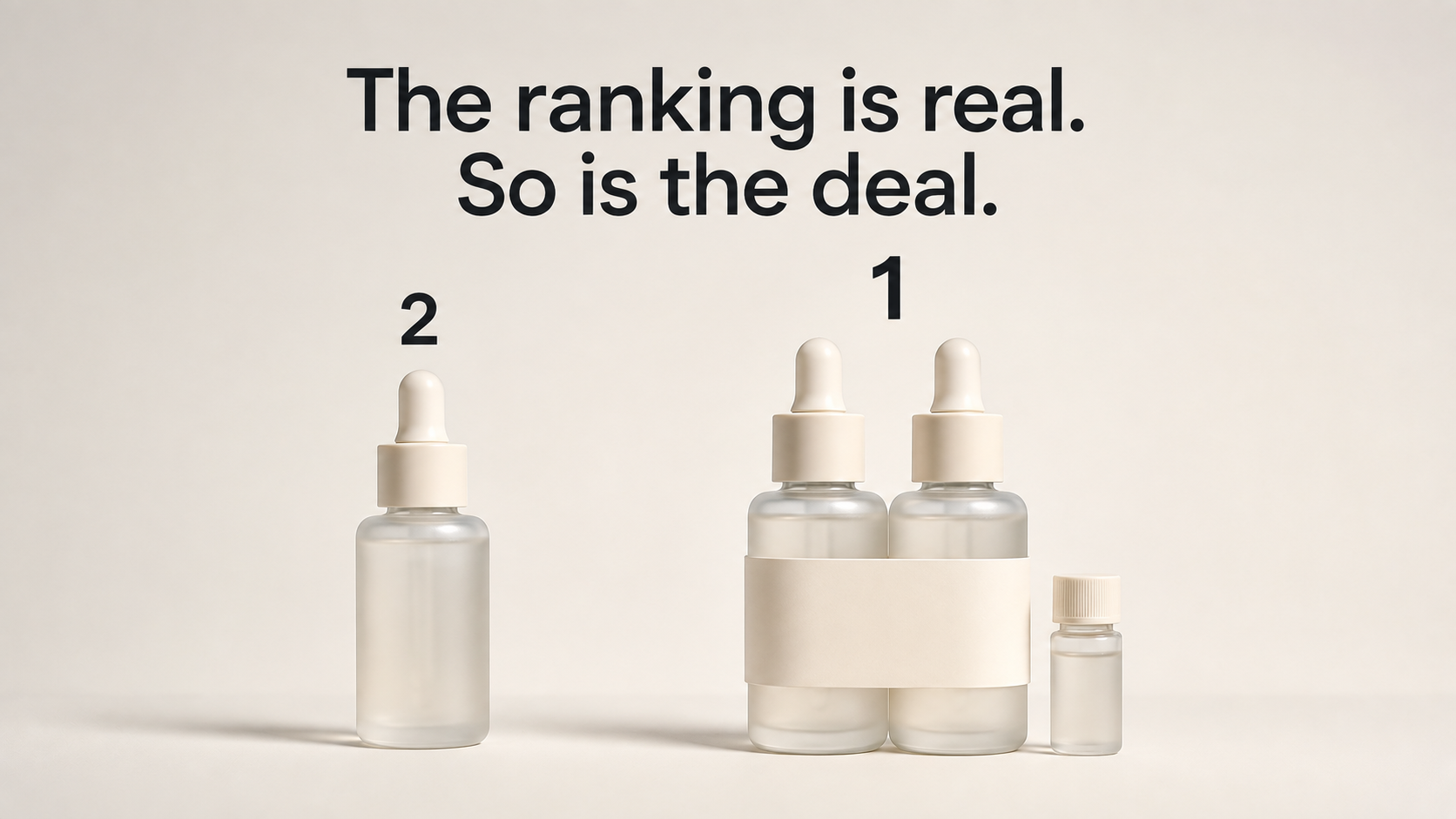
But there is an important detail that gets lost when the ranking travels outside Korea: the item being ranked is often not simply a bottle of serum competing against another bottle of serum.
It may be a 1+1 bundle, a refill set, an oversized value pack, a limited promotional configuration, or a product with something extra attached. So the sales are real, but if you read the chart as a pure ranking of which formulas Koreans prefer most, you are asking the data to tell you something it does not actually measure.
First: the ranking is based on real sales
This distinction matters.
Olive Young’s Korean sales ranking is based on online sales data. That makes it fundamentally different from a generic “best K-beauty” article assembled by an influencer, magazine, or retailer’s editorial team.
People are buying these listings.
The point is not that Olive Young’s ranking is fake, manipulated, or meaningless. The point is that retail sales never happen in a vacuum. Price, packaging, bundle size, gifts, discounts, availability, and limited promotions all sit alongside the product itself.
And on Olive Young, those details can be unusually visible.
Read the product name before the ranking number
If you do not read Korean, an Olive Young product title can look unnecessarily long.
It usually is not.
Words buried in the title often tell you exactly what kind of offer the customer is buying:
- 기획 — special or promotional set
- 단독기획 — exclusive special set
- 1+1 — buy one, get one
- 더블기획 — double set
- 리필기획 — refill set
- 대용량 — larger or value-size configuration
- 증정 — gift included
- 한정기획 — limited promotional set
Those words are part of the product listing, not background decoration.
When the Korean ranking was checked in August 2026, prominent listings included a Celimax mask five-pack with an additional mask, a Medicube Zero Pore Pad 1+1 refill configuration with 140 pads, a Mediheal Derma Pad 200-pad large-size promotional set, and a Fwee cushion sold as a refill configuration.
These are products people are buying, but the sale is not just about the underlying formula. The quantity, refill, extra unit, or promotional configuration is part of what the shopper sees before clicking “buy.”
A bestseller can also be a deal
Imagine two products with similar recognition.
One is sold as a standard single unit. The other is temporarily offered as a 1+1 set or comes with a refill.
If the second listing ranks higher, the ranking alone cannot tell you whether consumers prefer the formula, prefer the value, or respond to both.
That does not weaken the ranking. Value is part of real consumer behaviour. It simply means the product and the offer are being ranked together.
This is why I would not read Olive Young’s chart as a controlled experiment in which every product competes under identical conditions. It is a retail ranking, and retail includes the deal.
A Pokémon example makes the point unusually clear
A separate ranking from Olive Young’s health-focused Olive Better section shows just how much the offer surrounding a product can matter.
In May 2026, six of the top ten products in Olive Better’s real-time purchase ranking were Pokémon collaboration items, according to Korean business coverage (Korean). The products included protein shakes and protein bars, but the collaboration also involved collectible character merchandise.
That does not prove the same dynamic determines Olive Young’s skincare ranking, and it should not be used that way.
What it does show is something more basic about retail data: a ranking records the purchase decision as a whole, not an isolated judgment about the core product.
A customer may be responding to nutrition, price, packaging, a character collaboration, a limited gift, or all of those things together. Skincare is no different in principle. A toner sold alone and that same toner sold with a refill are not identical retail offers, even if the liquid inside the main bottle is unchanged.
Special sets are part of the Korean shopping experience
If you have mostly bought K-beauty through international retailers, this can be easy to underestimate.
On the Korean Olive Young site, promotional language can occupy a large part of a product title. A listing may communicate that it is an Olive Young exclusive, a 1+1, a refill set, a limited configuration, or a gift-with-purchase before you even reach the basic product description.
That structure is not separate from Korean beauty shopping. It is part of it.
It also explains why copying whatever happens to be number one is not necessarily the smartest way to use the ranking. If a promotional configuration ends, the listing’s performance can change even if nothing about the underlying formula has changed.
That does not mean the promotion caused the original ranking. The public ranking data does not let us isolate cause and effect. It means the promotion was part of the offer being ranked.
What does a high ranking actually tell you?
A high position tells you something valuable: this particular listing is converting into online sales under the conditions Olive Young is measuring.
That result may reflect product reputation, reviews, repeat purchases, brand recognition, price, stock availability, a special set, a discount, a gift, or some combination of those factors.
The ranking does not separate those variables.
So instead of asking only:
“What is number one?”
ask:
“What is number one, and what exactly is the customer getting at number one?”
That second question makes the ranking much more useful.
The ranking is a snapshot
There is another reason not to turn Olive Young’s live chart into a permanent list of “the ten products Koreans use.”
The ranking moves as products, stock, launches, promotions, and listing configurations change.
The examples in this article were checked in August 2026. They are a snapshot of what was visible at that point, not a claim that the same items will occupy the same positions when you read this.
That is also what makes the live ranking useful.
The annual Olive Young Awards (Korean) tell you something about performance across a much longer period. A live sales chart gives you a more immediate view of what is moving through the store now.
They answer different questions.
How I would use Olive Young’s ranking
I would use it as a discovery tool, not a verdict.
If a product or brand keeps appearing, open the listing and read beyond the rank. Check whether it is a single unit, a 1+1, a refill set, a larger size, a limited edition, or a gift configuration. Then look at the actual volume, price per unit, reviews, ingredients, and whether the product addresses something your skin needs.
That last part matters because Korean skincare itself is not one fixed sequence of popular products. As I wrote in what a Korean skincare routine actually looks like in 2026, the market makes more sense when you read it by function and concern rather than as a list of products everyone is supposed to use.
A product being number three does not mean it belongs in your routine more than a product at number twenty. It means the number-three listing generated more sales under the conditions being measured.
Those are different statements.
What the ranking cannot tell you
Olive Young’s ranking cannot tell you that the number-one product has the objectively best formula, that everyone in Korea uses it, or that it will work for your skin.
It also cannot tell you why a listing moved upward unless Olive Young publishes additional information that allows that conclusion.
That is why seeing a 1+1 or refill set high in the rankings does not prove the promotion caused the sales. It only tells you that the promotional configuration formed part of the offer consumers purchased.
So I would be cautious with a common English-language shortcut:
“Forget TikTok. Olive Young shows what Koreans actually buy.”
There is some truth in that. The ranking reflects actual online purchases.
But the more precise version is better:
Olive Young shows which listings Koreans are buying — product, price, bundle, gift, promotion and all.
That distinction is small on paper and significant in practice.
And what about Olive Young Global?
It is tempting to put Olive Young Korea’s ranking beside Olive Young Global’s bestseller page and interpret any difference as a clean split in taste: Koreans buy one set of products, international shoppers buy another.
That conclusion requires more evidence than two ranking pages provide.
Before comparing preferences, you would need to know whether the two stores are selling the same SKUs and package sizes, whether the promotional configurations are comparable, and whether both rankings cover comparable periods and use comparable methods.
If one store ranks a 1+1 refill set while another sells a single bottle, you are not comparing identical retail choices.
You may still have an interesting comparison, but it is a comparison of retail assortments as well as consumers, and the two should not be confused.
The bottom line
Olive Young’s Korean bestseller ranking is useful because it reflects real online sales activity. But real sales data is not the same thing as pure product preference.
Bundles, refills, gifts, exclusive sets, collaborations, and promotions can all be part of the offer consumers are choosing. That does not make the ranking less trustworthy; it tells you how to read it more intelligently.
So use the ranking to discover what is moving in Korea, but do not stop at the number beside the product. Read the Korean words in the listing, check what is actually included, and separate what you know from what the ranking cannot tell you.
Sometimes the most interesting thing about a Korean bestseller is the product itself. Sometimes it is the deal attached to it.
Curious about how Koreans actually shop for beauty products? Get in touch.