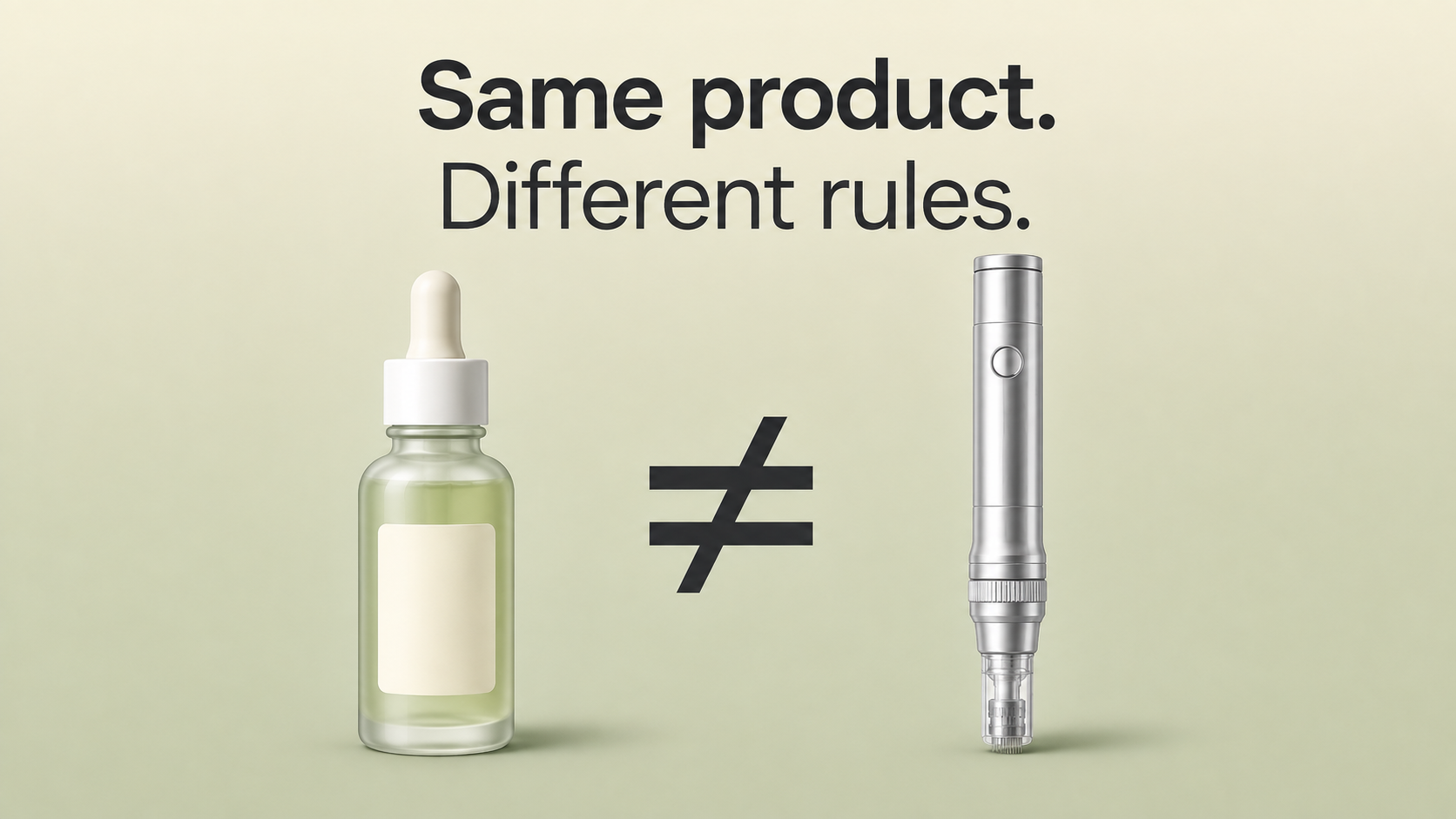
If you found spicule skincare through TikTok or Amazon, you almost certainly met it under one name: microneedling in a bottle. Liquid microneedling. Microneedling serum. On Amazon, the word often sits inside the product title itself.
Buy the same type of product in Seoul and you are far more likely to see language about boosting, absorption, or “reedle” technology than the word “microneedling.”
That is not a translation gap, and it is not a brand being coy. Korean cosmetic regulators have specifically restricted that vocabulary, and understanding why tells you something useful about what these products actually do.
Why the English-language version leans on “microneedling”
The comparison earns its keep. Microneedling is a clinical procedure people pay real money for, so borrowing the word tells a shopper instantly what the serum is promising: smoother texture, refined-looking pores, and better absorption of whatever goes on next.
It is not a baseless comparison either. Spicules are genuinely sharp, and they act on the skin mechanically rather than chemically, which puts them in a different category from acids or retinoids. Dermatologists interviewed in US coverage have described them as creating microchannels that may help actives penetrate and as producing a mild micro-injury response, and both CNN Underscored and NBC News have published explainers along those lines.
So the shorthand is doing useful work as marketing. It is just imprecise in a way that turns out to matter.
What a spicule actually is
Spicules are needle-shaped structures that form part of the skeleton of certain marine sponges. They are harvested, cleaned, and processed for cosmetic use, and many are primarily composed of silica.
Check a Korean ingredient list and you may find terms such as hydrolyzed sponge or silica, sometimes under a brand’s trademarked complex. VT, for example, describes its Cica Reedle complex using silica alongside centella asiatica extract. There is no ingredient called “microneedle,” because microneedling is not an ingredient. It is the name of a procedure.
The spicules themselves are microscopic, so you cannot pick out individual points in the bottle. What you get is an ordinary-looking essence or serum that can feel noticeably prickly once it touches the skin.
Where spicules and microneedling actually diverge
In a clinical microneedling session, needles of a selected length enter the skin and are then withdrawn. The practitioner controls the depth, the number of passes, and the treatment area.
Spicules work differently. Rather than being inserted and immediately withdrawn at a controlled depth, microscopic structures in the cosmetic formula mechanically interact with the superficial skin barrier during application. There is also no practitioner-controlled needle depth, which is one of the fundamental differences from an in-office procedure.
That difference is not automatically a drawback. But it does mean the two are not scaled versions of one another. A spicule serum is not a gentler microneedling session the way 0.1% retinol is a gentler version of 0.5%. The mechanisms are cousins, not points on the same dial.
Why it stings
The prickling is what surprises most first-time users, so it is worth being plain about it: you are feeling microscopic physical structures interacting with your skin. It is not the same type of sensation you might get from an acid or a warming ingredient.
With some formulas, mild prickling that gradually settles can be part of the expected experience. What the sensation does not tell you is whether the product is working better. Stronger is not better here. It is simply stronger.
If the sensation becomes painful, redness persists, or swelling develops, stop using the product rather than assuming that more irritation means better results. Some users may also notice temporary dryness or flaking afterward, but persistent irritation is a reason to stop and reassess.
The experience can vary significantly between products. “Spicule skincare” is a category, not one standardized formula.
Why Korean labels avoid the needle language
Here is the part that rarely makes it into English-language coverage.
In January 2025, Korea’s Ministry of Food and Drug Safety revised its guideline on cosmetic labeling and advertising — the 「화장품 표시·광고 관리 지침」 — after analyzing cases caught in false and exaggerated advertising enforcement. The revision expanded the list of prohibited expressions, and one category covers claims that misrepresent how a product is actually used. The restricted terms include:
- 바늘, meaning “needle”
- 니들, or “needle”
- 마이크로니들, meaning “microneedle”
- 미세침, meaning “micro-needle”
- MTS, short for Microneedle Therapy System
Crucially, the guideline states that using the same or a similar expression in English or another foreign language may still be judged as a prohibited expression based on the overall impression the advertising creates for an ordinary consumer. The English word “microneedling” is not a loophole.
The enforcement is real. In a 2024 inspection of 100 online cosmetic listings using microneedle-related advertising, MFDS found 82 in violation of the Cosmetics Act and requested that access to those listings be blocked. About half of the violations involved claims that went beyond the legal scope of a cosmetic, roughly a third involved claims that consumers could interpret as factually misleading, and the remainder risked making the products appear medicinal.
The same revision restricted a cluster of related shortcuts for the same underlying reason: a cosmetic should not borrow clinical authority it has not earned. Terms such as 병원용 (“for hospital use”), 피부과전용 (“dermatology clinic exclusive”), and 피부과시술용 (“for dermatological procedures”) were included, as was unqualified use of “exosome,” which we covered in our piece on exosome skincare in Korea.
So when a Korean product is described as an absorption-boosting first step while an overseas listing for the same kind of formula says “microneedling serum,” you are looking at more than a translation difference. You are looking at marketing written under different regulatory expectations.
How these products are actually used in Korea
It would be easy to read that regulatory caution as evidence that spicule products are niche in Korea. They are not.
VT’s Reedle Shot line is thoroughly mainstream and is sold through major beauty retailers such as Olive Young across multiple strengths. Other Korean brands now offer comparable spicule-based or reedle-style products as well. This is home skincare, not a clinic-only category.
What differs is the positioning. VT markets Reedle Shot as a “step zero” product: something applied to clean skin after cleansing and before the rest of the routine. That framing tells you how the category is meant to fit into everyday skincare. It is positioned as a preparation or boosting step, not as a substitute for a clinical procedure.
How often you use one depends on the specific formula and strength. Follow the instructions for that product rather than assuming every spicule serum should be used on the same schedule.
What the numbers mean
VT’s Reedle Shot line comes in multiple intensity levels, including 50, 100, 300, 700, and higher. Within the Reedle Shot range, those numbers distinguish different intensity levels associated with the amount or density of the spicule-based complex in the formula.
They should not be read as a simple scale of effectiveness. Higher means more intense. It does not necessarily mean better.
If you are new to spicule skincare, starting with a lower-intensity formula gives you a clearer sense of how your skin tolerates the sensation before moving up. The goal is not to create the strongest possible prickling. It is to find a level your skin handles without unnecessary irritation.
Who should be cautious
If your skin barrier is already irritated, this is probably not the right time to experiment. Be particularly cautious if you have:
- broken or actively inflamed skin
- a current eczema or rosacea flare
- sunburn
- open acne lesions
- recently undergone a peel, laser procedure, microneedling, or another resurfacing treatment
If products that normally feel comfortable have suddenly started to sting, give your skin time to recover before adding another source of mechanical stress. People with highly reactive skin may also want to test the product on a small area before applying it across the entire face.
What not to stack with it
Because spicule products already place mechanical stress on the skin barrier, there is little benefit in stacking several potentially irritating actives on the same night. When trying one for the first time, keep the rest of the routine simple — a basic hydrating serum or moisturizer makes it much easier to identify irritation than a routine containing several strong actives at once.
You may want to separate it from retinoids, AHAs, BHAs, or high-strength vitamin C until you know how your skin responds. That does not mean every combination is automatically unsafe. It means introducing several potentially irritating products at once makes it much harder to tell what your skin is reacting to.
And sunscreen still belongs in your daytime routine.
The bottom line
Spicule skincare is not fake microneedling, but it is not microneedling made weaker either. It is a different way of mechanically interacting with the outer skin barrier, and it has become a mainstream home-skincare category in Korea. If texture and skincare absorption are what interest you and your barrier is in good shape, these products can be relatively easy to fit into an existing routine.
What is worth holding onto is the distinction Korean regulators drew deliberately in the language. A needle-like sensation from a drugstore bottle and a controlled clinical procedure are not the same category of thing — and an interesting delivery mechanism is not the same as proof that a particular serum will erase acne scars or reproduce the results of an in-office treatment. Those are separate claims.
So treat “microneedling in a bottle” as marketing shorthand rather than a scientific definition. Once you know the difference, it becomes much easier to judge a spicule product for what it actually is rather than for the procedure its English-language name makes you imagine.
Curious about another Korean ingredient you keep seeing online? Get in touch.