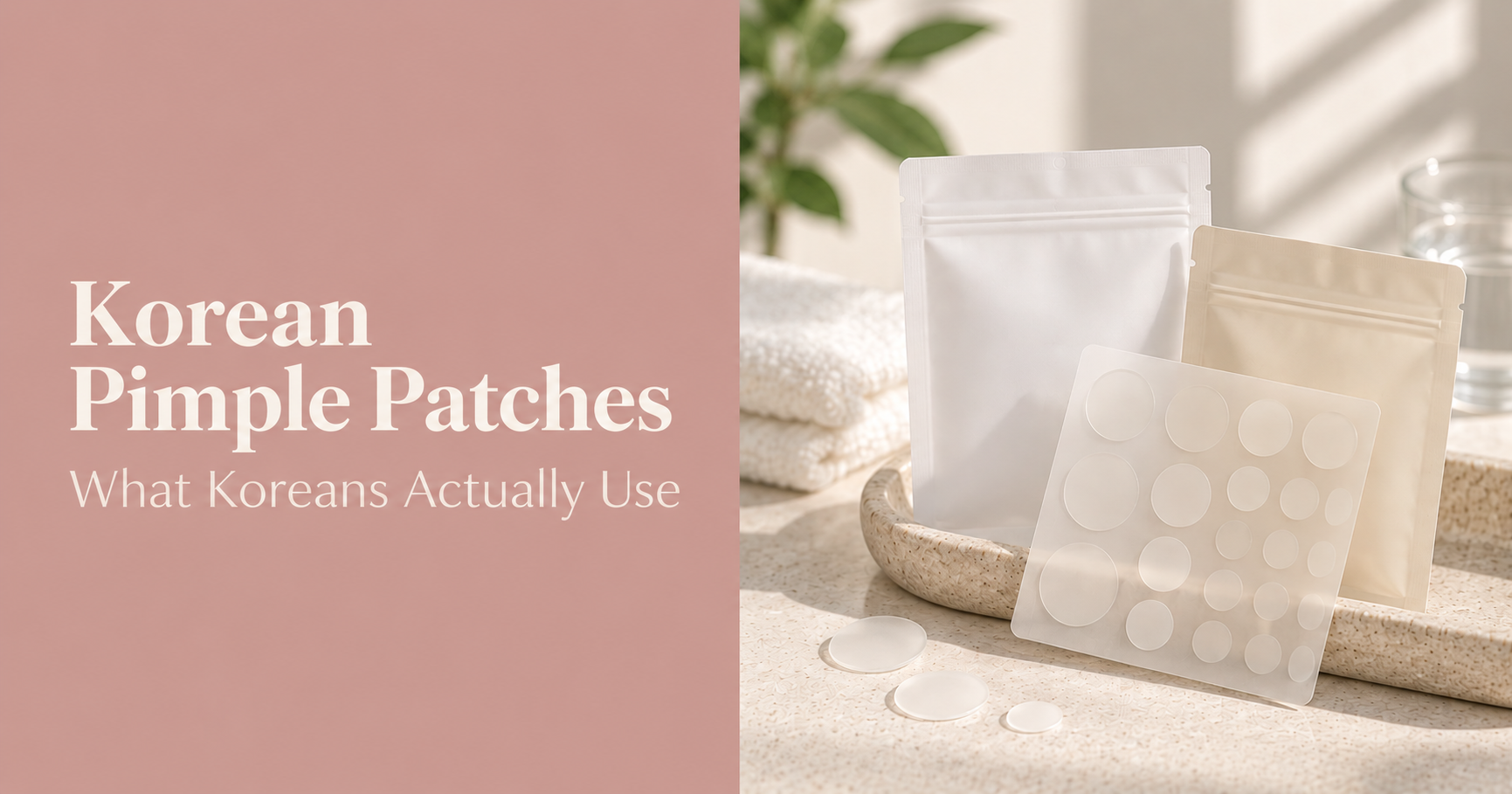
Search for Korean pimple patches outside Korea, and one name appears almost immediately:
COSRX.
Its acne patches helped make the tiny hydrocolloid sticker one of the most recognizable K-beauty products overseas.
But look at Korea’s current beauty market and the category is much broader.
Korean shoppers can choose from basic hydrocolloid patches, thin daytime patches, products designed for use after a blemish has opened, patches marketed for early-stage spots, and newer microstructured formats.
And the products winning Korean consumer awards are not necessarily the ones international K-beauty shoppers know best.
So what do Koreans actually use?
And more importantly, what can a pimple patch realistically do?
I checked Korean consumer rankings and current Korean retail listings in September 2026, then compared them with dermatology guidance on how hydrocolloid patches work.
The result is a useful example of something that happens often in K-beauty:
what becomes famous internationally and what stands out inside Korea are not always the same thing.
Data note: Korean rankings, retail listings and product configurations in this article were checked in September 2026. Rankings and prices can change. Consumer-platform awards and retailer listings should be treated as market signals, not as a nationwide survey of every Korean consumer.
The Short Answer
Yes, pimple patches are a well-established part of the Korean skincare market.
But “Korean pimple patch” does not describe one single type of product.
The simplest versions use hydrocolloid material.
These patches can absorb fluid from certain blemishes while covering the area and discouraging touching or picking.
Other spot patches may contain additional ingredients or use different structures.
And Korean consumer data reveals something international shoppers may not expect.
In the 2026 First Half Glowpick Awards, the spot-patch category ranked:
- Care Plus Wound Cover Spot Patch
- Dongkook Pharmaceutical Madeca Medi Patch Spot Patch
- Madeca21 Relief Spot Care Patch
Care Plus also has an unusually large review history on Glowpick, with more than 5,700 consumer reviews displayed when checked.
That does not prove that it is objectively the “best” acne patch in Korea.
But it does show that the Korean market is much broader than COSRX alone.
First: What Is a Pimple Patch Actually Doing?
To understand pimple patches, start with hydrocolloid.
Hydrocolloid materials have long been used in wound dressings because they can interact with wound fluid while maintaining a covered environment.
That basic function explains why hydrocolloid pimple patches are particularly useful for certain types of blemishes.
According to Cleveland Clinic, conventional pimple patches can help absorb fluid from open or oozing pimples while physically covering the blemish.
That means a hydrocolloid patch can potentially:
- absorb fluid from an opened blemish
- protect the area from outside contact
- reduce opportunities for touching and picking
- keep the spot covered while the skin recovers
This also helps explain why a patch sometimes becomes white or opaque after several hours.
But there is an important limitation.
A hydrocolloid sticker is not a complete acne treatment.
It does not prevent every clogged pore, treat an entire acne-prone area or automatically make a deep cyst disappear overnight.
It is more useful to think of the classic pimple patch as a localized spot dressing rather than a complete solution for acne.
When Does a Hydrocolloid Pimple Patch Make the Most Sense?
The answer depends on what is happening underneath the patch.
1. An opened or oozing blemish
This is where conventional hydrocolloid patches have their clearest role.
There is fluid for the material to absorb, while the patch provides a physical barrier over the area.
Cleveland Clinic specifically notes that pimple patches tend to be most effective on pimples that are open and oozing.
2. A superficial pimple
Some people also use patches on more superficial blemishes.
Results can vary because an intact blemish gives a basic hydrocolloid patch less fluid to absorb.
The important point is not to imagine that the patch is literally pulling an entire pimple out of the skin.
3. A pimple you cannot stop touching
This may be one of the simplest benefits of all.
The American Academy of Dermatology advises against touching, picking and popping acne because doing so can worsen acne and increase the risk of unwanted marks or scarring.
A patch creates a physical barrier between your fingers and the blemish.
For someone who repeatedly touches a spot without noticing, that alone can be useful.
What About a Deep, Painful Pimple Under the Skin?
This is where expectations should change.
A deep acne nodule or cyst develops below the surface of the skin.
If there is no opening and little or no fluid at the surface, a basic hydrocolloid patch has much less to absorb.
The American Academy of Dermatology specifically advises against squeezing deep, painful pimples because doing so can increase the risk of infection, discoloration and scarring.
So if you have a deep bump under intact skin, do not expect an ordinary hydrocolloid sticker to “pull it out.”
Some newer spot products contain additional ingredients or use different delivery structures, but those should not automatically be treated as equivalent to a basic hydrocolloid patch.
What Is Actually Ranking in Korea?
One of the clearest Korean consumer signals comes from Glowpick.
Glowpick is a Korean beauty platform built around consumer reviews and beauty awards.
In its 2026 First Half Glowpick Awards, the top three products in the spot-patch category were:
| Rank | Product | Korean Market Signal |
|---|---|---|
| 1 | Care Plus Wound Cover Spot Patch | 2026 First Half Glowpick Award #1 |
| 2 | Dongkook Pharmaceutical Madeca Medi Patch Spot Patch | 2026 First Half Glowpick Award #2 |
| 3 | Madeca21 Relief Spot Care Patch | 2026 First Half Glowpick Award #3 |
The Care Plus result is particularly interesting because it is not supported by one award alone.
When checked in September 2026, the product had accumulated more than 5,700 Glowpick reviews.
That kind of review history suggests a long-standing consumer presence rather than a product appearing briefly because of a recent launch.
Care Plus is also currently sold through Olive Young Korea, where multiple pack configurations are available.
Again, none of this means every Korean shopper prefers Care Plus.
Glowpick users are not identical to the entire Korean population.
But it is strong evidence that Care Plus is an established Korean spot-patch product — and one that international K-beauty shoppers may know much less well than COSRX.
So Where Is COSRX?
This is where the difference between K-beauty abroad and beauty shopping in Korea becomes especially interesting.
COSRX is absolutely a Korean brand.
Its acne patches have been sold in Korea for years, and the brand has a real Korean consumer base.
But COSRX has also become an unusually international company.
As I explained in my analysis of Is COSRX Actually Popular in Korea?, more than 90% of COSRX sales come from outside Korea.
That does not make COSRX less Korean.
It tells us something different:
international K-beauty visibility and Korean domestic market position are not the same measurement.
The pimple-patch category illustrates this perfectly.
An international shopper may associate:
Korean pimple patch = COSRX
A Korean shopper sees a much larger category containing Care Plus, Dongkook Pharmaceutical, Madeca21 and many other alternatives.
Both observations can be true.
Care Plus: A Korean Staple International Shoppers May Miss
Care Plus is interesting precisely because the product is not built around an exotic trend ingredient.
Its Wound Cover Spot Patch is fundamentally positioned around something simple:
covering a spot.
There is no need for a complicated PDRN story, collagen claim or viral ingredient narrative to understand the product.
And that simplicity is part of what makes it relevant to Picked in Korea.
One recurring pattern in Korean beauty is that products attracting the most international attention are not always identical to the products with the strongest domestic consumer history.
Sometimes the Korean staple is much less dramatic.
The current Olive Young Korea listing also shows how pack configurations can change over time. A 189-patch version is currently listed, while smaller configurations are also available.
That is why I would not treat a specific pack size or sale price as a permanent characteristic of the product.
Before Popping vs. After Popping
Browse Korean spot patches and you may encounter products positioned for different stages of a blemish.
That distinction matters.
A conventional hydrocolloid patch placed over an opened blemish is primarily providing absorption and coverage.
A product marketed for an early-stage blemish may use different ingredients or technology.
For example, Dongkook Pharmaceutical separately sells Madeca Medi Patch Arc-Q, which Glowpick describes as being intended for early-stage spot care before squeezing.
That is not the same product as its standard Madeca Medi Patch Spot Patch.
So instead of shopping by the words “acne patch” alone, look at what kind of product you are actually buying.
Hydrocolloid / wound-cover patch
Primarily useful for coverage and fluid absorption.
Ingredient-containing spot patch
May combine the patch format with cosmetic ingredients.
Microstructured or microneedle-style patch
Uses a different structure to a conventional flat hydrocolloid sticker.
This is similar to an important distinction I discussed in What Is Spicule Skincare?
A cosmetic product can use microscopic structures or needle-like terminology without being equivalent to a professional dermatology procedure.
The category and mechanism matter.
Should You Pop a Pimple Before Applying a Patch?
No.
Do not interpret the fact that hydrocolloid patches can be useful on opened pimples as a reason to deliberately squeeze one.
The American Academy of Dermatology warns that popping acne yourself can increase inflammation and raise the risk of infection and scarring.
These are two separate ideas:
If a blemish has already opened, a hydrocolloid patch may be useful.
That does not mean:
Open the blemish so the patch can work.
The difference is important because social-media pimple-patch videos can make extraction look like part of the routine.
It does not need to be.
Can You Put Skincare Under a Pimple Patch?
For a conventional hydrocolloid patch, application usually works best on clean, dry skin.
Putting a rich cream or facial oil directly underneath the adhesive can make it more difficult for the patch to stay in place.
A practical routine can therefore look like:
Cleanse → dry the blemish → apply patch → continue skincare around it
rather than:
Complete every skincare step → put the patch over moisturizer
This fits a broader point from my guide to a Korean Night Skincare Routine:
Korean skincare does not have to mean applying every product everywhere.
A routine can be selective.
You can treat one area differently from another.
Pimple Patch vs. Acne Treatment
This may be the most important distinction in this entire guide.
A pimple patch is designed for a spot.
Acne can involve a much broader area of skin.
If you repeatedly develop breakouts across your forehead, cheeks, chin or jawline, buying more hydrocolloid stickers does not necessarily address why those breakouts keep appearing.
The American Academy of Dermatology notes that acne medications are generally applied to acne-prone areas to help treat existing acne and prevent new breakouts — not only to individual visible pimples.
That is fundamentally different from covering one blemish with a sticker.
So separate these two questions:
“What can I put over this one blemish?”
and
“How should I manage recurring acne?”
A pimple patch may be useful for the first.
It may be nowhere near enough for the second.
And if you are shopping in Korea, remember that products that look like skincare are not always cosmetics.
As I explained in my guide to Korean Pharmacy Skincare, some Korean acne products sold in pharmacies are medicines rather than ordinary cosmetic skincare.
That regulatory distinction matters much more than whether a product is currently viral.
Are Korean Pimple Patches Better?
Not automatically.
The word “Korean” does not change the fundamental function of hydrocolloid.
If two conventional hydrocolloid patches use appropriate materials, adhere well and work comfortably on your skin, one does not become inherently superior simply because it was made in Korea.
What makes the Korean market interesting is the variety around the category.
Korean shoppers can choose among:
- high-count hydrocolloid packs
- small travel packs
- multiple patch sizes
- thinner cosmetic patches
- wound-cover formats
- products positioned for different stages of a blemish
- ingredient-containing patches
- newer microstructured formats
That variety tells us more about Korean beauty shopping than simply attaching the K-beauty label to one internationally famous product.
How I Would Choose a Korean Pimple Patch
Forget brand popularity for a moment.
Start with the blemish.
If the spot has already opened
A simple hydrocolloid patch is the most straightforward place to start.
The goal is mainly absorption and protection.
If it is a superficial blemish
A conventional patch may still be useful, especially if covering it prevents you from touching it.
Just keep expectations realistic.
If it is deep and painful
Do not expect a basic hydrocolloid sticker to extract something developing deep underneath intact skin.
Deep, painful acne may require a different approach.
If you have sensitive skin
Starting with a simple patch rather than a highly complicated formula can make sense.
Added ingredients are not automatically better for every person.
If you constantly pick at pimples
Pay attention to adhesion and coverage.
The physical barrier itself may be one of the most valuable features.
Why Does a Pimple Patch Turn White?
This is one of the most misunderstood parts of the category.
When a hydrocolloid patch absorbs moisture and fluid from the covered area, the material can become swollen, white or opaque.
That visible change is satisfying.
But do not interpret it too literally.
The white area does not prove that the patch has extracted every bit of sebum, bacteria or “impurity” from inside a pore.
It mainly tells you that the hydrocolloid material has interacted with moisture or fluid.
That explanation is less dramatic than the videos.
It is also more accurate.
What About Acne Marks?
Once the active blemish has healed, a remaining red or brown mark is a different concern.
A hydrocolloid pimple patch and a product marketed for post-acne marks are not automatically interchangeable.
This is especially important when shopping Korean products because words such as:
spot
trouble
blemish
scar
mark
may appear across products designed for very different purposes.
Do not choose only by the English word printed on the front.
Look at what the product is actually designed to do.
If you are buying directly in Korea and the back of the package is difficult to understand, my Korean Skincare Label Guide explains the Korean terms used for ingredients, expiration information and other required labeling.
FAQ
Do Koreans use pimple patches?
Yes.
Spot patches are widely sold through Korean beauty retailers, and they appear as a dedicated category in Korean consumer beauty rankings and awards.
What pimple patch is popular in Korea in 2026?
There is no single national ranking that can establish one permanent winner.
However, in the 2026 First Half Glowpick Awards, Care Plus Wound Cover Spot Patch ranked No. 1 in the spot-patch category, followed by Dongkook Pharmaceutical Madeca Medi Patch Spot Patch and Madeca21 Relief Spot Care Patch.
Care Plus also had more than 5,700 consumer reviews displayed on Glowpick when checked in September 2026.
Is COSRX pimple patch popular in Korea?
COSRX is a Korean brand with established domestic distribution and a real Korean customer base.
But Korea’s spot-patch category contains many competing products, and COSRX’s enormous international visibility should not automatically be treated as a measure of its domestic ranking.
Do pimple patches work on cystic acne?
A conventional hydrocolloid patch has limited ability to interact with a deep lesion beneath intact skin because there may be little fluid at the surface to absorb.
Deep or painful acne should not be squeezed.
Should I use a pimple patch before or after skincare?
For a conventional hydrocolloid patch, apply it to clean, dry skin unless the individual product instructs you otherwise.
Then continue the rest of your skincare around the patch.
Why does my pimple patch turn white?
Hydrocolloid material absorbs moisture and fluid from the covered area, which can make it swell and become white or opaque.
That does not mean the patch has literally extracted the entire contents of the pore.
The Bottom Line
Korean pimple patches are a perfect example of why I started Picked in Korea.
Outside Korea, one internationally famous product can become shorthand for an entire Korean beauty category.
Inside Korea, the shelf is usually much wider.
COSRX helped make Korean acne patches recognizable around the world.
But Korea’s own consumer data tells a broader story.
In the 2026 First Half Glowpick Awards, Care Plus Wound Cover Spot Patch took the top position in the spot-patch category, followed by Dongkook Pharmaceutical and Madeca21.
Care Plus also carries a substantial Korean review history, while current Olive Young listings show that the category continues to be sold in practical, high-count configurations.
But the ranking is only half the story.
The more useful question is not:
“What is the best Korean pimple patch?”
It is:
“What kind of blemish do I have, and what do I need the patch to do?”
For an opened or fluid-producing blemish, a simple hydrocolloid patch can provide useful absorption and protection.
For deep, recurring or widespread acne, a sticker is not a substitute for acne treatment.
That may be less exciting than promising an overnight miracle.
But it is a much better way to understand what you are actually buying in Korea.
Sources & Further Reading
Korean market sources
Glowpick — 2026 First Half Glowpick Awards, Spot Patch Category
Glowpick — Care Plus Wound Cover Spot Patch
Glowpick — Dongkook Pharmaceutical Madeca Medi Patch Spot Patch
Olive Young Korea — Care Plus Wound Cover Spot Patch
Dermatology / medical references
Cleveland Clinic — Can Pimple Patches Make a Zit Go Away?
American Academy of Dermatology — 9 Things to Try When Acne Won’t Clear
American Academy of Dermatology — Tips to Treat a Deep, Painful Pimple
American Academy of Dermatology — Pimple Popping: Why Only a Dermatologist Should Do It
Related Picked in Korea guides
Is COSRX Actually Popular in Korea? What Koreans Buy Now
Korean Night Skincare Routine: What Koreans Actually Do
What Is Spicule Skincare? Why Korea Doesn’t Call It “Microneedling in a Bottle”
Korean Pharmacy Skincare: What Koreans Actually Buy
How to Read a Korean Skincare Label