Korean double cleansing is often reduced to one rule: use an oil cleanser first, then wash again with a water-based cleanser.
But I think that skips the more useful question.
What is the oil cleanser actually removing?
I already looked at whether you need to double cleanse every night in my Korean night skincare routine guide. The short version is that I do not think “double cleanse every night” is a useful universal rule.
So I am not going to repeat that argument here.
Instead, I wanted to go one step deeper: what an oil cleanser can actually do once you decide to use one.
Does it remove sunscreen better?
Why does emulsification matter?
Can cleansing oil really “melt” blackheads?
And is there enough evidence to say cleansing oils, as a category, cause — or prevent — closed comedones?
Those questions are more useful than following a two-step routine simply because it is associated with K-beauty.
First, what is an oil cleanser actually doing?
An oil cleanser is not simply “oil dissolving oil.”
Cleansing products use surfactants to help oil and other material on the skin disperse so they can be removed with water.
A 2025 review of surfactant-containing cleansers describes surfactants as ingredients that emulsify oils, lower surface tension and facilitate cleansing. It also stresses that surfactants are not interchangeable: their structure affects both cleansing performance and their interaction with the skin barrier.
A 2026 review in the Journal of Drugs in Dermatology describes the same basic mechanism — emulsifying oils and reducing surface tension — although I treat that paper as supporting rather than primary evidence here because five of its eight authors are affiliated with Kenvue Brands LLC.
So when you use a cleansing oil, you are using a formulated cleanser.
You are not simply putting plain oil on your face and hoping that “oil dissolves oil.”
In Korea, this is also treated as a distinct cleansing format. Olive Young Korea currently separates Oil/Balm from foam/gel, water/milk and other cleansing formats, and its cleansing-oil subcategory showed 158 listings when I checked on August 27, 2026.
That number will change, so I would not treat it as a popularity metric. It simply shows how established the format has become in Korean retail.
Emulsification is not just a K-beauty ritual
If you have used a Korean cleansing oil, you probably know the visual cue.
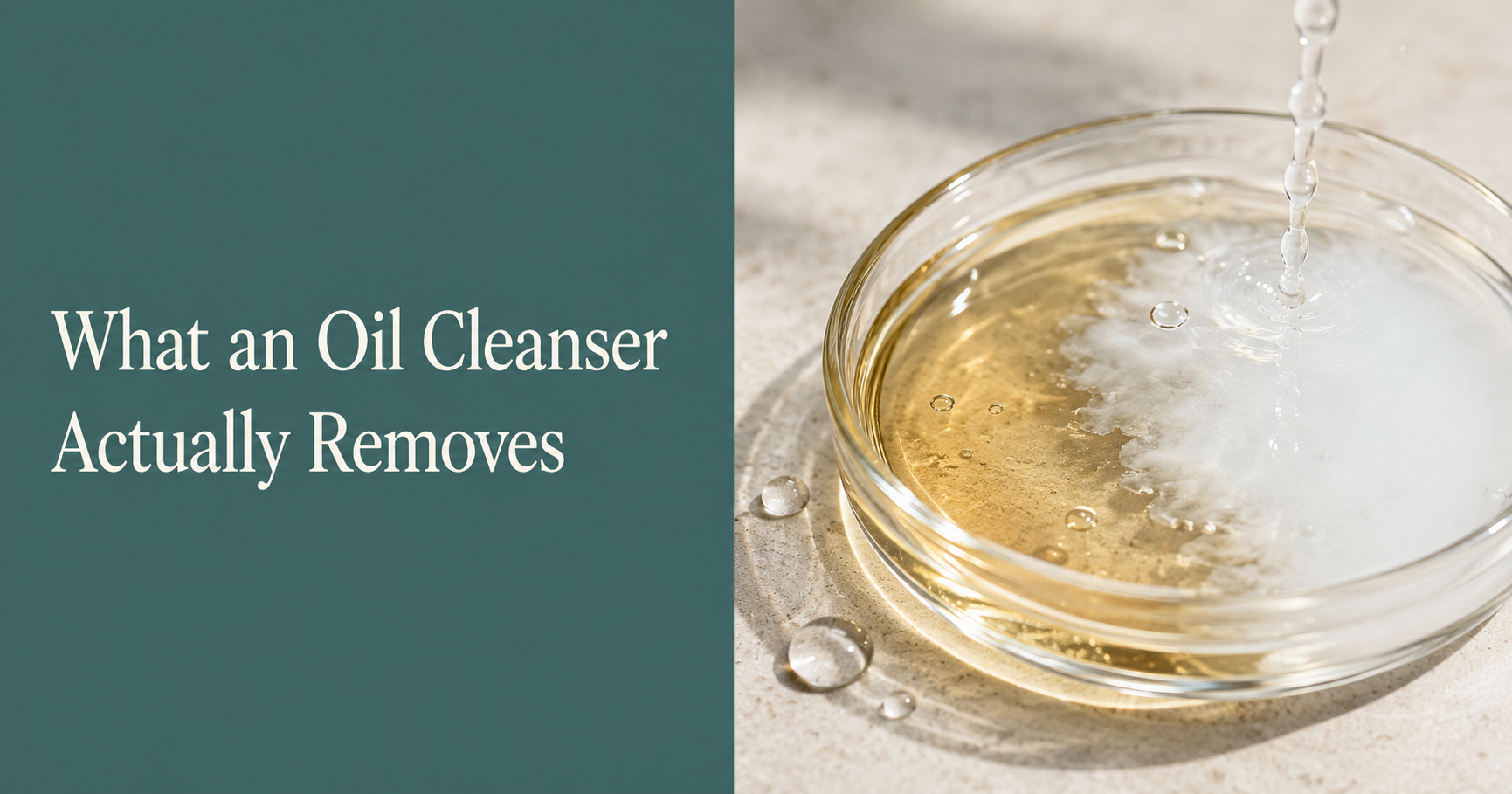
You massage a transparent oil onto dry skin, add water, and the oil turns milky.
That step is usually called emulsification.
Surfactants contain regions that interact differently with oil and water. In a cleanser, that allows oily material to be dispersed into the aqueous phase so it can be rinsed from the skin.
That is why I would not treat the milky stage as an optional aesthetic part of a Korean cleansing routine.
It is part of how this type of cleanser is designed to rinse.
A typical sequence is:
- Apply cleansing oil with dry hands to a dry face.
- Spread it gently over areas with sunscreen or makeup.
- Add a small amount of water.
- Massage briefly as the product turns milky.
- Rinse thoroughly.
- Follow with a water-based cleanser if you actually need a second cleanse.
This may also explain why two people can describe the same cleansing oil very differently.
One person says it rinses completely clean.
Another says the exact same product leaves a greasy film.
The formula matters, but application and rinsing technique can contribute too.
What I would not do is turn that observation into another unsupported rule.
A slippery or soft after-feel does not by itself prove that clinically meaningful “pore-clogging residue” has been left behind.
Skin feel is not the same thing as evidence of comedogenic residue.
I could not verify that stronger conclusion from the evidence I reviewed for this article.
Does cleansing oil actually remove sunscreen better?
This is one area where there is useful direct evidence.
A clinical study by Chen and colleagues compared water, a foaming cleanser and a cleansing oil for removing two different sunscreens.
The study included 20 participants. Researchers photographed the skin using VISIA and assessed sunscreen residue with Photoshop CS6.
It was small, and it tested specific products rather than every sunscreen and cleanser on the market.
But the difference between the two sunscreen types was striking.
For the non-waterproof sunscreen — the terminology used in the study’s results, corresponding to sunscreen without water-resistant performance — the average residue rates were:
| Cleansing method | Sunscreen residue |
|---|---|
| Water | 54.0% |
| Foaming cleanser | 15.6% |
| Cleansing oil | 13.4% |
| Negative control | 9.9% |
There was no statistically significant difference between the foaming-cleanser group and the negative control, or between the cleansing-oil group and the negative control.
In other words, both cleansers removed most of the tested non-waterproof sunscreen.
For the waterproof sunscreen, the result looked very different:
| Cleansing method | Sunscreen residue |
|---|---|
| Water | 59.3% |
| Foaming cleanser | 36.8% |
| Cleansing oil | 5.8% |
| Negative control | 3.2% |
For that sunscreen, cleansing oil left far less residue than the foaming cleanser. There was also no statistically significant difference between the cleansing-oil group and the negative control.
The researchers concluded that the tested non-waterproof sunscreen could be removed with either a cleanser or cleansing oil, while the tested waterproof sunscreen was better removed with cleansing oil.
That is much more useful than the internet rule:
“If you wear SPF, you must double cleanse.”
The better question is:
What kind of sunscreen film are you trying to remove?
A lightweight sunscreen without water-resistant performance is not necessarily the same cleansing problem as a formulation designed to remain on the skin through water and sweat.
So if you are wondering whether your Korean sunscreen requires an oil cleanser, the formulation matters.
I compare the products currently ranking in Korea separately in my Korean sunscreen rankings guide.
There is an important limitation here.
This was one 20-person study using specific sunscreens and cleansing products. The authors themselves said further research using other sunscreen and washing formulations was needed.
So I would not turn the result into a new absolute rule such as:
“Every water-resistant sunscreen must be removed with cleansing oil.”
The evidence is more useful than that — and more limited.
The study also recorded an interesting tolerability result. Eight participants reported skin dryness after using the cleanser, compared with one participant after using the cleansing oil. The authors suggested that cleansing oil may cause less irritation and dryness than the cleanser tested in the study.
I would still keep this in proportion: this was an adverse-effect observation in a study of only 20 people using specific products, not evidence that cleansing oils are universally gentler than other cleansers.
Can cleansing oil really “melt” blackheads?
This is where the evidence becomes much less dramatic than social media.
You may have seen videos of someone massaging cleansing oil around the nose until tiny particles — often called “grits” — appear on the fingertips.
The explanation is usually that the oil has dissolved the blackheads and pulled them out.
But first, it helps to define a blackhead correctly.
The American Academy of Dermatology describes a blackhead, or open comedo, as a lesion that develops when excess oil and dead skin cells accumulate inside a pore while the opening remains open.
The dark color is not dirt.
It appears when the buildup inside the open pore reacts with oxygen.
That creates a problem for the simple “oil melts blackheads” explanation.
A blackhead is not just surface oil waiting to be dissolved.
It is a comedonal lesion involving accumulated material within a follicle.
A cleansing oil can help remove surface oil, cosmetic residue and other material on the skin. That fits with what we know about the cleansing action of surfactants.
But that is not the same thing as demonstrating that an ordinary cleansing oil dissolves and treats an open comedo inside the follicle.
I could not find clinical evidence establishing ordinary cleansing oils as a blackhead treatment through that mechanism.
That does not mean nobody can notice smoother skin after oil cleansing.
It means the stronger claim —
“cleansing oil melts blackheads out of your pores”
— goes beyond what I could verify.
The American Academy of Dermatology treats blackheads and whiteheads as forms of acne and recommends established acne treatments such as retinoids for unclogging pores rather than trying to scrub or squeeze them away.
So I would describe the role of cleansing oil more narrowly:
It can remove surface oil and buildup. I would not call it a proven blackhead treatment.
And what about those “grits”?
People do sometimes feel tiny particles while massaging a cleansing oil.
What is harder to establish is exactly what those particles prove.
They may contain skin-surface material, cosmetic residue, sebum or product that has changed texture during massage.
What I could not find was strong evidence showing that seeing “grits” during cleansing demonstrates that intact blackheads have been extracted from follicles.
So I would not use grits as a measure of whether a cleansing oil is working.
And I would be cautious about extending the massage for several minutes simply to make them appear.
More rubbing is still more friction.
What about oily or acne-prone skin?
This is where online advice often splits into two extremes.
One side says:
“Oily skin needs oil because oil dissolves oil.”
The other says:
“Never use cleansing oil if you get acne because it will clog your pores.”
Neither works well as a rule for an entire product category.
Acne is more complicated than surface oil alone.
A classic review of acne pathogenesis by Zouboulis and colleagues describes acne as involving several interacting processes, including increased sebum production, follicular hypercornification, microbial factors and local inflammation.
For a simpler clinical description, the American Academy of Dermatology explains that a closed comedo, or whitehead, forms when excess oil and dead skin cells build up and plug the pore opening while the pore remains closed.
That is enough to show why this cannot be reduced to:
“You put cleansing oil on the skin, therefore oil clogged the pore.”
But the opposite statement would also go too far.
I did not find evidence strong enough to say that cleansing oils as a product category prevent closed comedones.
This is where I am deliberately limiting the claim
For this article, I looked for evidence connecting cleansing oils as a product category with the development or prevention of closed comedones.
I found literature on cleansing, surfactants, acne pathogenesis, sebum and follicular hyperkeratinization.
What I did not find was evidence strong enough to justify either of these category-wide statements:
- cleansing oils generally cause closed comedones
- cleansing oils generally prevent closed comedones
That is different from saying:
“There is no evidence.”
I am not making that universal claim.
I am saying that I could not verify a category-wide conclusion from the literature I examined for this article.
Individual cleansing oils can contain very different combinations of oils, esters, surfactants and other ingredients.
They can also rinse differently.
And individual skin responses can differ.
So if you repeatedly notice new bumps after adding a particular cleansing oil, I would not dismiss that experience just because someone online says cleansing oils are automatically good for oily skin.
I would look at the specific product and the rest of the routine rather than trying to decide whether all cleansing oils are “good” or “bad.”
Closed comedones are not proof that you need to cleanse harder
This matters because K-beauty routines can easily turn into a cycle of escalating cleansing.
You notice texture.
You assume your pores are clogged.
You add cleansing oil.
You massage for longer.
Then you add another cleanser, an exfoliating toner or a pore treatment.
But a closed comedo is not simply leftover sunscreen sitting on top of the skin.
Acne research describes comedone formation as involving processes within the pilosebaceous follicle, including sebum and abnormal follicular keratinization.
So if persistent bumps are your concern, I would separate two questions.
Am I adequately removing the sunscreen and makeup sitting on the surface of my skin?
And:
Am I trying to treat comedonal acne with a cleansing step?
Those are not the same problem.
A cleansing product can help solve the first without necessarily treating the second.
When Korean Double Cleansing Is Actually Worth It
After looking at the evidence, I think the simplest way to approach Korean double cleansing is to start with the material — or problem — you are actually dealing with.
| What are you dealing with? | What the evidence supports |
|---|---|
| Long-wear or waterproof makeup | An oil-based first cleanse can be useful |
| Water-resistant sunscreen | Cleansing oil may remove some formulations more effectively than a regular cleanser |
| Non-waterproof sunscreen | A suitable regular cleanser may already remove it adequately |
| Heavy SPF layers or repeated application | A first cleanse may be useful, depending on the formulation |
| Little makeup or easy-to-remove products | Cleansing oil is not automatically necessary |
| Blackheads | It can remove surface oil, but it is not established as a blackhead treatment |
| Oily skin | Oiliness alone does not establish that you need cleansing oil |
| Closed comedones | Do not assume that more cleansing treats the underlying problem |
This is why I would not reduce Korean double cleansing to a fixed two-step ritual.
The first cleanser should have a job.
If there is persistent makeup or a difficult-to-remove sunscreen film, an oil cleanser has an obvious role.
If there is nothing on the skin that requires that additional removal step, adding one simply because it is part of a “Korean routine” becomes harder to justify.
If you do decide you need a Korean cleansing oil
That leads to a completely different question:
Which one should you buy?
And this is where Korean and overseas recommendations start to diverge.
Anua, ma:nyo and SKIN1004 receive enormous visibility in English-language K-beauty content.
But Korea’s current cleansing-oil rankings include several products that are barely discussed in English.
I compared those rankings separately in Which Korean Cleansing Oils Rank Above Anua?.
That article is the better place to start once you have decided that an oil cleanser actually belongs in your routine.
This article answers the question before that.
The bottom line
Korean double cleansing makes more sense once you stop treating it as a ritual and start asking what each cleanser is supposed to remove.
There is evidence that cleansing method can matter.
In one 20-person clinical study, a foaming cleanser and cleansing oil both removed most of the tested non-waterproof sunscreen, while cleansing oil performed substantially better on the tested waterproof sunscreen.
There is also established cleansing science behind emulsification: surfactants help oily material disperse into water so it can be removed from the skin.
But some of the more viral claims are much less certain.
I could not verify that ordinary cleansing oils “melt” blackheads out of follicles.
I could not verify evidence strong enough to say cleansing oils, as an entire product category, either cause or prevent closed comedones.
And oily skin by itself is not a reason to automatically add another cleansing step.
That is the distinction I keep coming back to with Korean skincare:
A step should solve a problem. It should not exist just because the routine has a name.
Sources
Chen W, He M, Xie L, Li L. The optimal cleansing method for the removal of sunscreen: Water, cleanser or cleansing oil? Journal of Cosmetic Dermatology. 2020;19(1):180–184. DOI: 10.1111/jocd.12995. PMID: 31157512.
Abdollahi H, Ghanbarlou S, Babapoor A, et al. Surfactant-containing detergents: Impacts on dermal health. Colloids and Surfaces B: Biointerfaces. 2025;256(Pt 1):115026. DOI: 10.1016/j.colsurfb.2025.115026. PMID: 40795538.
Draelos Z, Zeichner J, Miller D, et al. Advances in Gentle Polymeric Cleansing Technologies. Journal of Drugs in Dermatology. 2026;25(5):465–470. DOI: 10.36849/JDD.9749. Five of the eight authors list Kenvue Brands LLC as their affiliation; I therefore use this as supporting rather than primary evidence for the general surfactant mechanism.
Zouboulis CC, Eady A, Philpott M, et al. What is the pathogenesis of acne? Experimental Dermatology. 2005;14(2):143–152. DOI: 10.1111/j.0906-6705.2005.0285a.x. PMID: 15679586.
American Academy of Dermatology. Acne: Signs and symptoms. Definitions of open comedones (blackheads) and closed comedones (whiteheads), including why blackheads appear dark.
American Academy of Dermatology. How to treat different types of acne. Guidance on blackheads and whiteheads and established pore-unclogging treatments.
Olive Young Korea. Cleansing > Oil/Balm > Cleansing Oil. 158 products displayed when checked August 27, 2026. Product counts and promotional listings can change.