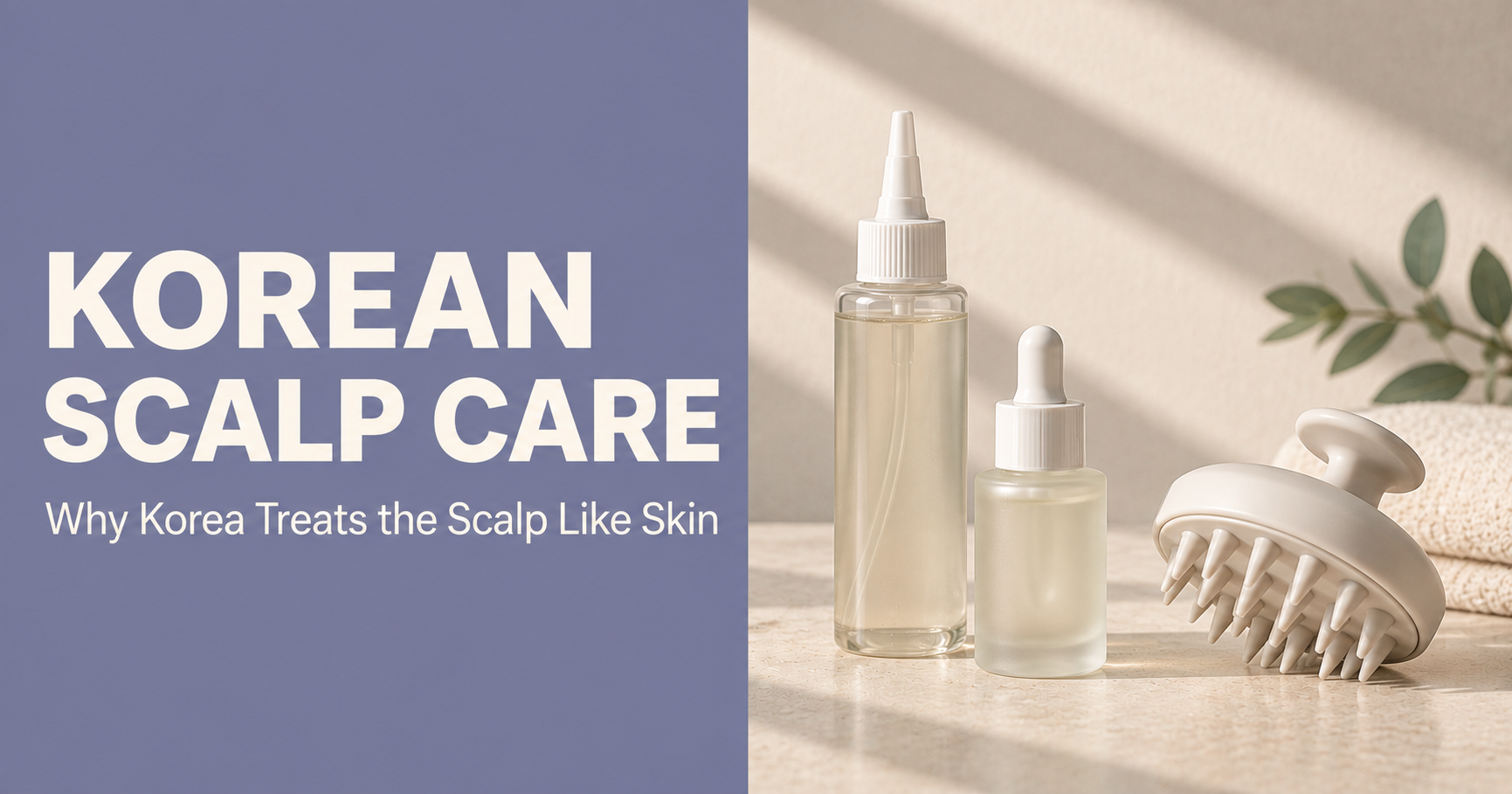
Korean scalp care is starting to look surprisingly similar to Korean skincare.
Walk through the hair-care section of a Korean beauty store and shampoo is only the beginning.
You may find:
scalp tonics
scalp ampoules
scalp serums
scalp scalers
cooling sprays
scalp brushes
and products marketed for hair-loss symptom relief.
If you are used to thinking about hair care as shampoo + conditioner, the Korean shelf can look unusually complicated.
But there is a reason.
Korean beauty retailers increasingly treat the scalp as something that deserves its own care — not simply as the place where hair grows.
CJ Olive Young has even used a word for the broader trend:
Skinification.
The idea is simple:
Treat the scalp and body with the same concern-based thinking already used for facial skin.
That does not mean your scalp needs a 10-step skincare routine.
It means Korean hair care is increasingly moving beyond the question:
“Which shampoo makes my hair look better?”
toward:
“What condition is my scalp actually in?”
And in 2026, that shift is becoming increasingly visible to international K-beauty shoppers too.
What Is Korean Scalp Care?
Korean scalp care is not one standardized routine.
It is better understood as a category of products focused on the condition of the scalp, rather than only the appearance of the hair.
That distinction is important.
Traditional hair-care marketing often focuses on the hair fiber:
damage
shine
frizz
volume
smoothness
color protection
Scalp-care marketing starts somewhere else.
It asks about:
oiliness
dryness
flakes
buildup
sensitivity
sebum
scalp comfort
and hair-loss-related concerns.
Some of these are everyday cosmetic concerns.
Others can overlap with conditions that may require professional diagnosis or treatment.
That distinction matters.
But first, it helps to understand why scalp care became such a visible category in Korea.
Korea Calls the Broader Trend “Skinification”
In July 2024, CJ Olive Young announced that it was strengthening its hair and body categories around a concept called:
스키니피케이션
or:
Skinification.
Olive Young defined Skinification as treating the scalp and body with the same detailed attention people apply to facial skin.
Instead of choosing shampoo only for cleansing or body wash only for fragrance, consumers were increasingly looking for products matched to specific concerns.
That included products such as:
hair tonics
scalp ampoules
functional hair-loss-care products
trouble-focused body care
and other specialized personal-care products.
The logic is easy to understand.
For years, beauty consumers have been taught to evaluate facial skincare according to:
skin type
ingredients
concerns
functions
texture
and routines.
Now that same shopping logic is moving beyond the face.
You can read Olive Young’s original Skinification announcement here.
The Sales Data Shows This Was More Than a Marketing Phrase
Olive Young’s 2024 announcement included a particularly useful data point.
According to the retailer, 2023 sales in its hair special-care category — including hair tonics and ampoules — increased 151% compared with the previous year.
At the same time, sales of trouble-care body products increased 65%.
This distinction matters.
The 151% figure does not describe the entire Korean hair-care market.
It specifically refers to Olive Young’s hair special-care category.
Still, it shows how quickly more targeted products were expanding beyond ordinary shampoo and conditioner.
The trend continued.
In a later update, Olive Young reported that sales in its broader personal-care category, including hair and body care, had increased by approximately 20% annually for three consecutive years.
Hair tonics and ampoules were among the product types it specifically highlighted.
That is a useful signal.
Scalp care was no longer simply a small shelf next to shampoo.
It was becoming part of a broader change in how beauty consumers shop for personal care.
And the Trend Is Still Visible in 2026
The most useful evidence is that scalp care did not disappear after the initial Skinification campaign.
In August 2026, Olive Young released new data on international customers shopping at its Korean stores.
Hair care ranked behind skincare and color cosmetics among the most popular categories for international customers.
But the more interesting detail was inside the hair category.
Across Olive Young’s hair-care category, international customers accounted for about 18% of sales.
For hair tonics and ampoules, however, the international-customer share reached 28%.
That is substantially higher.
Olive Young specifically noted growing attention around scalp-soothing and hair-loss-care products from brands such as LABO-H and LILLYEVE, including easy-to-use roll-on and brush-type applicators.
You can see the 2026 Olive Young international shopping data here.
That tells us something important.
Korean scalp care is no longer only a domestic personal-care trend.
It is becoming another part of K-beauty that international shoppers are discovering while shopping in Korea.
Shampoo Is No Longer the Whole Hair-Care Category
For many shoppers, hair care begins with shampoo and ends with conditioner.
The Korean market increasingly separates different jobs.
Shampoo
Primarily cleanses the scalp and hair.
Conditioner or treatment
Usually focuses more heavily on the hair fiber — softness, smoothness, detangling and damage care.
Scalp tonic
Usually a leave-on liquid applied directly to the scalp.
Scalp ampoule or serum
A targeted leave-on format marketed around particular scalp concerns.
Scalp scaler
Usually designed around excess oil, buildup or dead skin on the scalp.
Scalp mist or cooling product
Often positioned around freshness, scalp heat or temporary comfort.
Scalp brush
A physical tool commonly used while shampooing or when distributing a scalp product.
These categories can overlap.
And brands do not necessarily use the terminology in exactly the same way.
A “scalp serum” from one company may look very similar to a “scalp tonic” from another.
So, just as with Korean facial skincare, the product name alone does not tell you exactly what it does.
Scalp Tonic vs. Serum vs. Ampoule: Is There a Real Hierarchy?
Not in the simple way online beauty guides sometimes suggest.
K-beauty already has:
essence
serum
ampoule
booster
mist
toner
in facial skincare.
Similar vocabulary is now common in hair and scalp care.
But you should not assume these words form a strict potency ladder.
A scalp ampoule is not automatically stronger than a scalp serum.
A tonic is not automatically weaker than an ampoule.
The useful questions are:
What is the product designed to do?
Is it rinse-off or leave-on?
What ingredients does it contain?
What claims is the brand making?
What regulatory category does that claim fall under?
That is much more useful than assuming the fanciest product name means the strongest treatment.
I found the same naming problem when researching facial skincare in Essence vs. Serum vs. Ampoule: What the Words Mean in Korea.
Korean retailers actually group those three terms together much more loosely than the familiar English-language strength hierarchy suggests.
Hair-Loss Care Is Where Korean Regulation Matters
This is one area where international shoppers should read Korean claims particularly carefully.
Under Korea’s current Cosmetics Act Enforcement Rule, cosmetics that help alleviate symptoms of hair loss are included within the country’s functional-cosmetics framework.
The Korean wording is:
탈모 증상의 완화에 도움을 주는 화장품
roughly:
cosmetics that help alleviate symptoms of hair loss.
That wording matters.
It does not say:
medicine that regrows hair.
And it does not mean every shampoo, tonic or scalp ampoule mentioning roots or scalp health automatically qualifies for the same regulated claim.
Korean functional cosmetics have their own regulatory framework.
That makes the term more meaningful than a generic phrase such as “root care” printed on the front of a bottle.
“Hair-Loss Symptom Relief” Does Not Mean “Hair Regrowth Drug”
This distinction deserves its own section because it can easily disappear in translation.
A Korean cosmetic recognized for hair-loss symptom relief should not automatically be described in English as a hair-regrowth treatment.
Those are different claims.
A cosmetic can sit within Korea’s functional-cosmetics framework without becoming a drug.
That is similar to the distinction I discussed in Korean Pharmacy Skincare: What Koreans Actually Buy.
A product can look medical without being medicine.
A product can also make a regulated cosmetic claim without becoming medicine.
So if you see a Korean scalp tonic marketed around hair loss, do not immediately translate that into:
“This grows hair.”
First ask:
What is the exact Korean claim?
What type of product is it?
What evidence supports that claim?
And if the concern is significant or persistent hair loss, cosmetics and medical treatment should not be treated as interchangeable.
Why Scalp Care Feels So Much Like Skincare
Look at the vocabulary and the similarity becomes obvious.
Facial skincare talks about:
oil control
hydration
soothing
exfoliation
barrier care
sensitivity
sebum
dead skin
Scalp care talks about:
oil control
hydration
soothing
exfoliation
sensitivity
sebum
dead skin
There is a logical reason for the overlap.
The scalp is skin.
But that does not mean you should simply apply your facial skincare routine to your scalp.
The scalp has its own environment:
dense hair follicles
substantial sebaceous activity
hair covering the surface
different cleansing challenges
and different cosmetic goals.
The useful part of Skinification is the concern-based thinking.
Not literally copying your facial routine onto your head.
Does Your Scalp Need Exfoliation?
Sometimes.
But not automatically.
Scalp scalers and deep-cleansing products are highly visible in Korean hair care.
They are often positioned around:
buildup
excess sebum
dead skin
or a heavy scalp feeling.
That can make sense for some people.
But exfoliation is not something every scalp needs every day.
More exfoliation is not automatically better cleansing.
Repeatedly using strong cleansing or exfoliating products can leave some scalps feeling dry or irritated.
And persistent flaking does not necessarily mean:
“I need a stronger scalp scaler.”
Flaking can have different causes.
If it is persistent, severe, very itchy, painful or accompanied by substantial redness, the problem may be larger than cosmetic buildup.
A shopping list is not a diagnosis.
What About “Scalp Heat”?
This is a phrase you will encounter frequently in Korean hair-care marketing.
Products may emphasize:
cooling
refreshing
scalp temperature
or heat relief.
A cooling sensation can be real.
Ingredients such as menthol can create a noticeable cooling feeling, while sprays and tonics can make the scalp feel temporarily fresher.
But this is another area where the claim needs to be interpreted carefully.
A product that creates a cooling sensation does not automatically treat the underlying causes of hair loss.
Feeling cooler and growing more hair are not the same outcome.
That sounds obvious when written plainly.
On a beauty package surrounded by scalp-health language, the distinction can become easier to miss.
Why Applicators Are Becoming Part of the Product
One of the more interesting things in Olive Young’s 2026 data is not an ingredient.
It is packaging.
Olive Young specifically pointed to scalp-soothing and hair-loss-care products using formats such as:
roll-ons
and
brush applicators.
This solves a practical problem.
Facial serum is easy to apply directly to facial skin.
Scalp serum has hair in the way.
A narrow nozzle can reach between sections of hair.
A roll-on can target the roots.
A brush applicator can help deliver product closer to the scalp.
That is not necessarily an innovation in ingredient science.
It is an innovation in usability.
And usability matters.
A theoretically excellent leave-on product is not particularly useful if applying it is messy enough that you stop using it.
What About Scalp Brushes?
Scalp brushes make the routine especially visible.
Instead of simply washing your hair, you can:
apply shampoo
massage the scalp
rinse
then perhaps apply a leave-on product.
That creates a recognizable scalp-care routine.
But a brush is still a physical tool.
More pressure does not automatically mean better cleansing.
Aggressive scrubbing can irritate the scalp.
If you use one, gentle contact makes more sense than treating the scalp as something that needs to be scrubbed clean.
Again, Skinification works best when it encourages more thoughtful care.
Not more aggressive care.
Why International K-Beauty Shoppers Are Noticing Scalp Care
International K-beauty attention has historically centered on facial skincare.
Sunscreen.
Cleansing oil.
Toner pads.
Serums.
Sheet masks.
Scalp care has received much less attention.
That appears to be changing.
In Olive Young’s August 2026 international-shopping data, hair care ranked after skincare and color cosmetics among popular categories.
More importantly, the foreign-customer sales share for hair tonics and ampoules reached 28%, compared with roughly 18% for hair care overall.
That difference suggests specialized scalp products are particularly interesting to visitors.
And international shoppers now matter considerably more to Korean beauty retail than they once did.
Olive Young reported that international customers accounted for 33% of its Korean offline-store sales in August 2026, compared with only 2% in 2022.
That creates an important change in how we should read Korean retail data.
“Popular at Olive Young” Does Not Automatically Mean “Popular With Koreans”
This distinction is becoming increasingly important.
I explained in Olive Young Best Sellers: What the Korean Ranking Actually Measures that a retailer’s ranking needs context.
Bundles matter.
Discounts matter.
Promotions matter.
Listing configurations matter.
And now customer mix matters too.
If international shoppers account for a significant share of offline Olive Young sales, a product selling strongly at Olive Young cannot automatically be described as:
“what Korean people use.”
It tells us what is selling through Olive Young.
That is still useful information.
It is simply not identical to a national survey of Korean consumers.
This is one reason I am particularly careful with the phrase “what Koreans actually buy.”
Sometimes the Korean retail evidence answers that question.
Sometimes it answers a slightly different one.
What Should You Look for When Buying Korean Scalp Care?
Start with the concern.
Not the product trend.
If your scalp feels oily
A product designed around sebum and cleansing may make more sense than an intensive moisturizing treatment.
If your scalp feels dry
Aggressive deep cleansing may make the problem feel worse.
Do not assume every flake means excess buildup.
If you have buildup
An occasional scalp scaler or clarifying product may be useful.
Frequency matters.
If your scalp feels sensitive
Be cautious with aggressive exfoliation, intense cooling sensations and formulas that your scalp does not tolerate well.
If hair loss is your concern
Read the exact claim.
In Korea, hair-loss symptom relief has a specific functional-cosmetic context.
Do not automatically translate that into hair regrowth.
And if hair loss is sudden, patchy, severe or persistent, cosmetic shopping should not be the only response.
Do You Need a Korean Scalp-Care Routine?
No.
This is where the lesson from Korean skincare repeats itself.
You do not need to turn scalp care into:
shampoo
scaler
tonic
ampoule
serum
mist
brush
mask
all at once.
There is no universal Korean scalp-care routine.
A perfectly reasonable routine may simply be:
Shampoo → conditioner on the hair lengths
Someone with a particular scalp concern may add one targeted product.
Someone else may not need one.
The goal is not to collect steps.
The goal is to identify a problem and choose an appropriate product if one is actually necessary.
That is also the more realistic way to understand what a Korean skincare routine actually looks like in 2026.
Concern first. Steps second.
Is Korean Scalp Care Better Than Western Hair Care?
Not automatically.
The scalp exists outside Korea too.
Scalp tonics, medicated shampoos, clarifying products and hair-loss treatments are not uniquely Korean inventions.
What makes the Korean market interesting is the way beauty retail is organizing the category.
Scalp care is increasingly presented using the same shopping logic as skincare:
identify the concern
choose the function
compare the formula
consider the claim
select a usable format
That structure can make the category feel more developed than a hair-care shelf organized mainly by shampoo and conditioner.
But Korean packaging does not automatically make a product effective.
The individual product still matters.
Skinification Is Bigger Than Scalp Care
Scalp care is only one part of Skinification.
When Olive Young introduced the concept, it applied it to both:
hair/scalp care
and
body care.
Body products are increasingly organized around concerns once associated mainly with facial skincare:
blemishes
pigmentation
elasticity
exfoliation
sun protection
and barrier care.
That tells us something larger about K-beauty.
The face is no longer the only area being treated as skin.
Skincare logic is expanding across the body.
This Fits the Bigger K-Beauty Story in 2026
Several category boundaries in Korean beauty are becoming less rigid.
Skincare is moving toward derma.
Makeup is borrowing skincare language.
Hair care is becoming scalp care.
Body care is becoming more concern-specific.
And beauty is moving closer to wellness.
These are different categories.
But the underlying pattern is similar.
Korean beauty is increasingly organized around:
What is the concern?
rather than only:
What type of product is this?
That is why scalp care belongs in the larger K-beauty conversation.
Not because everyone in Korea suddenly needs a scalp ampoule.
Because the same concern-based shopping logic that shaped modern Korean skincare is now moving to the scalp.
The Bottom Line
So, why does Korean scalp care look so much like skincare?
Because that is increasingly how the Korean beauty market thinks about it.
Olive Young calls the broader trend Skinification — applying skincare-style, concern-based thinking to the scalp and body.
And there is measurable retail evidence behind the idea.
In 2023, Olive Young’s hair special-care category, which included tonics and ampoules, recorded 151% year-over-year sales growth.
Its broader personal-care category later recorded roughly 20% annual sales growth for three consecutive years.
And in August 2026, international customers represented about 18% of Olive Young’s overall hair-care sales but 28% of sales for hair tonics and ampoules.
Those numbers do not mean everyone needs a scalp serum.
They do not mean a scalp ampoule regrows hair.
And they definitely do not mean you need a ten-step routine for your head.
The more useful lesson is simpler:
Korean hair care is increasingly starting with the scalp, not only the hair.
Identify the concern.
Understand the claim.
Check what type of product you are buying.
Then decide whether another step is actually necessary.
That is Skinification at its most useful.
Not necessarily more products.
More specific ones.
FAQ
What is Korean scalp care?
Korean scalp care refers to products and routines focused on the condition of the scalp rather than only the appearance of the hair. Products can include scalp tonics, ampoules, scalers, specialized shampoos and application tools.
What is Skinification in Korean beauty?
Skinification is the trend of applying skincare-style concern-based thinking to areas beyond the face, particularly the scalp and body. Olive Young explicitly began developing its hair and body categories around the concept in 2024.
Are Korean scalp tonics hair-growth treatments?
Not necessarily. Some products are cosmetics, while products making recognized hair-loss symptom-relief claims may fall within Korea’s functional-cosmetics framework. That should not automatically be translated as a claim that the product regrows hair.
What does “hair-loss symptom relief” mean in Korean cosmetics?
Korea’s Cosmetics Act Enforcement Rule includes cosmetics that help alleviate symptoms of hair loss within the functional-cosmetics framework. This is different from saying that a cosmetic is a hair-regrowth drug.
Do Koreans use scalp ampoules?
Scalp ampoules and tonics are part of Korea’s expanding hair special-care market. Olive Young reported 151% year-over-year growth in its hair special-care category in 2023.
Do I need a scalp scaler?
Not everyone does. Scalp scalers are generally designed around buildup, excess sebum or dead skin. Overusing strong cleansing or exfoliating products may irritate some scalps.
Why do Korean scalp products use roll-ons and brushes?
Hair makes direct scalp application more difficult than facial skincare. Roll-ons, pointed nozzles and brush applicators can make it easier to deliver leave-on products directly to the scalp.
Is Korean scalp care popular with international shoppers?
There are signs of growing interest. In August 2026, international customers accounted for about 18% of Olive Young’s overall hair-care sales but 28% of hair-tonic and ampoule sales.
Is Korean scalp care better than regular hair care?
Not automatically. The Korean market is notable for its concern-based segmentation and product variety, but effectiveness depends on the individual formula, claim and scalp concern.
Sources & Further Reading
- CJ Olive Young — Skinification and the New Hair & Body Care Routine
- CJ Olive Young — Personal Care and Skinification Growth
- CJ Olive Young — International Customer Shopping Trends, August 2026
- Korea National Law Information Center — Cosmetics Act Enforcement Rule, Functional Cosmetics
- Picked in Korea — Essence vs. Serum vs. Ampoule
- Picked in Korea — Korean Pharmacy Skincare
- Picked in Korea — Olive Young Best Sellers: What the Korean Ranking Actually Measures
- Picked in Korea — What a Korean Skincare Routine Actually Looks Like in 2026
Retail data, regulations and source pages were checked in September 2026. Product availability, retail assortments and regulations may change after publication.