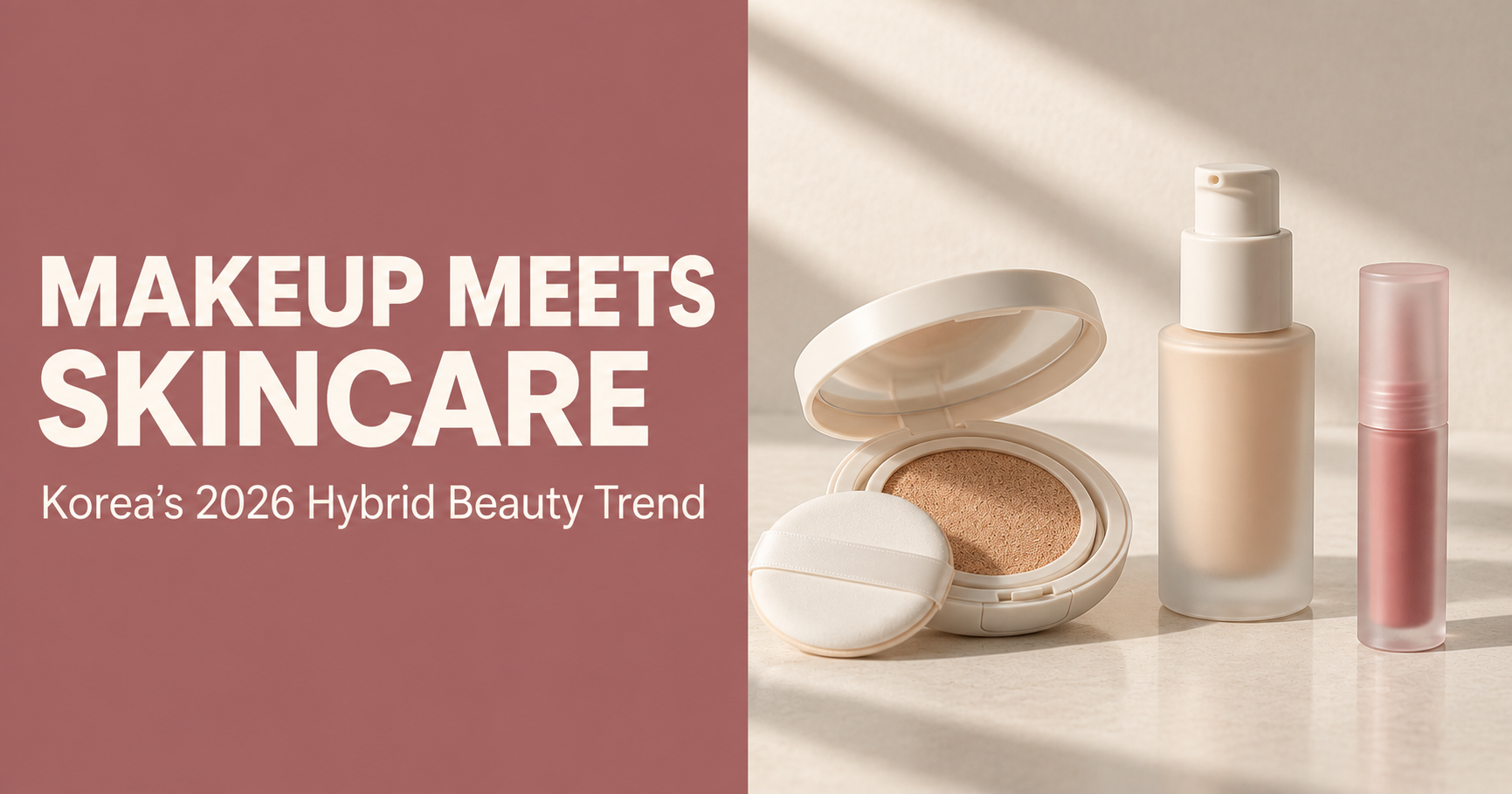
Korean skincare makeup is becoming one of the more interesting K-beauty shifts in 2026.
Look at makeup in Korea and you will increasingly encounter language that sounds as if it belongs in the skincare aisle:
soothing
barrier
moisture
serum
ampoule
Cica
hyaluronic acid
At first, this can look like ordinary beauty marketing.
But there is measurable consumer behavior behind it.
CJ Olive Young, Korea’s largest health and beauty retailer, identified “skincaring makeup” (스킨케어링 메이크업) as one of its key beauty trends for 2026.
According to Olive Young, searches within its makeup category for skincare-related keywords such as soothing, barrier and moisture increased by more than 150% year over year.
That is a significant change in what shoppers are looking for when they buy makeup.
Korean consumers are not only asking:
How much coverage does this cushion have?
How long does this tint last?
They are increasingly also asking:
How will this feel on my skin?
But does a cushion with skincare ingredients actually replace moisturizer?
Does a “serum foundation” treat your skin?
And is skincaring makeup a meaningful product shift — or simply another marketing phrase?
The useful answer sits somewhere in between.
Korean skincare makeup is becoming a real market trend. But makeup containing skincare ingredients is still makeup.
That distinction matters.
What Is “Skincaring Makeup”?
Olive Young uses the Korean term:
스킨케어링 메이크업
or:
skincaring makeup.
It describes the growing overlap between traditional color cosmetics and skincare-oriented functions, ingredients and claims.
A conventional makeup shopper might compare products by:
- color
- coverage
- finish
- adhesion
- longevity
Those criteria still matter.
But shoppers are increasingly adding another layer:
- ingredients
- hydration
- comfort
- soothing
- barrier-related claims
- how the product feels after hours of wear
In other words, skincare expectations are moving into the makeup aisle.
Olive Young Calls It a 2026 Beauty Trend
This is not a trend inferred from a few viral products.
In December 2025, CJ Olive Young published its 2026 Beauty & Wellness Trend Keywords.
One of the trends it highlighted was the idea that makeup is increasingly being treated as an extension of skincare.
Olive Young described the expansion of hybrid products in both directions:
color cosmetics containing high-function skincare ingredients
and
skincare products incorporating color.
The retailer also reported something more measurable.
Within its makeup category, searches for skincare-related terms such as:
진정 — soothing
장벽 — barrier
수분 — moisture
increased by more than 150% compared with the previous year.
That does not prove that every Korean makeup shopper suddenly wants skincare-infused foundation.
But it does show that skincare concepts are becoming increasingly relevant to how consumers search for makeup.
Why Is Korean Makeup Moving in This Direction?
The trend makes more sense when you look at what has already happened to Korean skincare.
Korean beauty consumers are surrounded by ingredient language.
Terms such as:
ceramide
panthenol
Centella
niacinamide
hyaluronic acid
peptides
PDRN
have become familiar parts of skincare marketing.
Consumers are also used to shopping by skin concern:
hydration
barrier
sensitivity
pigmentation
breakouts
elasticity
Once consumers begin evaluating skincare this way, it is logical for those expectations to follow them into makeup.
The question changes from:
“Does this foundation look good?”
to:
“Does this foundation look good without making my skin feel worse?”
That second question helps explain skincaring makeup.
Hybrid Makeup Is Not Actually New
There is an important caveat.
Makeup and skincare have been overlapping for years.
BB creams were doing it long before anyone started calling the trend “skincaring makeup.”
They combined complexion coverage with skincare and sun-protection positioning.
Korean cushion foundations pushed the idea further.
A cushion could offer:
coverage
SPF
portable application
a particular skin finish
and convenient touch-ups
in one compact.
Tone-up sunscreens blur another boundary.
Tinted lip balms blur another.
So skincaring makeup is not an entirely new invention.
What appears to be changing is how broadly skincare language is influencing color cosmetics and how explicitly retailers are identifying it as a category-level trend.
Cushion Foundation Is an Obvious Place for the Trend
If there is one K-beauty format perfectly positioned for this crossover, it is the cushion.
Cushions already combine multiple expectations.
A shopper may evaluate:
coverage
finish
shade
wear
SPF
texture
hydration
and comfort
before choosing one.
That makes the cushion a natural place for skincare-oriented positioning.
But current Korean rankings also show why we should not overstate the trend.
In the 2025 Olive Young Awards, the cushion category ranked:
No. 1 — JUNG SAEM MOOL Essential Skin Nuder Cushion
No. 2 — CLIO Kill Cover Founwear Cushion
No. 3 — hince Second Skin Mesh Matte Cushion
The ranking still reflects products sold primarily as makeup.
Coverage, finish and adhesion have not disappeared.
Skincare has become an additional expectation rather than a replacement for makeup performance.
You can check the current award listings on the Olive Young Awards page.
Lip Makeup Shows the Same Pattern
The overlap becomes even clearer with lip products.
A lip tint obviously needs color.
But consumers also care about:
comfort
moisture
texture
shine
whether it emphasizes dry patches
and how the lips feel after several hours.
The 2025 Olive Young Awards ranked lip makeup:
No. 1 — rom&nd The Juicy Lasting Tint 03 Bare Grape
No. 2 — Colorgram Nudey Blur Tint 07 Geek Rose
No. 3 — Peripera Ink Mood Glowy Tint 03
These products are still judged as color cosmetics.
But comfort and texture increasingly sit alongside color payoff and longevity.
That is exactly the environment in which skincare language can become influential.
Skincare Language Is Changing How Makeup Is Sold
A traditional foundation description might emphasize:
24-hour wear
high coverage
oil control
matte finish
A newer hybrid product may add:
moisture
serum texture
barrier care
soothing ingredients
skin comfort
glow
That changes the consumer decision.
Instead of choosing only between matte and dewy, or high coverage and sheer coverage, shoppers may now compare how each product interacts with the condition of their skin.
This does not make makeup skincare.
It changes what consumers expect makeup to do.
Does Skincaring Makeup Actually Improve Your Skin?
This is where we need to separate ingredient presence from finished-product performance.
Imagine a cushion that contains hyaluronic acid.
That tells you something about the formula.
It does not automatically tell you:
how much is present
what type is used
how the entire moisturizing system is formulated
how much cushion product you apply
or how the formula performs after several hours on your skin.
The same applies to ingredients such as:
Centella
niacinamide
ceramides
panthenol
and peptides.
A familiar skincare ingredient can be relevant.
But the front label alone cannot tell you how meaningful it is in the finished product.
Makeup Still Does Not Replace Your Skincare Routine
A moisturizing cushion may feel much more comfortable than a drying one.
That is useful.
It does not automatically replace moisturizer.
A lip tint with conditioning ingredients may feel better on dry lips.
That does not automatically make it equivalent to a dedicated lip-care product.
And a foundation marketed around barrier care should not automatically be treated like a barrier cream.
The same principle applies to the broader shift toward Korean derma skincare.
Scientific or skincare-oriented positioning can tell you how a product is being marketed.
The finished formula, product category and supporting evidence tell you more about what it actually does.
This Fits Korea’s Move Away From the “10-Step” Stereotype
There is another reason this trend makes sense in 2026.
Modern Korean beauty is not simply about adding more products.
It is increasingly about choosing products according to function, concern and convenience.
I discussed this in What a Korean Skincare Routine Actually Looks Like in 2026.
The international image of K-beauty was once heavily associated with the “10-step Korean skincare routine.”
But there is no single standard Korean routine.
Hybrid makeup fits the more flexible reality.
Instead of assuming that every function requires another bottle, consumers can increasingly choose products that overlap.
That does not necessarily mean fewer products for everyone.
It means the boundaries between products are becoming less rigid.
K-Beauty Has Always Been Good at Blurring Categories
This is one reason I would describe skincaring makeup as an evolution rather than a revolution.
K-beauty has repeatedly created products that sit between familiar categories.
BB cream: skincare + complexion makeup + sun protection positioning
Cushion: foundation + SPF + portable application
Tone-up sunscreen: sunscreen + complexion correction
Tinted lip balm: lip care + color
Toner pad: toner + physical application format + sometimes exfoliation or masking
Now we are seeing the same logic applied more broadly.
Makeup borrows skincare ingredients and claims.
Skincare sometimes borrows tint and color.
The result is a beauty market where the category printed on the package tells only part of the story.
“Serum Foundation” Does Not Automatically Equal Serum
This is one of the easiest marketing terms to misread.
The word serum can refer to:
texture
formula positioning
the presence of skincare ingredients
or simply the product concept.
It does not automatically mean that a foundation contains the same concentration or delivery system as a dedicated skincare serum.
The same applies to:
ampoule cushion
Cica foundation
barrier makeup
hyaluronic tint
The name can tell you what idea the brand wants to communicate.
It does not replace the ingredient list or product evidence.
Read Past the Front Label
This is especially important when shopping Korean beauty products directly in Korea.
The front of the package is marketing space.
The back is where you can find more useful information.
If you are unfamiliar with Korean cosmetic labels, my Korean Skincare Label Guide explains terms such as:
전성분 — full ingredient list
사용기한 — use-by period
화장품책임판매업자 — responsible cosmetic seller
제조업자 — manufacturer
The guide focuses on skincare, but the same principle is useful when evaluating makeup.
Do not judge a product only from the largest English word printed on the front.
Does “Cica Makeup” Work Like Cica Skincare?
Not necessarily.
Cica is a good example because the word itself is already broader than many shoppers realize.
In Korean skincare, Cica commonly refers to Centella asiatica and ingredients derived from it.
But Centella extract, madecassoside and other Centella-derived components are not identical ingredients.
I explain that distinction in What Is Cica in Korean Skincare?.
Now apply the same logic to makeup.
Seeing CICA on a cushion does not tell you:
which Centella-related ingredient is used
how much is present
what role it plays in the formula
or whether the finished product has demonstrated a meaningful soothing benefit.
The ingredient name is a clue.
It is not the entire answer.
What Should You Look for in Korean Skincare Makeup?
I would start with the job you need the makeup to perform.
If you have dry skin
Look at the actual finish and wear experience.
A long list of moisturizing ingredients means little if the foundation still feels tight after three hours.
If you have sensitive skin
Do not assume that words such as “soothing” or “derma” guarantee that a formula will suit everyone.
Check the full formula and relevant testing information.
If you need coverage
Judge coverage as coverage.
Skincare positioning should not distract you from whether the product performs its primary makeup function.
If hydration matters
Look beyond one hero ingredient.
The finished formula matters more than a single recognizable name.
If you are acne-prone
Do not assume “skin-friendly,” “barrier” or “soothing” means the product cannot cause problems for your individual skin.
Makeup remains a leave-on cosmetic formula.
The Korean Makeup Market Has Not Suddenly Become Skincare
There is a danger in turning every Korean trend into an absolute statement.
Skincaring makeup is growing.
That does not mean ordinary color cosmetics disappeared.
The 2025 Olive Young Awards still contain familiar categories including:
eye makeup
eye shadow
base makeup
contouring
cushion
lip makeup
And their leading products are still expected to perform as makeup.
This is an important distinction.
The trend is not:
Koreans no longer care about makeup performance.
It is closer to:
Koreans increasingly expect makeup performance and skin comfort at the same time.
International Shoppers Matter More to Korean Beauty Retail Than Before
This trend also needs to be understood in a changing Korean retail environment.
By August 2026, Olive Young reported that cumulative purchases by international customers at its Korean offline stores had already exceeded ₩1 trillion for the year.
That milestone arrived three months earlier than in 2025.
International customers accounted for 33% of Olive Young’s offline sales in August 2026, up from just 2% in 2022.
The retailer said the most popular categories among international customers were:
skincare
color cosmetics
hair care
in that order.
That is important for interpreting K-beauty trends.
International shoppers are not simply observing Korean beauty from overseas anymore.
They are increasingly participating in Korea’s domestic beauty retail market itself.
That Also Changes What “Popular in Korea” Means
This is something I think K-beauty content needs to handle more carefully.
If a product sells strongly at Olive Young in Korea, that does not automatically mean Korean residents alone are driving the sales.
Tourists are now a significant customer group.
That does not make the sales data less useful.
It means we need to ask a more precise question:
Who is buying the product?
The same caution applies when reading Olive Young bestseller rankings.
A ranking can tell us that a particular listing is selling.
But bundles, discounts, promotions, stock availability and customer mix can all influence the result.
Retail data becomes more useful when we understand what it actually measures.
Is Skincaring Makeup Just Marketing?
Partly.
But that does not make the trend meaningless.
Almost every consumer beauty category is shaped by marketing.
The more useful question is:
Does the finished product deliver the benefit being implied?
If shoppers increasingly search for:
soothing
barrier
moisture
while browsing makeup, brands have a commercial reason to respond.
Some will develop genuinely thoughtful hybrid formulas.
Others may place a familiar skincare ingredient prominently on the front of the package even when its practical role is modest.
The category name cannot tell you which is which.
You still have to evaluate the product.
What This Says About K-Beauty in 2026
Put several recent Korean beauty trends together and a larger pattern appears.
Korean beauty is becoming less interested in rigid boundaries.
Skincare is becoming more concern-specific.
Derma is moving further into mainstream beauty retail.
Makeup is borrowing skincare language.
Skincare products are sometimes adding color.
Consumers increasingly recognize individual ingredients.
And retailers are organizing products around concerns as much as traditional categories.
None of this means classic K-beauty has disappeared.
Sheet masks still exist.
Toner pads remain popular.
Cushions are still cushions.
Lip tints are still lip tints.
What is changing is the expectation that one product can occupy more than one role.
The Bottom Line
So, is Korean makeup becoming skincare?
Not literally.
A cushion is still makeup.
A tint is still color cosmetics.
And putting a skincare ingredient into either product does not automatically turn it into a treatment.
But the way Korean consumers shop for makeup is changing.
Olive Young identified skincaring makeup as one of its 2026 beauty trends.
More importantly, the retailer reported that searches within its makeup category for skincare-related terms such as soothing, barrier and moisture increased by more than 150% year over year.
That gives us something more useful than a trend label.
It gives us evidence that skincare concepts are influencing how people search for makeup.
For K-beauty, this is not entirely new.
BB creams and cushions were blurring categories years ago.
What is new is how broadly that logic is spreading.
Korean shoppers increasingly expect makeup to perform as makeup without ignoring the condition of the skin underneath it.
That may be the most useful definition of skincaring makeup.
Not makeup pretending to be medicine.
Not foundation replacing your skincare routine.
But a beauty market in which coverage, color and wear are increasingly expected to coexist with comfort, ingredients and skin-conscious formulation.
And in Korea in 2026, that boundary is getting harder to see.
FAQ
What is Korean skincare makeup?
Korean skincare makeup refers to the growing overlap between color cosmetics and skincare-oriented ingredients, claims and benefits. Olive Young describes the trend as “skincaring makeup.”
What does “skincaring makeup” mean in Korea?
The Korean term is 스킨케어링 메이크업. It describes makeup that incorporates skincare-oriented features such as moisturizing, soothing or barrier-related positioning while still functioning as color cosmetics.
Is skincaring makeup actually popular in Korea?
Olive Young identified it as a key 2026 beauty trend. The retailer reported that searches for skincare-related terms including soothing, barrier and moisture within its makeup category increased by more than 150% year over year.
Can a cushion foundation replace moisturizer?
Not automatically. A moisturizing cushion may feel more comfortable, but its primary purpose remains makeup. Whether you need moisturizer underneath depends on the formula, your skin and your routine.
What Korean cushion ranked No. 1 at the 2025 Olive Young Awards?
JUNG SAEM MOOL Essential Skin Nuder Cushion ranked No. 1. CLIO Kill Cover Founwear Cushion ranked No. 2, followed by hince Second Skin Mesh Matte Cushion at No. 3.
What Korean lip tint ranked No. 1?
rom&nd The Juicy Lasting Tint 03 Bare Grape ranked No. 1 in the 2025 Olive Young Awards lip makeup category. Colorgram Nudey Blur Tint ranked No. 2 and Peripera Ink Mood Glowy Tint ranked No. 3.
Does “serum foundation” work like a skincare serum?
Not necessarily. “Serum” may describe a product’s texture, ingredients or positioning. The finished formula, ingredient concentrations, amount applied and evidence determine what the product can actually do.
Is hybrid makeup unique to Korea?
No. Skincare-makeup hybrids exist globally. The Korean trend is notable because it builds on a long K-beauty history of category-blurring products such as BB creams, cushions, tone-up sunscreens and tinted lip products.
Sources & Further Reading
- CJ Olive Young — 2026 Beauty & Wellness Trend Keywords
- Olive Young — 2025 Olive Young Awards
- CJ Olive Young — International Customer Sales Surpass ₩1 Trillion, August 2026
- Picked in Korea — What a Korean Skincare Routine Actually Looks Like in 2026
- Picked in Korea — How to Read a Korean Skincare Label
- Picked in Korea — What Is Cica in Korean Skincare?
- Picked in Korea — Olive Young Best Sellers: What the Korean Ranking Actually Measures
Trend, retail and ranking data were checked in September 2026. Live rankings, product availability and retail conditions may change after publication.