Search for a Korean cleansing balm, and one piece of advice appears again and again:
Use it as the first step of a double cleanse.
Search for a Korean cleansing oil, and you will hear almost exactly the same thing.
Both are commonly used on dry skin.
Both can remove makeup and sunscreen.
Both can change texture when water is added.
And both can be followed by a water-based cleanser.
So why does Korean skincare sell both?
The short answer is that cleansing balm and cleansing oil are two different formats designed to perform a very similar cleansing job.
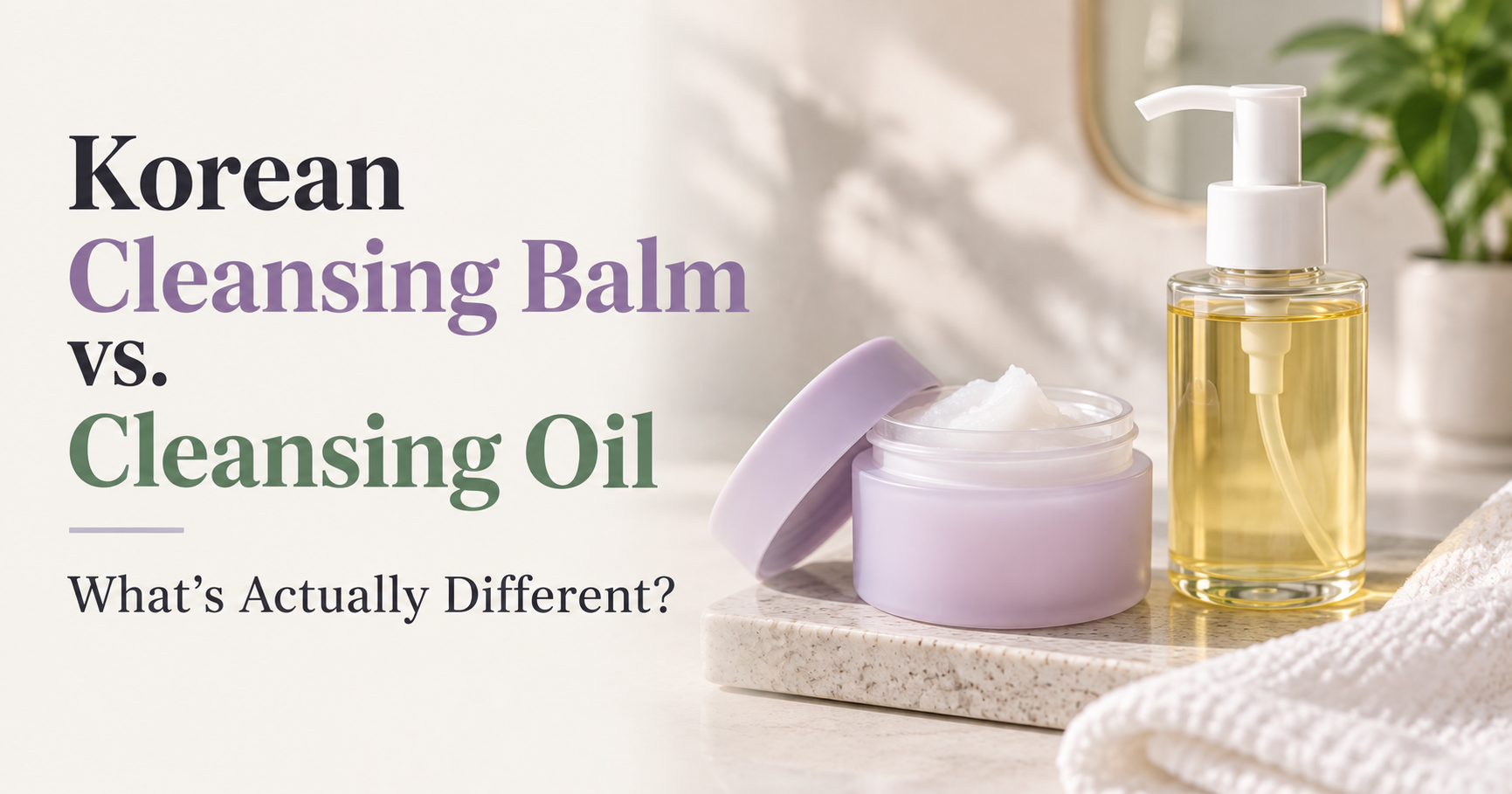
A cleansing oil starts as a liquid.
A cleansing balm starts solid or semi-solid and melts into an oil-like texture as you massage it over the skin.
But that texture difference does not automatically mean a balm cleans more deeply, an oil is better for oily skin, or one removes blackheads better than the other.
That distinction matters because K-beauty marketing often makes product categories sound more different than they really are.
The better question is not:
“Which one is more Korean?”
It is:
“Which format makes more sense for what I need to remove — and how I prefer to cleanse?”
The Short Answer
A Korean cleansing balm is generally an oil-based rinse-off cleanser with a solid or semi-solid texture that melts as you massage it onto dry skin.
A cleansing oil performs a similar job but begins as a liquid.
Both can use emollients and surfactants to help loosen and disperse makeup, sunscreen, sebum and other oil-soluble residue so they can be rinsed away.
The biggest practical differences are usually:
- texture
- packaging
- dispensing method
- how quickly the product spreads
- portability
- and personal preference
Not an automatic difference in cleansing power.
A well-formulated balm can remove long-wear makeup.
A well-formulated cleansing oil can too.
The complete formula matters more than whether the cleanser came from a pump or a jar.
What Is a Korean Cleansing Balm?
A cleansing balm looks more like a jar of solid skincare than a bottle of face wash.
At room temperature, it may have a sherbet-like, waxy, buttery or soft-solid texture.
You typically scoop a small amount onto dry hands and massage it over a dry face.
As it warms and spreads, the balm transforms into an oil-like layer.
Then comes an important step:
water.
For many cleansing balms, adding water helps the product emulsify into a milkier mixture that can be rinsed away.
BANILA CO Clean It Zero Cleansing Balm Original provides a clear example.
BANILA CO instructs users to scoop the balm with the included spatula, massage it onto dry skin, add water to emulsify, massage again and rinse with lukewarm water.
That process should sound familiar if you have used a cleansing oil.
Because mechanically, the two formats have a lot in common.
What Is a Cleansing Oil?
A cleansing oil begins as a liquid.
Instead of scooping product from a jar, you normally dispense it from a pump bottle.
You massage it over dry skin, then add water and rinse according to the individual product’s directions.
This is why cleansing oils are commonly associated with the first step of double cleansing.
But a cleansing oil is not simply ordinary facial oil used to wipe makeup away.
It is a formulated rinse-off cleanser.
The surfactant system helps oily material disperse when the product comes into contact with water.
If you want the deeper explanation of what a first cleanser can and cannot remove, read Korean Double Cleansing Explained — Sunscreen, Blackheads & Oily Skin.
That guide looks separately at sunscreen, makeup, blackheads and oily skin rather than treating double cleansing as a mandatory Korean ritual.
Korean Cleansing Balm vs. Cleansing Oil: The Real Difference
| Cleansing Balm | Cleansing Oil | |
|---|---|---|
| Starting texture | Solid or semi-solid | Liquid |
| Commonly used on dry skin | Yes | Yes |
| Can remove makeup | Yes | Yes |
| Can remove sunscreen | Yes | Yes |
| Can emulsify with water | Yes | Yes |
| Commonly used as a first cleanse | Yes | Yes |
| Typical packaging | Jar, tube or dispensing container | Pump bottle |
| May require a spatula | Often | Usually no |
| Automatically cleans better | No | No |
| Automatically better for oily skin | No | No |
| Automatically better for dry skin | No | No |
The amount of overlap is the point.
A Balm Is a Different Physical Format, Not a Different Cleansing Philosophy
The easiest way to understand a cleansing balm is to watch what happens after it touches the skin.
BANILA CO describes Clean It Zero Original as a balm that melts while removing makeup, and its instructions include emulsification with water before rinsing.
heimish provides another example.
Its All Clean Balm Mandarin is described as a balm-oil-milk transforming cleansing balm.
The brand instructs users to scoop the balm onto a dry face, allow it to melt, massage it over the areas being cleansed and wash it off with warm water.
That progression explains the category better than skin-type stereotypes do.
Balm → melts into an oil-like phase → rinses away
versus:
Oil → already liquid → emulsifies and rinses away
The starting format is different.
The cleansing objective is very similar.
Why Does a Cleansing Balm Melt?
The transformation can make cleansing balms seem technologically unrelated to cleansing oils.
But much of what you are experiencing is the physical structure of the formula.
A balm contains ingredients that allow it to remain solid or semi-solid in the container.
BANILA CO’s current Clean It Zero Original ingredient list, for example, includes emollients such as ethylhexyl palmitate and cetyl ethylhexanoate, emulsifying ingredients including PEG-20 glyceryl triisostearate and PEG-10 isostearate, and synthetic wax.
You can check the current formula on the official BANILA CO product page.
As the product is spread over the skin, that balm structure softens and becomes much more oil-like.
The important point is that this is not simply a jar of solid facial oil.
It is a formulated cleanser designed to spread, interact with makeup and oily residue, and then rinse away.
Does Cleansing Balm Remove Makeup Better?
Not automatically.
A balm can be very effective at removing makeup.
BANILA CO specifically positions Clean It Zero Original for removing stubborn face and eye makeup and recommends it as the first step in a double-cleansing routine.
But none of that establishes a general rule that:
balm > oil
for makeup removal.
A liquid cleansing oil can also be formulated for long-wear makeup and sunscreen.
Actual performance depends on the complete formula, what you are trying to remove, how much cleanser you use and whether you use it according to the directions.
So I would not choose a balm solely because someone says:
“Balms are for heavy makeup; oils are for light makeup.”
That is too simple.
Is Cleansing Oil Better for Oily Skin?
Not automatically.
This is one of the most persistent cleansing myths.
The word oil can make a cleansing oil sound wrong for oily skin.
Meanwhile, a solid balm may look richer and therefore seem more appropriate for dry skin.
But appearance is not enough to determine how a rinse-off cleanser will work for you.
BANILA CO, for example, sells a separate Clean It Zero Pore Clarifying Cleansing Balm positioned toward oily and combination skin.
That does not mean everyone with oily skin should use that product.
It demonstrates something more useful:
“Balm” describes a format, not a skin type.
Is Cleansing Balm Better for Dry Skin?
Again, not automatically.
Some people with dry skin may prefer the sensory experience of a balm.
Others may prefer a fluid cleansing oil.
Products within the balm category can also differ substantially.
BANILA CO’s current cleansing balm collection includes several formulas rather than one universal balm.
They are all cleansing balms.
They are not identical formulas.
That is why choosing between balm and oil using only:
dry skin = balm
oily skin = oil
misses too much information.
What About Blackheads?
This is where cleansing claims can become especially confusing.
Cleansing oils and balms can remove surface oil, makeup and other residue.
That is not the same thing as proving that they treat blackheads.
Blackheads are open comedones.
A cleanser may help remove oily material from the skin surface, but you should be cautious about turning that into a claim that a balm can permanently “pull out” or treat blackheads.
This is also why I would be skeptical of viral routines telling you to massage an oil cleanser or balm for a very long time until “grits” appear.
As explained in Korean Double Cleansing Explained, cleansing oil can have a legitimate role in removing persistent makeup or sunscreen without needing to be reframed as a blackhead treatment.
Do You Need to Massage a Cleansing Balm for 10 Minutes?
There is no universal 10-minute rule.
The official directions from the products checked for this article do not require an extended pore massage.
BANILA CO tells users to gently massage Clean It Zero on dry skin, add water, emulsify and rinse.
heimish similarly tells users to massage its melted All Clean Balm Mandarin over the areas they want to cleanse and wash it off.
Neither instruction turns cleansing into a 10- or 15-minute pore-extraction session.
If a product’s directions do not call for prolonged massage, there is no reason to assume dramatically increasing the massage time improves the result.
Especially if your skin becomes red or uncomfortable.
Emulsification Matters More Than a Viral Massage Routine
One of the most useful habits with many cleansing balms and oils is much less dramatic:
add water before fully rinsing.
BANILA CO explicitly instructs users to add water to emulsify Clean It Zero Original before rinsing.
A practical balm routine therefore looks like this:
- Start with dry hands and a dry face.
- Scoop the amount recommended by the product.
- Gently massage it over the areas you need to cleanse.
- Add a small amount of water if directed.
- Massage briefly as the texture changes.
- Rinse thoroughly.
- Use a second cleanser if your routine and the product call for one.
The goal is not to make the massage as long as possible.
It is to use the cleanser as it was formulated to be used.
Do You Have to Double Cleanse After a Cleansing Balm?
No universal rule says you do.
This is worth emphasizing because cleansing balms are so closely associated with Korean double cleansing.
BANILA CO positions Clean It Zero Original as a first step in a double-cleansing regimen.
heimish, on the other hand, says its All Clean Balm Mandarin can be used by people who want cleansing without having to double cleanse.
Those two official product directions alone demonstrate why the answer cannot be universal.
Whether you want a second cleanser can depend on:
- the individual balm
- what you were wearing
- how thoroughly the cleanser rinses
- your skin
- and the manufacturer’s directions
Double cleansing is a method.
It is not a rule that automatically activates because the first product came from Korea.
For the full explanation, see Korean Double Cleansing Explained — Sunscreen, Blackheads & Oily Skin.
What About Sunscreen?
This is another area where rigid rules cause problems.
You will often hear:
“If you wear sunscreen, you must double cleanse.”
That is too absolute.
Sunscreen formulations differ.
Water resistance differs.
The amount applied differs.
Your cleanser differs.
If you wore long-wear or water-resistant sunscreen plus makeup, an oil-based first cleanser may be useful.
If you wore an easier-to-remove product and your regular cleanser removes it adequately, your needs may be different.
The useful question is not whether the word sunscreen automatically triggers a two-cleanser routine.
It is whether your cleansing method adequately removes what you actually wore.
How Does This Fit Into Korean Cleansing?
This is where Korean retail evidence becomes useful.
When I checked Olive Young Korea’s overall cleansing sales ranking for Best Korean Cleanser? What Olive Young Actually Ranks, the ranking was not simply a list of ten face washes.
It included multiple cleansing formats, including foam cleanser, cleansing milk, micellar water, cleansing oil and a cream-to-oil cleanser.
That is important because it shows how broad the Korean cleansing market actually is.
There is no single product format that defines “Korean cleansing.”
A Korean shopper may encounter:
- foam and gel cleansers
- cleansing oils and balms
- cleansing waters and milks
- lip and eye removers
- pads and other cleansing formats
So cleansing balm should be understood as one option inside a much larger category.
Cleansing Balm Is Not the “Advanced” Version of Cleansing Oil
K-beauty categories are often presented as ladders.
Basic cleanser.
Then cleansing oil.
Then perhaps cleansing balm as the richer or more sophisticated option.
That is not a useful hierarchy.
A balm is not an upgraded cleansing oil.
And an oil is not a beginner version of a balm.
They are alternative formats.
The same mistake appears elsewhere in skincare when consumers assume:
essence < serum < ampoule
or
moisturizer < night cream < sleeping pack
as if the product name itself establishes potency.
It does not.
With cleansing balm and cleansing oil, the physical difference is obvious.
One starts solid.
One starts liquid.
Beyond that, compare the individual formulations.
What Does Korea’s Cleansing-Oil Ranking Show?
There is another useful piece of context.
If you already know that you prefer a liquid cleansing oil, there is little reason to compare it against every cleansing balm on the market.
The more useful comparison is oil versus oil.
I did that separately in Which Korean Cleansing Oils Rank Above Anua?.
In the Hwahae cleansing-oil ranking checked for that article, Anua’s internationally famous Heartleaf Pore Control Cleansing Oil was not No. 1; six oils ranked above it in the August 20, 2026 snapshot.
That illustrates another important Picked in Korea principle:
First decide which category actually fits your routine.
Then compare products within that category.
Otherwise you end up comparing products designed around different formats and preferences.
Is BANILA CO Still Relevant?
Yes, as an example of the Korean cleansing-balm format.
BANILA CO’s Clean It Zero collection remains an active cleansing-balm range with multiple formulas and formats.
But there is an important distinction.
International brand claims, retailer rankings and Korean consumer behavior are three different kinds of evidence.
A brand calling a product its bestseller tells us something about that brand.
A Korean retailer ranking tells us something about sales on that retailer at a particular time.
Neither alone proves what all Korean consumers use.
That is why this article uses BANILA CO primarily to explain how the balm format works, rather than claiming one balm represents all Korean cleansing habits.
What About heimish?
heimish is useful because the brand sells multiple cleansing formats.
Its cleansing collection includes All Clean Balm products as well as cleansing oil.
That is another reminder that brands do not necessarily treat balm and oil as competing philosophies.
A company can sell both.
The consumer chooses the format and formula that make sense for their routine.
Cleansing Balm vs. Cleansing Oil for Travel
Here, balm has a practical advantage for many people.
A traditional cleansing balm is solid or semi-solid.
That means there is no free-flowing bottle of oil that can accidentally pump into your bag.
BANILA CO even sells a Clean It Zero Original Cleansing Balm Travel Kit.
Traditional balm jars do create another inconvenience:
you may need a spatula.
So this is not about one format being universally better.
It is a trade-off.
Oil: convenient pump, fluid texture.
Balm: compact solid format, but often requires scooping.
Which Is Faster: Balm or Oil?
For many users, cleansing oil has the simpler dispensing system.
Pump.
Massage.
Emulsify.
Rinse.
A traditional balm adds another small action:
open the jar and scoop out the product.
But speed is a personal-use issue, not a skincare-performance rule.
Someone who dislikes oil running between their fingers may find balm easier.
Someone who wants the fastest pump-and-go first cleanse may prefer oil.
Which One Should You Choose?
I would make the decision based on how you actually cleanse rather than skin-type stereotypes.
Choose a cleansing balm if:
You prefer a solid texture.
You dislike runny cleansing oils.
You travel frequently.
You enjoy the balm-to-oil sensory experience.
You prefer jar or solid-format packaging.
Choose a cleansing oil if:
You prefer pump packaging.
You want the cleanser to spread immediately.
You do not want to use a spatula.
You prefer a thinner texture.
You want quick dispensing.
Either format can make sense if:
You wear makeup.
You need help removing harder-to-remove sunscreen.
You prefer an oil-based first cleanser.
You sometimes double cleanse.
The category name alone does not decide which product is better for you.
What Do Koreans Actually Prefer: Balm or Oil?
This is where I would avoid making a claim that the available evidence cannot support.
Both cleansing oil and cleansing balm are established parts of Korean beauty.
Korean retailer data and Korean ranking platforms provide useful snapshots of products and categories.
But that is not the same as a nationwide survey asking every Korean consumer whether they prefer balm or oil.
So I would not claim:
“Koreans prefer cleansing oil.”
or:
“Korean women use cleansing balm more.”
without appropriate population-level evidence.
What we can say is narrower and more defensible:
Both formats are established in the Korean cleansing market, and Korean beauty brands continue to sell both.
That is enough.
Korean Cleansing Balm FAQ
What is a Korean cleansing balm?
A Korean cleansing balm is generally an oil-based rinse-off cleanser that begins as a solid or semi-solid product and melts into an oil-like texture as it is massaged over the skin.
Is cleansing balm the same as cleansing oil?
Not exactly, but the two formats can perform very similar jobs.
The most obvious difference is physical form: cleansing oil begins liquid, while cleansing balm begins solid or semi-solid and melts during use.
Is cleansing balm better than cleansing oil?
Not universally.
The formulation, what you need to remove and your texture preference matter more than the category name.
Does cleansing balm remove waterproof makeup?
Some cleansing balms are specifically formulated and marketed for stubborn makeup.
BANILA CO, for example, says Clean It Zero Original removes stubborn face and eye makeup.
That does not mean every cleansing balm performs identically.
Do I use cleansing balm on wet or dry skin?
Many Korean cleansing balms are designed to be applied to dry skin with dry hands.
BANILA CO and heimish both instruct users to begin with dry skin for the products referenced in this article.
Always check the instructions for your specific product.
Do I need to emulsify cleansing balm?
For products such as BANILA CO Clean It Zero Original, yes.
BANILA CO explicitly instructs users to add water to emulsify before rinsing.
Follow the directions for your individual balm.
Does cleansing balm remove blackheads?
A cleansing balm can remove makeup, surface oil and residue.
That is not the same thing as demonstrating that it treats blackheads.
Be cautious with exaggerated pore-cleansing or “grit” claims.
Is cleansing balm good for oily skin?
It can be.
“Balm” describes the cleanser’s physical format, not the skin type it is allowed to be used on.
Individual formulations differ.
Do I need a foam cleanser after cleansing balm?
Not automatically.
Some brands position their balm as the first step of double cleansing, while others say their balm can be used without a second cleanse.
Follow the directions for your product and consider what you were trying to remove.
Is cleansing balm more Korean than cleansing oil?
No.
Both are established K-beauty cleansing formats.
If you specifically want to compare Korean cleansing oils, see Which Korean Cleansing Oils Rank Above Anua?.
The Bottom Line
Korean cleansing balm and cleansing oil are much more similar than they first appear.
Both can remove makeup and sunscreen.
Both can be used as oil-based first cleansers.
Both can be formulated to emulsify and rinse with water.
And neither format is automatically superior.
The biggest difference is usually the one you can see immediately:
Oil starts liquid.
Balm starts solid or semi-solid.
BANILA CO’s current Clean It Zero Original demonstrates the classic balm process: scoop the solid balm, massage it over dry skin, add water to emulsify and rinse.
heimish’s All Clean Balm Mandarin similarly transforms from balm to oil during cleansing, while the same brand also sells other cleansing formats.
So I would not choose between the two by asking:
“Which one cleans deeper?”
or:
“Which one is more Korean?”
Start with something simpler:
Do I prefer a pumpable liquid or a solid cleanser that melts as I massage it?
Then compare the actual formulas and directions.
That is usually the difference that matters.
Sources & Further Reading
BANILA CO — Clean It Zero Cleansing Balm Original
BANILA CO — Clean It Zero Pore Clarifying Cleansing Balm
heimish — All Clean Balm Mandarin
heimish — Cleansing Collection
Picked in Korea — Korean Double Cleansing Explained
Picked in Korea — Which Korean Cleansing Oils Rank Above Anua?
Picked in Korea — Best Korean Cleanser? What Olive Young Actually Ranks