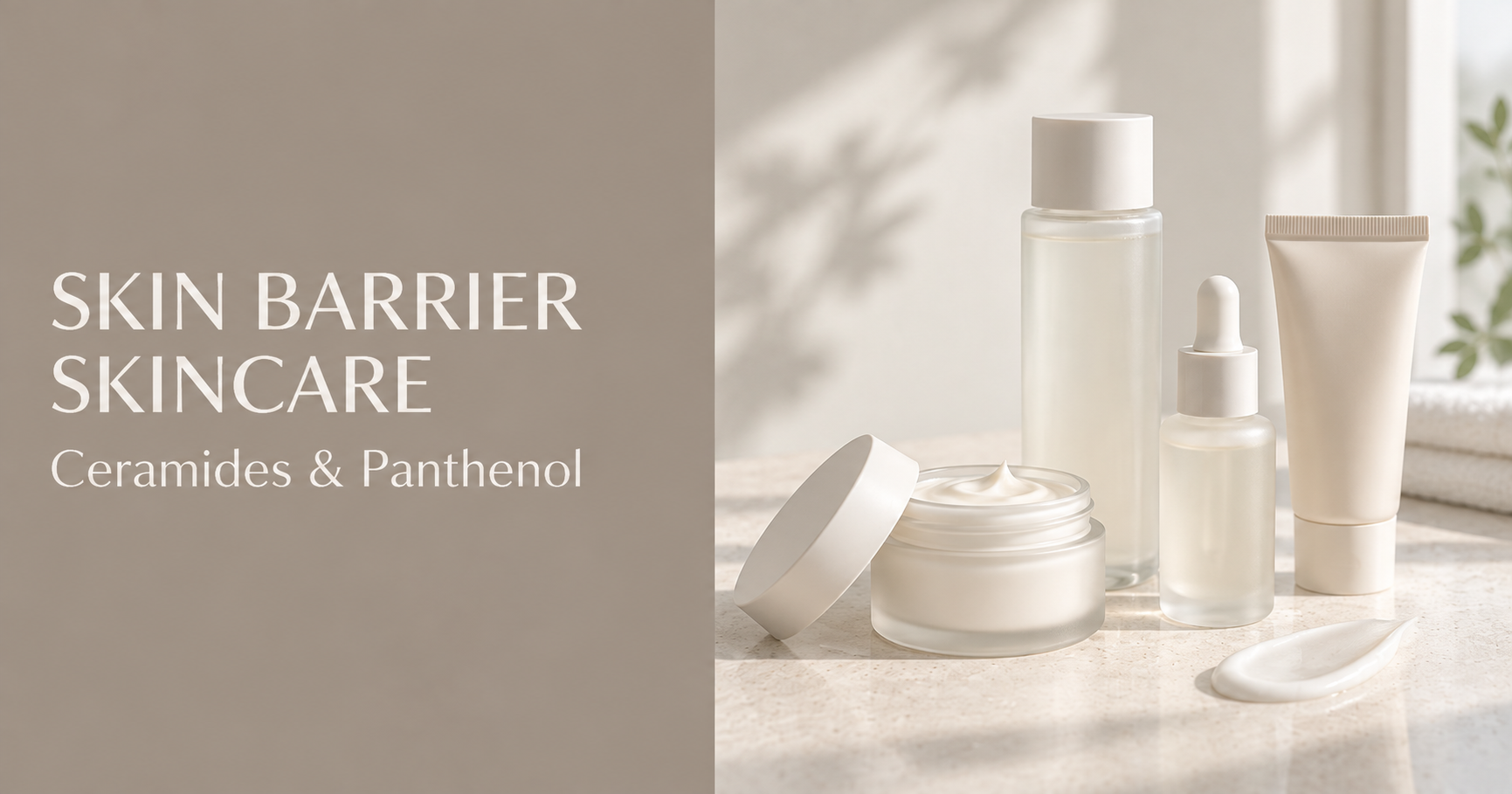
Korean skin barrier skincare is everywhere right now.
Barrier cream.
Ceramide toner.
Panthenol ampoule.
Cica barrier serum.
“Skin barrier repair” moisturizer.
Walk through a Korean beauty store and you will see 장벽 — jangbyeok, meaning barrier — across products in almost every skincare category.
But “barrier skincare” can become just as vague as any other beauty trend.
Does your skin barrier actually need repairing?
Are ceramides always better than an ordinary moisturizer?
Is panthenol doing the same job as Cica?
And does a product become more effective simply because the word BARRIER is printed across the front?
The short answer:
The skin barrier is real, and ingredients such as ceramides and panthenol have legitimate roles in skincare. But “barrier repair” is a broad product claim and marketing category, not one standardized Korean formula.
A useful barrier-focused routine is usually less about collecting every ingredient associated with sensitive skin and more about reducing unnecessary irritation while using products that help the outer layer of the skin retain water and function normally.
Here is what that actually means.
What Is the Skin Barrier?
When skincare brands talk about the skin barrier, they are usually referring primarily to the stratum corneum, the outermost layer of the epidermis.
You may have heard it described using the “bricks and mortar” model.
The bricks are corneocytes — flattened cells in the outermost skin layer.
The mortar is the lipid material between them.
Three important lipid groups in the stratum corneum are:
- ceramides
- cholesterol
- free fatty acids
These lipids help form organized structures between corneocytes and contribute to the skin’s ability to limit excessive water loss and protect against penetration from the outside environment.
A 2024 scientific review describes ceramides as important components of these intercellular lipids, functioning together with cholesterol and free fatty acids in the skin barrier.
Read the 2024 ceramide review on PubMed
That is the scientific foundation behind much of the modern “barrier skincare” category.
The marketing version, however, often becomes much simpler:
Dry? Damaged barrier.
Red? Damaged barrier.
Stinging? Damaged barrier.
Breaking out? Damaged barrier.
Reality is more complicated.
What Does a “Damaged Skin Barrier” Actually Mean?
“Damaged skin barrier” is useful skincare language, but it is not one precise medical diagnosis.
People often use the phrase when their skin becomes:
- unusually dry
- tight
- flaky
- more sensitive than usual
- uncomfortable after cleansing
- prone to stinging when products are applied
Those experiences can occur when barrier function is impaired.
But they can also happen for other reasons.
Persistent redness, itching, scaling, swelling or burning can be associated with dermatologic conditions rather than simply an overcomplicated skincare routine.
That distinction matters.
I would therefore treat “my skin barrier may be irritated” as a useful reason to simplify a routine — not as a self-diagnosis that explains every skin problem.
Why Skin Barrier Skincare Fits Korean Beauty So Well
Korean skincare has long used concepts such as:
진정 — soothing
보습 — moisturization
수분 — hydration
장벽 — barrier
These ideas overlap.
That is why one Korean moisturizer may contain several ingredient groups at once:
ceramides for barrier-focused positioning,
panthenol for moisturizing and conditioning,
Centella-derived ingredients for soothing-focused formulas,
glycerin for hydration,
and emollient or occlusive ingredients to help reduce water loss.
Then the entire product may simply be marketed as a:
barrier cream.
That does not mean every Korean barrier cream uses the same formula.
It means the finished product has been positioned around supporting dry, sensitive or easily irritated-feeling skin.
Ceramides: The Most Literal Barrier-Related Ingredient
If there is one ingredient family most directly associated with the lipid structure of the stratum corneum, it is ceramides.
Ceramides are naturally present in human skin.
Together with cholesterol and free fatty acids, they form part of the intercellular lipid matrix of the stratum corneum.
A 2024 review in the International Journal of Cosmetic Science specifically notes that properly formulated ceramides can be relevant to products intended to support impaired skin-barrier function.
But the same review makes an important point that beauty marketing often ignores:
Formulation matters.
Simply putting ceramides into a cosmetic does not tell us everything about how the finished product will perform.
Read the ceramide formulation review on PubMed
The American Academy of Dermatology also includes ceramides among ingredients consumers can look for when choosing moisturizers for dry skin.
American Academy of Dermatology: How to Choose a Moisturizer
So ceramides make sense in barrier-focused skincare.
What does not make sense is shopping like this:
Product A has three ceramides.
Product B lists five ceramides.
Therefore Product B must be better.
The full formula matters more than simply counting ceramide names.
Why Ceramides Are So Visible in Korean Skincare
Ceramides are no longer restricted to thick creams.
They now appear in:
- toners
- lotions
- serums
- masks
- creams
- cleansers
One useful example appears in current Korean toner rankings.
When I examined Hwahae’s Korean toner ranking, TONYMOLY Wonder Ceramide Mochi Toner ranked No. 1 in the overall toner snapshot.
That does not prove ceramides are Korea’s favorite skincare ingredient.
A ranking is not a national survey.
But it does show how mainstream ceramide-focused positioning has become in Korean beauty.
I analyzed that ranking in more detail here:
Best Korean Toner? What Korean Rankings Actually Show
The interesting point is that the product is not marketed as a specialized clinical treatment.
It is a large everyday toner.
Barrier language has moved well beyond barrier creams.
Panthenol: Different From Ceramide, But Still Relevant
Panthenol is another ingredient that appears constantly in Korean barrier-focused skincare.
Panthenol is related to vitamin B5 and is commonly used in cosmetics as a moisturizing and skin-conditioning ingredient.
There is also clinical research behind its use.
In a randomized, double-blind study, seven days of topical dexpanthenol treatment increased stratum-corneum hydration and reduced transepidermal water loss, or TEWL, compared with the vehicle control.
Read the dexpanthenol study on PubMed
A separate randomized study evaluating a panthenol-containing emollient also reported improvements in hydration and barrier-related measurements.
Read the panthenol emollient study on PubMed
There is an important limitation, though.
These studies evaluate specific formulations.
They do not prove that every product containing panthenol will produce identical results.
That is a distinction worth keeping throughout skincare research:
Evidence for an ingredient does not automatically become evidence for every finished product containing that ingredient.
Panthenol Is Not the Same as Ceramide
Ceramides and panthenol frequently appear together in Korean barrier products.
They are not interchangeable.
Ceramides are lipids naturally present in the stratum corneum.
Panthenol is a cosmetic ingredient used primarily for moisturizing, conditioning and barrier-support applications.
So a cream containing both is not necessarily duplicating the same ingredient.
They belong to different ingredient categories.
The same distinction becomes even more important once Cica enters the formula.
Is Cica a Skin Barrier Ingredient?
Cica is often placed in the same Korean skincare conversation as ceramides and panthenol.
But Cica is different.
In Korean beauty, Cica is commonly associated with Centella asiatica and ingredients derived from it.
You may see:
- Centella Asiatica Extract
- Madecassoside
- Asiaticoside
- Madecassic Acid
- Asiatic Acid
Those are not ceramides.
And “Cica” itself is not one standardized molecule.
Korean brands frequently combine Cica ingredients with panthenol, ceramides and humectants in products positioned for irritated or sensitive-feeling skin.
That creates a lot of overlap in marketing.
But the ingredient names still mean different things.
Cica ≠ ceramide
Madecassoside ≠ panthenol
Barrier cream ≠ automatically Cica cream
I explain that distinction in detail here:
What Is Cica in Korean Skincare? Why It’s Everywhere in Korea
Understanding that difference makes it easier to read Korean skincare labels instead of treating every “soothing barrier” product as essentially the same formula.
What About Hyaluronic Acid?
Hyaluronic acid is another ingredient frequently included in barrier-focused routines.
But it is more useful to think of it as primarily hydration-focused.
Humectants such as hyaluronic acid and glycerin help increase water availability in the outer layers of the skin.
That can be useful when skin feels dry or dehydrated.
But:
hydrating ingredient ≠ skin-barrier lipid
This is why a well-designed moisturizer often uses several ingredient types.
For example:
Humectants
Glycerin, hyaluronic acid and similar ingredients help support hydration.
Emollients
These help soften and smooth the skin.
Occlusive ingredients
These help reduce water evaporation.
Barrier-related lipids
Ceramides and other lipids may be incorporated into barrier-focused formulas.
Instead of asking which single hero ingredient is best, it usually makes more sense to ask how the entire formula is built.
Barrier Cream vs. Regular Moisturizer: Is There Really a Difference?
Sometimes.
But perhaps not as much as the product names suggest.
“Barrier cream” is generally a positioning term rather than one completely separate cosmetic category with a mandatory formula.
A perfectly ordinary moisturizer may already contain:
- glycerin
- fatty alcohols
- emollients
- occlusive ingredients
- ceramides
- panthenol
In other words, a moisturizer can already perform the job someone expects from a “barrier cream.”
That is why I would not automatically replace a moisturizer that already works because another product puts BARRIER in larger letters on the box.
The more useful questions are:
Does your current moisturizer keep your skin comfortable?
Does your skin remain dry shortly after applying it?
Is the texture appropriate for your skin type and climate?
Does it sting?
Are you using irritating products more frequently than your skin tolerates them?
Function matters more than the name of the category.
What Korean Moisturizer Rankings Show
Barrier-focused moisturizers are firmly established in Korea.
When I compared Korean cream rankings, Aestura Atobarrier365 Cream held the No. 1 position in both the overall cream and moisturizing-cream rankings in the snapshot I examined.
That does not prove that Aestura is objectively the best moisturizer.
Rankings can be influenced by category definitions, promotional sets, platform merchandising and the exact SKU being sold.
That is why I analyzed the ranking instead of simply turning it into a bestseller list.
You can see the full comparison here:
7 Korean Moisturizers Koreans Actually Use in 2026
The important takeaway for this article is simpler:
Barrier-focused creams are not a niche Korean skincare trend. They are part of the mainstream moisturizer market.
What Is TEWL?
Research about the skin barrier often uses the abbreviation:
TEWL — transepidermal water loss.
TEWL refers to water passing through the epidermis and evaporating from the skin surface.
Researchers use it as one measurement related to skin-barrier function.
This is why studies of moisturizers and barrier-support formulations often measure both:
- stratum-corneum hydration
- TEWL
But consumers should be careful not to turn TEWL into another DIY diagnosis.
You cannot reliably look at your face in a mirror and calculate your transepidermal water loss.
Research measurements help scientists compare skin conditions and interventions under controlled conditions.
They are not a number most people need to monitor at home.
Can You Repair Your Skin Barrier Overnight?
This is where skincare marketing can become misleading.
A moisturizer can make dry skin feel more comfortable quickly.
Occlusive ingredients can also help reduce water loss after application.
But that is not the same thing as saying one sleeping mask completely “rebuilds” an impaired skin barrier overnight.
A more realistic goal is:
reduce unnecessary irritation, maintain hydration and give the skin time to recover.
It is less dramatic than an overnight transformation claim.
It is also a more useful expectation.
The Biggest Barrier-Skincare Mistake: Adding Too Much
This is where K-beauty can become self-defeating.
Someone decides their skin barrier feels irritated.
So they buy:
a barrier toner,
Cica pads,
a panthenol serum,
a ceramide ampoule,
a probiotic essence,
a barrier cream,
and a sleeping mask.
Now their “simple barrier routine” contains seven new products.
If the skin becomes more irritated, which one caused the problem?
There is no easy way to know.
The more useful strategy is often the opposite:
simplify first.
That fits the broader point I made in my guide to Korean skincare routines:
What a Korean Skincare Routine Actually Looks Like in 2026
Korean beauty offers an unusually large number of product categories.
That does not mean healthy skin requires using all of them.
A Simple Korean Skin Barrier Skincare Routine
There is no universal barrier routine.
But if my skin suddenly felt unusually dry or irritated after over-exfoliation, frequent retinoid use or too many new products, I would start by simplifying.
Morning
1. Gentle cleansing — if needed
Not everyone needs a strong cleanser every morning.
If your skin feels dry or tight after cleansing, reassess the cleanser and frequency rather than assuming more skincare is the answer.
2. Moisturizer
This is where I would put most of the attention.
If you want a barrier-focused formula, ingredients worth considering include:
- ceramides
- panthenol
- glycerin
- emollient lipids
But again:
judge the complete moisturizer, not the number of barrier buzzwords on the packaging.
3. Sunscreen
Sunscreen remains an important daytime skincare step regardless of whether your moisturizer is marketed as a barrier cream.
Choose one you can apply consistently and in an adequate amount.
Night
1. Remove what actually needs removing
If you wore makeup or difficult-to-remove sunscreen, an oil cleanser or cleansing balm may be useful.
But double cleansing does not need to be an automatic ritual performed simply because the routine is Korean.
The relevant question is what you need to remove.
I covered this separately here:
Korean Double Cleansing: What an Oil Cleanser Actually Removes
2. Optional hydration
A toner, essence or serum can stay in the routine if it already works for you and does not cause discomfort.
It is optional.
There is no barrier-health rule requiring toner.
3. Moisturizer
For many people, this is the core of a simplified night routine.
If the skin feels very dry, a richer cream may be more comfortable than a lightweight gel.
And then stop.
You do not automatically need a fourth, fifth and sixth product because the category exists.
What Should You Temporarily Reassess?
If irritation began after changing your skincare routine, look first at products with greater irritation potential or products you have recently introduced.
Depending on the person, that may include:
- exfoliating acids
- physical scrubs
- retinoids
- aggressive cleansing
- multiple active ingredients introduced together
That does not make those products inherently bad.
Retinoids, for example, have well-established uses in skincare and dermatology.
The question is whether the product, concentration and frequency are appropriate for your skin.
Korea also has its own regulatory framework for wrinkle-improvement functional cosmetics, which I examined here:
Korean Retinol: What Korea Actually Recognizes for Wrinkle Claims
Barrier care should not become an excuse to label every active ingredient harmful.
It is about using products at a level your skin tolerates.
Do You Need a Toner for Skin Barrier Support?
No.
This is particularly worth mentioning on a Korean skincare site because toners are so visible in K-beauty.
A toner can:
- add hydration
- contain ceramides
- contain panthenol
- include soothing ingredients
- simply feel pleasant to use
But none of those things make toner physiologically mandatory.
The same applies to:
- essence
- ampoule
- serum
- toner pads
- sheet masks
Those are product formats.
They are not mandatory biological steps.
Does More Ceramide Mean Better Skin-Barrier Support?
Not necessarily.
Consumers usually do not have enough information from the ingredient list alone to make that conclusion.
An ingredient list may tell you that a ceramide is present.
It generally cannot tell you everything about:
- exact concentration
- lipid organization
- manufacturing process
- delivery within the formulation
- comparative clinical performance
The scientific literature on ceramides is actually a good reason not to oversimplify them.
The 2024 review cited earlier specifically discusses the importance of how ceramides are incorporated into the final formulation.
PubMed: Ceramides and Skin Barrier Formulation
So I would not choose between two creams simply by counting how many versions of “Ceramide” appear in the INCI list.
Is Panthenol Always Safe for Sensitive Skin?
Panthenol is widely used and generally considered well tolerated in cosmetics.
But no cosmetic ingredient is guaranteed to suit every person.
A review published in Dermatitis discusses documented cases of allergic contact reactions to panthenol, while noting that contact allergy has historically been uncommon.
Read the panthenol contact-allergy review on PubMed
That does not make panthenol an ingredient most people need to avoid.
It illustrates a broader point:
“Barrier ingredient” does not mean “an ingredient that can never cause a reaction.”
If a product repeatedly causes itching, swelling, burning or a rash, a soothing label is not a reason to keep using it.
When Another Barrier Cream Is Not the Answer
Cosmetics can help support ordinary skincare.
But there is a point where buying another moisturizer is not the best next step.
If you have persistent or significant:
- itching
- cracking
- swelling
- weeping
- pain
- rash
- severe redness
- worsening symptoms despite simplifying your routine
consider seeking professional medical evaluation.
The American Academy of Dermatology notes that excessively dry skin can sometimes be associated with underlying conditions such as atopic dermatitis, ichthyosis or psoriasis.
AAD: Dry Skin — Diagnosis and Treatment
A trendy “barrier cream” should not be treated as a substitute for evaluation when symptoms are persistent or severe.
How to Shop for Korean Barrier Skincare
If I were standing in a Korean beauty store, I would use a simple checklist.
Step 1: Read the Front — Then Ignore It for a Moment
Words such as:
Barrier
Cica
Derma
Repair
Ceramide
tell you how the product is positioned.
They do not tell you everything about the formula.
Step 2: Check the Ingredient List
If you are looking specifically for ceramides, check the INCI list for names beginning with Ceramide.
For panthenol, look for:
Panthenol
For Centella-related products, you may see:
Centella Asiatica Extract
Madecassoside
Asiaticoside
If reading Korean packaging is difficult, I have a separate guide explaining the terms that matter most:
How to Read a Korean Skincare Label: Expiration Dates, Ingredients & What’s Required
Step 3: Evaluate the Whole Moisturizer
Ask:
Does it contain useful humectants?
Does it include emollient ingredients?
Is the texture appropriate for your skin?
Is it rich enough — or too rich?
Will you actually use it consistently?
Those questions are usually more useful than whether the product advertises three, five or seven “barrier ingredients.”
Step 4: Introduce One Product at a Time
This is especially useful if your skin already feels reactive.
If you replace an entire routine at once, you lose the ability to tell which product helped — or which product caused a problem.
FAQ
What is Korean skin barrier skincare?
Korean skin barrier skincare broadly refers to products and routines marketed around hydration, moisturization and supporting the outer skin barrier. Common ingredients include ceramides, panthenol, glycerin and, in some products, Centella-derived ingredients.
What is the Korean word for skin barrier?
The common Korean expression is:
피부 장벽
피부 means skin.
장벽 means barrier.
You may also see phrases such as 피부 장벽 강화, referring to strengthening or supporting the skin barrier in cosmetic marketing.
Are ceramides good for the skin barrier?
Ceramides are natural components of the stratum corneum’s intercellular lipid matrix and play an important structural role alongside cholesterol and free fatty acids. Proper formulation matters, so the presence of ceramides alone does not establish how well a finished product performs.
PubMed: The Role of Ceramides in Skin Barrier Function
Is panthenol good for the skin barrier?
Studies of specific dexpanthenol- and panthenol-containing formulations have reported improvements in stratum-corneum hydration and TEWL measurements.
That supports panthenol’s use in moisturizing and barrier-focused formulas, but it does not mean every panthenol cosmetic will perform identically.
PubMed: Topical Dexpanthenol and Barrier Function
Is Cica the same as ceramide?
No.
Cica is a skincare term associated primarily with Centella asiatica and ingredients derived from it.
Ceramides are a family of lipids found naturally in the stratum corneum.
They may appear in the same product, but they are not the same ingredient.
Do I need ceramide, panthenol and Cica together?
No.
There is no requirement to combine all three.
A well-formulated moisturizer may work very well for your skin without containing every popular barrier-related ingredient.
Is a barrier cream different from a moisturizer?
Sometimes, but not always dramatically.
“Barrier cream” generally describes product positioning rather than one standardized formula.
Many regular moisturizers already contain humectants, emollients, occlusive ingredients and barrier-related lipids.
Do I need a separate barrier serum?
No.
If your moisturizer already meets your skin’s needs, a separate barrier serum is optional.
Add another product only if it has a clear purpose in your routine.
Can I repair my skin barrier overnight?
A moisturizer can improve hydration and comfort quickly, but biological recovery from irritation or barrier disruption should not be reduced to an overnight marketing promise.
How long recovery takes depends on the cause and severity of the problem.
What should I stop using if my skin barrier feels irritated?
There is no universal stop list.
If irritation began after changing your routine, first reassess newly introduced or potentially irritating products such as strong exfoliants, retinoids, scrubs or aggressive cleansers.
Persistent or severe symptoms warrant professional evaluation.
The Bottom Line
Korean skin barrier skincare is not one ingredient.
And it is not one product.
The skin barrier itself is real.
Ceramides are real components of the stratum corneum.
Panthenol has research supporting its use in moisturizing and barrier-support formulations.
Cica and Centella-derived ingredients belong to a different but frequently overlapping soothing category.
But none of that means you need:
a ceramide toner,
a panthenol ampoule,
a Cica serum,
a barrier cream,
and a sleeping mask
all in one routine.
The more useful lesson is simpler.
Use enough skincare to keep your skin comfortable without making the routine itself a source of unnecessary irritation.
Cleanse according to what actually needs removing.
Use a moisturizer suited to your skin.
Protect your skin from UV exposure.
Introduce stronger products gradually.
And add extra steps only when they have a clear purpose.
Because when it comes to the skin barrier, a longer ingredient list is not automatically a stronger barrier.
Sometimes the most sensible Korean skincare routine is also the simplest one.
Sources
- The role of ceramides in skin barrier function and the importance of their correct formulation for skincare applications.
PubMed - Effect of topically applied dexpanthenol on epidermal barrier function and stratum corneum hydration.
PubMed - A new topical panthenol-containing emollient: Results from two randomized controlled studies assessing its skin moisturization and barrier restoration potential.
PubMed - How to pick the right moisturizer for your skin.
American Academy of Dermatology - Dry skin: Diagnosis and treatment.
American Academy of Dermatology - Panthenol Allergic Contact Dermatitis: Sources of Exposure, Reported Cases, and a Call for More Frequent Testing.
PubMed