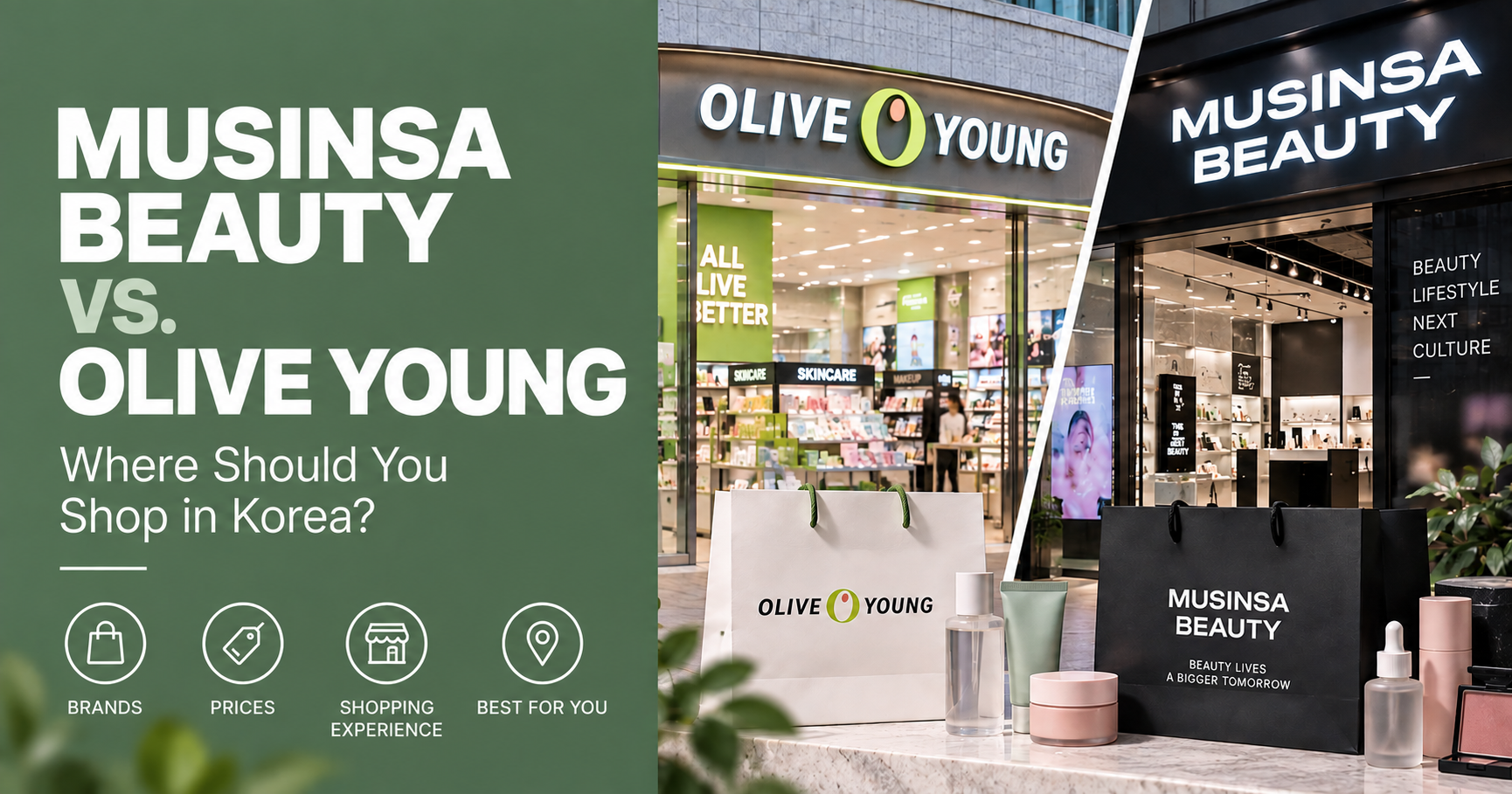
MUSINSA Beauty vs Olive Young is becoming a more useful K-beauty shopping comparison in Korea in 2026.
For international visitors, Korean beauty shopping has long had one obvious destination: Olive Young.
It remains one of the easiest places to compare skincare, makeup, hair care, body care, and many of the Korean brands already familiar overseas.
But Korea’s beauty retail landscape is widening.
MUSINSA, best known for fashion, has been investing heavily in beauty and moving its beauty curation from online and pop-ups toward permanent offline retail.
The important point is that MUSINSA Beauty is not simply another Olive Young.
The two retailers come from different backgrounds and organize beauty differently.
Olive Young is built around broad health-and-beauty shopping. MUSINSA Beauty is explicitly building its identity around curation and the fusion of fashion and beauty.
So if you are visiting Korea, which one should you visit?
The answer depends less on which retailer is “better” and more on what kind of shopping you want to do.
The Short Answer
Choose Olive Young when you want a broad, efficient overview of mainstream Korean beauty categories and an easy way to compare many products in one place.
Add MUSINSA Beauty when you want a more fashion-connected view of Korean beauty, including curated brands, collaborations, fragrance, emerging labels, and the Seongsu beauty scene.
If you have time, the most informative approach is not choosing one over the other.
It is understanding what each retailer shows you about the Korean market.
What Is MUSINSA Beauty?
MUSINSA developed its reputation through fashion, and that background matters to its beauty strategy.
The company describes MUSINSA Beauty as a beauty curation service and says it is strengthening a value proposition centered on the fusion of fashion and beauty.
In January 2026, MUSINSA announced that its first permanent offline MUSINSA Beauty store would open in the second quarter inside MUSINSA Megastore Seongsu in Seoul.
The company said the space would be divided into categories including makeup, skincare, and fragrance, with exhibition content built around fashion-beauty collaborations.
MUSINSA also said approximately 800 beauty brands were expected to be featured at Megastore Seongsu, curated from domestic and international indie brands aligned with its “Next Beauty” strategy.
MUSINSA Beauty Is Growing, but Read the Numbers Carefully
MUSINSA reported that its beauty business grew by more than 50% year over year in 2025.
It also reported that transaction value for four in-house beauty brands increased by 120% year over year.
Those are useful signals of momentum, but they are company-reported platform figures.
They should not be read as growth rates for the entire Korean beauty market.
The more defensible conclusion is narrower:
Beauty has become important enough to MUSINSA that the company is expanding offline, investing in brand development, and making beauty part of its broader fashion-and-lifestyle ecosystem.
Olive Young Is Operating at a Different Scale
Olive Young plays a much broader role in Korean beauty retail and has also become a major shopping channel for international visitors.
CJ Olive Young reported that by August 2026, cumulative spending by international customers at its Korean offline stores had exceeded KRW 1 trillion.
From January through August, it recorded 11.01 million international-customer transactions.
The share of Korean offline-store sales generated by international customers rose from:
2% in 2022
to
33% in August 2026.
The most popular categories among those customers were skincare, color cosmetics, and hair care.
That is an important piece of context whenever an Olive Young ranking is described as a simple measure of “what Koreans buy.”
Olive Young remains a Korean retailer, but its offline sales increasingly reflect both Korean residents and international visitors.
The Biggest Difference: Broad Comparison vs. Fashion-Connected Curation
The simplest way to compare the two retailers is to look at what they are designed to help you discover.
Olive Young is especially useful when you start with a category or concern:
sunscreen
cleanser
toner
serum
moisturizer
hair treatment
lip tint
or body care.
Its strength is breadth and category comparison.
MUSINSA Beauty’s stated strategy places more emphasis on curation, fashion-beauty collaboration, exclusive content, and brand discovery.
That makes it particularly interesting if your question is not just:
“Which moisturizer should I buy?”
but:
“Which brands and aesthetics are emerging around Korean fashion and beauty?”
This is an emphasis, not a rigid dividing line.
Olive Young also develops and promotes emerging brands, while MUSINSA Beauty also carries established names.
MUSINSA Is Explicitly Connecting Fashion and Beauty
One of the clearest examples came in January 2026, when MAC officially launched on MUSINSA Beauty.
MUSINSA paired the online launch with a Seongsu pop-up, platform-exclusive shades, professional makeup touch-ups, and personal-color consultations.
In its announcement, MUSINSA described MAC as its first fashion-platform partner and said it planned to continue beauty branding that creates synergy with fashion.
That tells us more about MUSINSA Beauty than a simple brand list does.
Products are being presented as part of:
fashion
content
events
and personal style.
Why Seongsu Matters
MUSINSA’s permanent beauty expansion is centered on Seongsu, one of Seoul’s most visible districts for fashion, beauty, cafes, and pop-up retail.
For a visitor already planning to spend time in Seongsu, MUSINSA Beauty can therefore make sense as part of a broader neighborhood experience rather than as a direct replacement for an Olive Young run.
This geographic context matters.
Retailers are not only selling products.
They are creating different reasons to visit.
Olive Young Is Still the Easier First Stop for a Broad K-Beauty Overview
If you have limited time and want to understand mainstream Korean beauty retail quickly, Olive Young remains the more straightforward starting point.
You can compare multiple brands across cleansers, toners, serums, creams, sunscreens, sheet masks, makeup, hair care, and body care without changing stores.
That structure is particularly useful when you already know your problem:
“I need sunscreen.”
“I want a cleansing oil.”
“I need a moisturizer for dry skin.”
But broad selection should not be confused with a national popularity survey.
I explain that distinction in Olive Young Best Sellers: What the Korean Ranking Actually Measures.
Olive Young’s ranking is based on real retail sales, but a ranked listing can also be a double pack, refill set, exclusive bundle, or other promotional SKU.
Price and configuration are part of the sale.
Which Is More Interesting for Brand Discovery?
MUSINSA Beauty’s positioning makes it especially relevant for shoppers who enjoy discovering brands through fashion, visual identity, collaborations, and curated retail.
That does not mean every MUSINSA Beauty brand is small or independent.
MAC’s launch is an obvious counterexample.
It also does not mean Olive Young only carries established mainstream labels.
A more accurate comparison is this:
Olive Young = a broad health-and-beauty ecosystem
MUSINSA Beauty = a fashion-connected beauty ecosystem
Which Is Better for Skincare?
For the widest practical comparison across familiar skincare categories, Olive Young is generally the more efficient place to browse.
Its category depth makes it easy to compare cleansers, toners, serums, creams, masks, and sun care.
MUSINSA Beauty also includes skincare, but its value is less about replacing Olive Young’s category depth and more about showing another selection of brands and another retail perspective.
If your goal is to find a specific type of everyday skincare quickly, start with Olive Young.
If your goal is to explore beyond the most familiar shopping route, add MUSINSA Beauty.
Which Is Better for Makeup?
Makeup is where MUSINSA’s fashion background becomes especially visible.
Color, personal style, seasonal aesthetics, collaborations, and exclusive shades naturally overlap with fashion.
The MAC launch demonstrates how MUSINSA can combine product launches with exclusive colors and offline experiences.
Olive Young remains useful for comparing a much broader range of widely purchased Korean color cosmetics.
The two stores therefore answer different questions rather than producing a universal winner.
What About Fragrance?
Fragrance is explicitly part of MUSINSA Beauty’s planned offline category zoning.
That fits the company’s broader fashion-and-lifestyle positioning.
For shoppers whose definition of K-beauty includes fragrance and personal style rather than only facial skincare, this is another reason MUSINSA Beauty can feel different from a conventional health-and-beauty store.
Which Store Shows What Koreans Actually Buy?
Neither retailer can answer that question by itself.
Retail sales tell you what was purchased through a particular retail channel.
They do not automatically measure the preferences of the entire Korean population.
This is especially important for Olive Young in 2026 because international customers accounted for 33% of its Korean offline-store sales in August.
So an Olive Young bestseller can be meaningful retail evidence without being a pure measure of Korean-resident preference.
The same discipline should be applied to MUSINSA data:
Platform growth and assortment tell us about MUSINSA’s business, not the entire Korean beauty market.
Korean Beauty Shopping Is Bigger Than Two Retailers
The larger lesson is that K-beauty shopping in Korea is an ecosystem.
Olive Young is one major channel.
MUSINSA Beauty represents a growing fashion-platform approach.
Daiso occupies a low-price channel.
Pharmacies can carry cosmetics as well as products with different regulatory classifications.
Brand stores, department stores, online marketplaces, and pop-ups add still more layers.
That is why Picked in Korea does not treat one store’s shelf as the whole Korean market.
For a different retail model, see Daiso Skincare in Korea: Is the KRW 3,000 Reedle Shot Really the Same?.
Daiso shows how package size, channel-specific products, and formulation differences can completely change a price comparison.
And if you are considering pharmacy shopping, read Korean Pharmacy Skincare: What Koreans Actually Buy (and What Tourists Should Know).
A Korean pharmacy can sell cosmetics, quasi-drugs, and OTC medicines, so it should not be treated as a stronger version of Olive Young.
Do Not Compare Prices by Brand Name Alone
Korean beauty retailers frequently sell:
special sets
refills
extra units
limited collaborations
or exclusive configurations.
That means seeing the same brand at MUSINSA Beauty and Olive Young does not necessarily mean you are comparing the same offer.
Before deciding which store is cheaper, check:
the exact product name
volume
number of units
included refills or gifts
and current promotion.
This is a better comparison than looking at two sticker prices and assuming the underlying products are identical.
If You Only Have One Hour
If your main goal is to compare a broad range of Korean skincare and makeup quickly, Olive Young is the more efficient general-purpose stop.
If you are already visiting Seongsu and want to see a fashion-connected beauty concept, curated brands, and the direction MUSINSA is trying to build, MUSINSA Beauty adds a different perspective.
That is the most useful distinction:
not better versus worse, but broad category shopping versus a different kind of discovery.
A Practical Korea Beauty Shopping Strategy
For a first trip, it makes more sense to use the retailers in sequence rather than treating them as competitors you must choose between.
1. Start at Olive Young
Use it to understand the broad category landscape and compare mainstream products.
2. Add MUSINSA Beauty
Visit if Seongsu is on your itinerary and you want fashion-connected curation, collaborations, fragrance, and another set of brands.
3. Check Daiso for a different price tier
Daiso can be useful for very low entry prices, smaller formats, and channel-specific products.
But compare volume and formulation, not only sticker price.
4. Use a Korean pharmacy for a specific reason
If you are shopping at a pharmacy, first understand what type of product you are buying.
A cosmetic, quasi-drug, and OTC medicine should not be treated as interchangeable categories.
5. Compare the exact SKU
When a product appears at multiple retailers, compare the size, bundle, refill, gifts, and promotion before comparing price.
What MUSINSA Beauty Tells Us About K-Beauty in 2026
MUSINSA Beauty matters even if you never shop there because its expansion illustrates how Korean beauty retail is changing.
Beauty is increasingly overlapping with:
fashion
content
pop-up culture
fragrance
and lifestyle.
MUSINSA’s own strategy explicitly connects beauty with fashion and collaborations.
Its reported 2025 growth of more than 50%, its move toward permanent offline retail, and the expansion of in-house beauty brands show that beauty is becoming a larger part of MUSINSA’s business.
That is not evidence that Olive Young’s role is disappearing.
It is evidence that Korean beauty retail is becoming more diverse.
The Bottom Line
So, MUSINSA Beauty vs Olive Young: where should you shop in Korea?
Olive Young is the more comprehensive general-purpose beauty destination when you want broad category comparison and easy access to many widely purchased skincare, makeup, hair, and body products.
MUSINSA Beauty is building a different identity around:
fashion-beauty crossover
curation
collaborations
fragrance
and
brand discovery.
The useful conclusion is not that MUSINSA Beauty is “the new Olive Young.”
The available evidence does not support that framing.
It is also increasingly incomplete to treat Olive Young as the only Korean beauty retail environment worth understanding.
If your goal is to see what is actually happening in Korean beauty, visit more than one type of retailer.
Each channel shows you a different part of the market.
FAQ
Is MUSINSA Beauty the same as Olive Young?
No. Olive Young is a broad health-and-beauty retailer. MUSINSA Beauty comes from a fashion-platform ecosystem and explicitly emphasizes curation and the fusion of fashion and beauty.
Does MUSINSA Beauty have an offline store in Korea?
MUSINSA announced that its first permanent offline MUSINSA Beauty store would open in the second quarter of 2026 inside MUSINSA Megastore Seongsu in Seoul. Check MUSINSA’s current store information before visiting because retail details can change.
What categories does MUSINSA Beauty focus on offline?
MUSINSA said the permanent store would use category zones including makeup, skincare, and fragrance.
Does MUSINSA Beauty only sell indie brands?
No. Its strategy highlights curated domestic and international indie brands, but established global brands can also be present. MAC officially launched on MUSINSA Beauty in January 2026.
Is Olive Young still important for tourists?
Yes. CJ Olive Young reported that international customers accounted for 33% of its Korean offline-store sales in August 2026, up from 2% in 2022.
Which is more useful for a first-time K-beauty shopper?
If you want a broad overview and easy category comparison, Olive Young is generally the simpler starting point.
MUSINSA Beauty is useful as an additional stop for a different, fashion-connected retail perspective.
Can Olive Young rankings tell me what all Koreans buy?
No. They are useful retail data, but they reflect sales through Olive Young, including promotions, specific SKUs, and a growing share of international customers.
Should I compare the same brand across both retailers?
Yes, but compare the exact SKU, size, bundle, gifts, and promotion rather than the brand name alone.
Sources & Further Reading
MUSINSA — MUSINSA Beauty Officially Launches Global Makeup Brand MAC
CJ Olive Young — International Customer Sales Exceed KRW 1 Trillion by August 2026
Picked in Korea — Olive Young Best Sellers: What the Korean Ranking Actually Measures
Picked in Korea — Daiso Skincare in Korea
Picked in Korea — Korean Pharmacy Skincare
Retail data and source pages were rechecked in September 2026. Store assortments, promotions, locations, and product availability can change. Company-reported growth figures are identified as such and should not be interpreted as measurements of the entire Korean beauty market.