If you’ve spent any time on skincare TikTok lately, you’ve probably seen it: the “salmon DNA” serum.
Usually there’s a caption about Korean glass skin. Sometimes there’s footage of someone getting dozens of tiny injections at a clinic in Seoul. And almost always, there’s an implication that the serum in the next clip is basically the same thing in a bottle.
It isn’t.
Understanding the difference between the treatment and the serum is probably the most useful thing you can know about PDRN.
I live in Korea, where PDRN has moved quickly from clinic language into everyday skincare marketing. Here’s what the ingredient actually is, what the research can — and can’t — tell us about topical products, and how PDRN actually fits into the Korean beauty landscape beyond what TikTok is selling you.
What PDRN actually is
PDRN stands for polydeoxyribonucleotide. In simple terms, it’s made up of purified fragments of DNA. Traditionally, PDRN used in medical and aesthetic applications has been derived from salmonid fish, including salmon and trout.
That’s where the phrase “salmon DNA” comes from. But the phrase can also be misleading: you’re not applying raw fish DNA to your face. The material goes through purification and manufacturing processes before it ends up in a medical product or cosmetic formula.
Another point worth knowing is that PDRN didn’t begin as a beauty trend. DNA-derived materials such as PDRN have a history in regenerative medicine and have been studied for processes related to tissue repair, wound healing and inflammation.
That medical background is one reason skincare brands are so interested in the ingredient now. It’s also one reason PDRN is easy to oversell.
Research showing biological effects from medically delivered PDRN does not automatically prove that a serum applied to intact skin will produce the same results.
And that distinction becomes especially important when Rejuran enters the conversation.
The part TikTok gets wrong: PN is not PDRN
This is where a lot of K-beauty content becomes confusing.
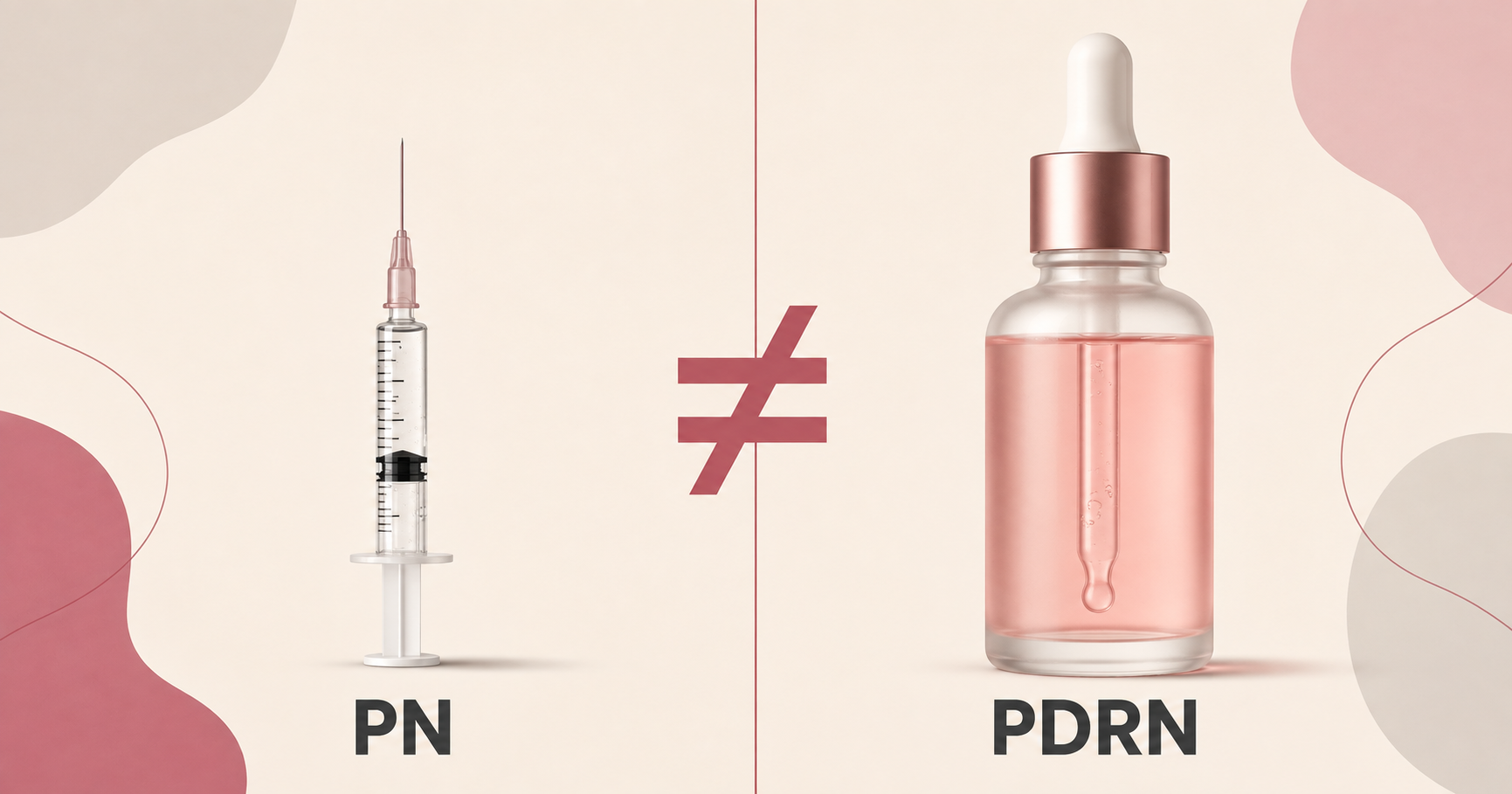
One of the treatments most strongly associated with the “salmon DNA” trend is Rejuran, a Korean injectable skin treatment. But Rejuran is based on PN — polynucleotide — rather than the topical PDRN serums now appearing across skincare shelves.
PN and PDRN belong to the same broader family of DNA-derived materials, and they can come from similar sources. But they aren’t interchangeable terms.
PN generally consists of longer, higher-molecular-weight DNA fragments, while PDRN is composed of relatively shorter fragments. Molecular size, structure, formulation and delivery method can all affect how these materials behave.
More importantly, injectable PN is placed directly into the skin. A topical PDRN serum has to deal with something much less convenient: your skin barrier.
So when a video shows someone getting Rejuran injections in Seoul and then cuts directly to a PDRN serum, you’re looking at different products delivered in completely different ways.
That doesn’t mean the serum is useless. It means the clinical evidence for the injection should not automatically be treated as evidence for what the serum can do.
Does topical PDRN actually penetrate?
This is probably the most important question in the whole PDRN conversation, and the answer is more complicated than either “yes” or “no.”
PDRN itself has been studied for biological processes related to tissue repair and regeneration. The harder question is what happens when PDRN is simply applied to intact skin.
Your skin barrier is specifically designed to limit the entry of many outside substances, particularly larger molecules. Clinical delivery methods can bypass that problem through injections or techniques that physically assist delivery. A regular serum doesn’t have those same advantages.
There is, however, emerging research suggesting that specially formulated topical PDRN may reach viable epidermal regions and influence markers related to skin repair.
That’s promising, but it doesn’t mean every product with “PDRN” printed on the bottle has been proven to penetrate to the same extent or produce the same clinical results. Molecular size, concentration, formulation and delivery technology can all differ from product to product.
So the evidence for topical PDRN is interesting and developing, rather than settled.
For now, I wouldn’t buy a PDRN serum expecting it to recreate an injectable treatment. I’d evaluate it first as part of a hydrating, soothing or recovery-focused skincare formula — and I’d pay attention to everything else in the ingredient list too.
How to read a PDRN skincare label
This is where the marketing becomes much easier to evaluate.
Look for the concentration — but don’t treat it like a score
Some Korean skincare brands disclose their PDRN concentration in ppm, or parts per million. For reference, 5,000 ppm = 0.5%.
Having a disclosed concentration gives you another piece of information when you’re comparing products, but higher doesn’t automatically mean better. There isn’t a universal rule showing that a 5,000 ppm cosmetic will outperform a 1,000 ppm product simply because the number is larger.
Concentration is only one part of the formula.
Check the full ingredient list
PDRN-related ingredients may appear under different labeling terminology depending on the formula and market. But don’t judge a product solely by where one ingredient appears on the list, because some ingredients are intentionally used at relatively low concentrations.
Instead, look at the complete formula. Does it contain well-established humectants or soothing ingredients? Does the formula make sense for the skin concern you’re trying to address?
And most importantly, is the brand making realistic cosmetic claims — or is most of the sales pitch built around the idea that the product somehow recreates a clinic procedure?
That distinction matters much more than one impressive number on the front of the bottle.
Be skeptical when a cosmetic borrows injection data
This is the biggest red flag I look for.
If a topical PDRN product uses results from injectable PN or medically delivered PDRN as though those results automatically apply to the serum, slow down. The materials may be related, but their formulation, delivery method and depth of treatment are different.
The research can be relevant background. It isn’t automatically evidence for the product in your hand.
How PDRN actually fits into Korean skincare
This is where living in Korea changes how I look at the trend.
From outside Korea, PDRN is often framed almost entirely as an anti-aging or “glass skin” ingredient. Here, it also fits into something broader: Korea’s very established culture of combining professional skin treatments with gentler home care.
One way I see PDRN positioned here is as supportive skincare around professional treatments, rather than as a replacement for them.
Someone might get a laser treatment, microneedling, or a PN-based treatment at a clinic and then focus on gentle, hydrating skincare at home once their provider says it’s appropriate to resume their routine. PDRN is one of several ingredients now being marketed into that recovery-focused space.
That doesn’t mean every Korean getting Rejuran goes home and uses a PDRN serum. It also doesn’t prove that a topical product will shorten downtime or reproduce what happened in the clinic.
But it does help explain why PDRN makes sense in the Korean market in a way that the Western “salmon DNA = glass skin” framing doesn’t fully capture.
And yes, Rejuran has another issue: it hurts
There’s also a very practical reason a bottle of PDRN skincare can be appealing even when people know it isn’t equivalent to an injection.
Rejuran involves multiple small intradermal injections across the treatment area, and it has a reputation in Korea for being an uncomfortable procedure.
That matters.
The appeal of topical PDRN isn’t necessarily just that it’s cheaper. For someone who doesn’t want repeated injections, downtime or an in-clinic procedure, skincare is simply a much more approachable format.
Of course, easier doesn’t mean equivalent.
A serum and an injectable treatment can both have a place without pretending they’re doing the same job.
What formats does PDRN come in?
Serums and ampoules
This is probably the format international shoppers are most familiar with. They’re lightweight, easy to layer and usually positioned as the concentrated step in a routine.
When evaluating one, look beyond the headline ingredient. Humectants, emollients, soothing ingredients and the overall formulation may contribute significantly to how the product actually performs on your skin.
Toner pads
PDRN has also entered Korea’s already popular toner-pad category. They’re convenient and fit naturally into routines built around lightweight hydrating layers.
But putting PDRN into a toner pad doesn’t automatically solve the penetration question.
It’s still a topical cosmetic.
Creams
Creams may make particular sense if your main concerns are dryness and barrier support. They can combine PDRN with emollients, humectants and occlusive ingredients that already have well-understood roles in moisturizing the skin.
That’s why I wouldn’t dismiss a PDRN cream just because the topical evidence isn’t as strong as the injection hype suggests.
A good moisturizer containing PDRN can still be a good moisturizer. It just shouldn’t be sold to you as Rejuran in a jar.
What can you pair PDRN with?
PDRN-focused skincare often comes in formulas designed around hydration and soothing, which generally makes these products easy to fit into an existing routine.
Hyaluronic acid
This is a straightforward pairing. Hyaluronic acid is widely used as a humectant, so products combining it with PDRN naturally fit into hydration-focused routines.
Vitamin C
You’ll also see PDRN paired with brightening and antioxidant ingredients. There’s nothing inherently wrong with that combination, but evaluate the vitamin C portion of the formula on its own merits too.
The type of vitamin C, formulation and packaging still matter. Adding PDRN doesn’t automatically turn an average vitamin C formula into a great one.
Retinoids
This is probably the combination I find most practical.
Not because PDRN has been proven to cancel out retinoid irritation, but because many PDRN products are formulated around hydration and soothing. If you’re using retinol or another retinoid and struggling with dryness or tightness, a well-formulated hydrating PDRN serum or cream may fit nicely into the rest of your routine.
Think of it as supportive skincare, not an antidote to retinol.
Who is topical PDRN actually for?
Worth considering if:
Your skin is dry, dehydrated or easily sensitized. You’re using stronger actives and want to add a gentler, hydration-focused step. You’re interested in recovery-focused Korean skincare.
It may also appeal to you if you’re curious about the clinic-to-skincare trend but understand that you’re buying a cosmetic product — not recreating a professional treatment at home.
Manage expectations if:
You’re hoping a serum will dramatically lift sagging skin, restore lost facial volume or erase deep wrinkles.
Those are deeper structural concerns, and a topical cosmetic shouldn’t be sold as the equivalent of an intradermal treatment.
Pregnant or breastfeeding?
There isn’t enough pregnancy-specific evidence around topical PDRN to make a blanket statement about every product, and PDRN is only one ingredient in the formula.
If you’re pregnant, breastfeeding or under medical treatment, check the complete ingredient list with your healthcare professional if you’re unsure.
Skip the hype if:
The main reason you’re considering the product is because the brand showed you Rejuran results.
That’s exactly where the distinction between PN injections and PDRN skincare matters.
If you’re shopping for PDRN products in Korea itself, it’s worth knowing that pharmacies and beauty stores carry very different categories of product — and some pharmacy items that look like skincare are actually medicine. I covered that in my guide to Korean pharmacy skincare.
The short version
PDRN isn’t a made-up skincare ingredient. It has a genuine history in regenerative research, and the growing interest in topical PDRN is worth watching.
There’s emerging research suggesting that certain specially formulated topical PDRN preparations may have meaningful effects in skin. But that’s very different from saying every PDRN serum on the market has been clinically proven to regenerate your skin.
The strongest evidence surrounding medically delivered PDRN or injectable PN cannot simply be transferred to a cosmetic bottle.
Rejuran is an injectable PN treatment. A topical PDRN cosmetic is something else.
That doesn’t mean a PDRN serum can’t be worth using. A well-formulated product may still be a useful part of a hydrating, soothing or recovery-focused routine.
Just don’t buy it because you think you’re getting Rejuran without the needles.
It isn’t a needle in a bottle.
Check the full formula, treat ppm as information rather than a score, and be skeptical when topical products borrow injectable clinical claims.
Most importantly, judge the serum by what that specific cosmetic can realistically do.
That’s a less dramatic story than TikTok usually tells.
But it’s also a much more useful one.